By Henry Umoru
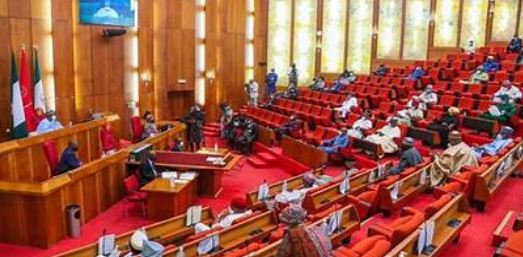
ABUJA- THE Senate has deferred the consideration of the report of the Committee on Electoral Matters to enable lawmakers study the report following the absence of the Chairman, Senator Simon Lalong, APC, Plateau South.
The consideration of the Report of the Committee on Electoral MattersElectoral Act, 2022 (Repeal & Enactment) Bill, 2026 (SB. 903) was slated in Wednesday’s Order Paper, shortly after the distribution of the 238 page document to all the Senators at the hallowed Chamber and when it was time to consider it, it became imperative to postpone it because the Chairman of the Committee was absent.
Senator Lalong said to the Senators, “that the Senate do Receive and Consider the Report of the Committee on Electoral Matters on the Electoral Act, 2022 (Repeal & Enactment) Bill, 2026 (SB. 903),”
The recommendation and others shall be considered by the Senate in plenary on Thursday when report of its committee on Electoral Matters is presented and debated clause by clause.
Decisions to this effect were taken by the Senate during plenary on Wednesday when its Leader, Senator Opeyemi Bamidele, APC, Ekiti Central, informed Senators that the report billed for consideration should be circulated to all the Senators for scrutiny ahead of clause-by-clause consideration on Thursday.
Bamidele, as approved by the President of the Senate, Godswill Akpabio, also informed the Senators that a brief closed-door session would be held on the report before general consideration at the committee of the whole.
Bamidele had said that the Chairman of the Committee, Senator Lalong was not immediately available.
He said, “But copies have been circulated. We will allow senators to go home with the report and study it and when we come tomorrow, we will hold a brief closed-door session and debate the critical clauses of the bill and pass it”.
In his response and being a very sensitive legislation, Akpabio appealed to all Senators to study copies of the report given to them ahead of final consideration on Thursday during plenary.
He said, “Distinguished colleagues, as suggested by the leader, please let’s look into the report very well ahead of final consideration tomorrow, first from closed-door session and at Committee of the Whole.
“We don’t need to rush the report. We will take our time and do the needful and ensure justice is done for all and sundry.”
As the Senate considers the report tomorrow, electronic transmission of results from polling units to INEC Result Viewing Portal ( IREV) after counting of votes, checking manipulation of results and ballot box snatching are among those issues that are major recommendations made for the proposed Electoral Act for the 2027 general elections.
A copy of the report obtained by Vanguard shows that on page 45, a new subsection (3) was introduced into the 2022 Electoral Act ( Amendment) Bill 2025, to check manipulation of results and ballot box snatching.
The section states that “INEC shall electronically transmit election results from each polling unit to IREV portal in real time and such transmission shall be done simultaneously with physical collation of results.”
In the report , a new subsection 2 was also introduced to section 77 to make the offence of failure of Presiding Officers to sign and stamp ballot papers and results announced by them punishable.
Section 47(2) and (3) were also amnended by substituting the words “smart card reader” with the words “Bimodal Voter Accreditation System”.
Also, the Senate Committee on Electoral Matters in the report, amended section 54(1) to check abuse of electoral process by those who take advantage of visually impaired and incapacitated voters by barring any political party agent , candidate or official from accompanying such voters into voting compartment.
More stringent measures against buying and selling voters’ cards by any agent of political parties by increasing N500, 000.00 in section 22 to N5, 000.000.00million were also recommended.
In the report, the objectives of the bill are ” bring about Improvement in the electoral process by ensuring transparency, efficiency and integrity of the electoral system.
“Ensure that there is free and fair competitions where all political parties are given equal opportunities to compete favourably in elections: ensure that outcomes of elections reflect the will of the people, reduce electoral malpractices by setting stricter punitive measures to serve as deterrence to electoral malpractices; enhance voters’ confidence and participation in elections, thereby reducing voters apathy; and further strengthen the independence of INEC by insulating it from incessant and unnecessary interference from the government and political parties, etc.”
According to the Committee’s report, the findings were “That stakeholders were unanimous in their support for the passage of the Bill, as its passage will address most of the inherent lacunae expressed in the course of implementing the extant Act.
“That the current legal and administrative reforms proposed in the Bill are laudable and commendable, as they are designed to improve the integrity and credibility of the electoral process, through strategic and operational policy actions by the Independent National Electoral Commission (INEC):
“That by enacting the proposed legislation, the 100 National Assembly will bequeath to Nigerians, an enduring legacy of electoral integrity for a sustainable democratic practice, which recognises and upholds the rule of law:
“That the proposed legislative framework is a direct response to the challenges that undermined public confidence and transparency. despite the progressive steps recorded in the implementation of the extant Act, hence the need for the National Assembly to enact this proposed legislation.
“That one of the salient attributes of the proposed legislation is the aspect that provides legal and policy justifications, designed to promote transparency, inclusivity and technological advancement in Nigeria’s electoral process. This will undoubtedly streamline our electoral laws in line with global best practices.
“That is not out of place for continuous attendance of all to be carried out from time to time on each election circle, whereby significant flaws may have been exρosed. Therefore, the current legislative effort is central to our collective desire as a nation to build a proper and resilient culture of citizen participation in elections in order to deepen our democratic practice:
“That the reforms contemplated by the Bill are essential to Nigeria’s evolving political landscape. These reforms have been streamlined to ensure that the electoral process remains fair, credible arsd reflective of the collective will of the people, hence the need for the Senate to pass this Bill expeditiously, and
“That the passage of this Bill will ultimately strengthen accountability, expand voting space for broader participation provide safeguards against electoral frauds, as well as invigorate institutional capacity of the INEC for transparency and inclusivity in its operations. Therefore, the Bill should be accorded all the necessary support it deserves for the socio-economic and political transformation of this country.”
The post Electoral Act: Electronic transmission of results, others top recommendations as Senate considers report Thursday appeared first on Vanguard News.
