6 min read
2027 Polls: How S-Court ignited push for electronic transmission of results
vanguardngr.com
Thursday, February 12, 2026
By Ikechukwu Nnochiri October 26, 2023, was the day the Supreme Court stamped its legal imprimatur on President Bola Tinubu’s election victory. In a unanimous decision, a seven-member panel of the apex court, led by Justice Inyang Okoro, dismissed two separate appeals as lacking in merit. ...
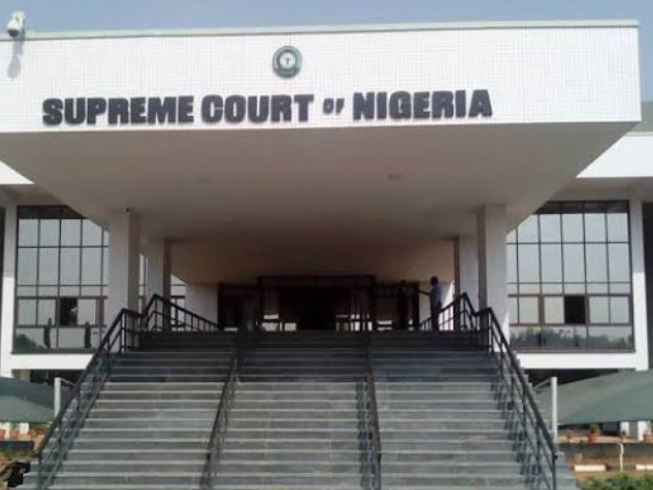
By Ikechukwu Nnochiri
October 26, 2023, was the day the Supreme Court stamped its legal imprimatur on President Bola Tinubu’s election victory.
In a unanimous decision, a seven-member panel of the apex court, led by Justice Inyang Okoro, dismissed two separate appeals as lacking in merit.
The appeals were filed by former Vice-President and Peoples Democratic Party (PDP) presidential candidate, Alhaji Atiku Abubakar, as well as his Labour Party (LP) counterpart, Mr. Peter Obi, to challenge the outcome of the presidential poll held on February 25, 2023.
According to the Supreme Court, it found no reason to dislodge an earlier verdict the Presidential Election Petition Court (PEPC) delivered on September 6, 2023, which also threw away cases Atiku and Obi filed against Tinubu who was the flag bearer of the ruling All Progressives Congress (APC).
That verdict had thrown out the cases filed by Atiku and Obi against Tinubu, who was the flag bearer of the ruling All Progressives Congress (APC).
Recall that the Independent National Electoral Commission (INEC) announced on March 1, 2023, that Tinubu of the APC won the presidential poll, ahead of 17 other candidates.
It declared that Tinubu scored a total of 8,794,726 votes to defeat the two major contenders, Alhaji Atiku of the PDP, who came second with a total of 6,984,520 votes, and Mr. Obi of the LP, who came third with a total of 6,101,533 votes.
Dissatisfied with the outcome of the election, both Atiku and Obi approached the court to invalidate it.
The two petitioners raised sundry issues for the tribunal to determine, among which was a challenge to Tinubu’s eligibility to contest the election.
They insisted that the declaration of Tinubu as winner of the presidential poll was invalid by reason of non-compliance with provisions of the Electoral Act, 2022.
Particularly, Atiku, in his appeal to the Supreme Court, contended that the Justice Haruna Tsammani-led five-member panel of the PEPC, “erred in law when it refused to uphold the mandatoriness of electronic transmission of results for confirmation and verification of final results introduced by the Electoral Act 2022 for transparency and integrity of results in accordance with the principles of the Act.”
He argued that sections 64(4) and (5) of the Electoral Act, as well as INEC’s Regulations and Guidelines for the conduct of the election (which he tendered in evidence), made mandatory the use of Bimodal Voter Accreditation System (BVAS) machines for the electronic transmission of results from the polling units directly to INEC’s collation system for verification, confirmation, and collation of results before announcement.
Atiku told the apex court that some of the Presiding Officers who personally handled BVAS machines at polling units on election day had testified before the PEPC that they “confirmed the non-transmission of results of the presidential election electronically from the BVAS machines, whereas results of the National Assembly election, held simultaneously, were electronically transmitted without difficulty.”
He added that the non-compliance with the Electoral Act was nationwide, cutting across 176,846 polling units in the country—a situation he said, substantially affected the outcome of the election.
Insisting that Tinubu “was not duly elected by majority of lawful votes cast at the election,” Atiku accused the PEPC of erring in law by refusing to nullify the election outcome on grounds of non-compliance with the Electoral Act, 2022, even when, according to him, evidence showed that INEC acted in breach of extant laws and regulations guiding the conduct of elections.
Meantime, while dismissing the appeals, the Supreme Court held that there was no mandatory provision in the Electoral Act 2022 for electronic transmission of election results.
Maintaining that the appellants failed to prove that INEC did not substantially comply with the provisions of the Electoral Act in conducting the poll, the apex court held that section 185(1) of the Evidence Act provides that an election should not be invalidated when alleged non-compliance with the law does not substantially affect the outcome.
It held that evidence contained in Atiku’s record of appeal showed that the appellant abandoned the duty the law imposed on him to not only prove the alleged noncompliance, but also to establish that INEC’s failure to electronically transmit results of the election through its IReV portal influenced the final outcome of the presidential election.
The court noted that it had in past judgments clarified that the election result collation system was not the same as the uploading of results to the IReV portal.
“Where the IReV portal fails, it does not stop the collation process, which up till the last election was manually done,” the court added.
Nevertheless, the Supreme Court noted that INEC’s failure to electronically transmit election results denied the electorate the opportunity to follow the process in real-time and cross-check results that were eventually uploaded.
“The truth must be told that the non-transmission of results to the IReV portal may also reduce the confidence of the voting population in the electoral process,” Justice Okoro, who prepared the lead judgment, added.
The court emphasized that, in a bid to guarantee the safety of election results, provision was made for both the hardcopy of results and the electronically transmitted copy to be used in the collation process.
It held that, aside from results uploaded to the IReV portal, duplicate copies were usually handed to both the police and agents of political parties.
However, it was the position of the apex court panel that the unavailability of results of the presidential election on INEC’s IReV portal, “for whatever reason”, was not sufficient enough to warrant the nullification of President Tinubu’s victory.
It further held that whereas Atiku and Obi alleged that the result INEC declared in Tinubu’s favour was not accurate, they, however, failed to put forward the perceived rightful result.
It held that the result announced by INEC ought to be presumed as correct in the absence of “any rival or alternative result.
“The figure before us shows that the 2nd Respondent (Tinubu) won the highest number of votes and was duly declared winner,” the Supreme Court added.
Aside from Justice Okoro, other members of the panel were Justices Uwani Abba-Aji, Lawal Garba, Ibrahim Saulawa, Adamu Jauro, Abubakar Tijjani and Emmanuel Akomaye Agim.
Over two years after the judgment was delivered, the Senate’s decision not to make electronic transmission of election results mandatory has once again placed the spotlight on INEC’s discretionary powers.
Flowing from the outcomes of past electoral litigations, civil society groups and reports from local and international election observer missions recommended mainstreaming key electoral reforms—not only in INEC’s guidelines but also in the Electoral Act.
Consequently, real-time e-transmission of results from polling units became a major plank of agitation in the 2025-2026 electoral reform bill.
Expectations were high that the reforms would enhance transparency and ensure the fidelity of election results.
Nevertheless, whereas the House of Representatives allowed the amendments, the Senate—after weeks of delays—rejected them, opting instead to retain existing provisions of the Electoral Act that preserve INEC’s discretionary powers.
The action led to protestations from stakeholders insisting that retaining the status quo would further erode public confidence in the electoral process.
The post 2027 Polls: How S-Court ignited push for electronic transmission of results appeared first on Vanguard News.
Read the full article
Continue reading on vanguardngr.com


