
From Sumy to Zaporozhye, the winter lull reveals the outlines of two potential large-scale operations shaping the year ahead
By the start of 2026, the Ukraine conflict had entered a familiar but no less consequential phase. After a year of intense maneuver warfare, grinding battles for key logistics hubs, and the steady erosion of Ukrainian reserves, the front line has once again settled into an operational pause. Such lulls should not be mistaken for de-escalation. In this war, periods of relative calm have consistently served as intervals for regrouping, replenishment, and the preparation of the next major blows.
A similar pattern unfolded a year ago. The fighting subsided during the winter months, only to give way in spring to a large-scale Russian offensive that defined much of 2025 and effectively concluded by year’s end. There is little reason to assume that the Russian General Staff has abandoned this approach. On the contrary, the current pause appears to be less an endpoint than a transition – one shaped by the outcomes of last year’s operations and by the strategic objectives that remain unresolved.
Against this backdrop, the key question is not whether the front will heat up again, but where and how. The configuration of forces, the condition of Ukrainian defenses, and the logic of Russian operational planning all point to several potential axes of advance, each with its own constraints and strategic value. In this overview, we assess the results of the recent fighting across the main sectors of the front and examine which directions may emerge as priorities for Russian operations in 2026.
Sumy front: Deceptive calm
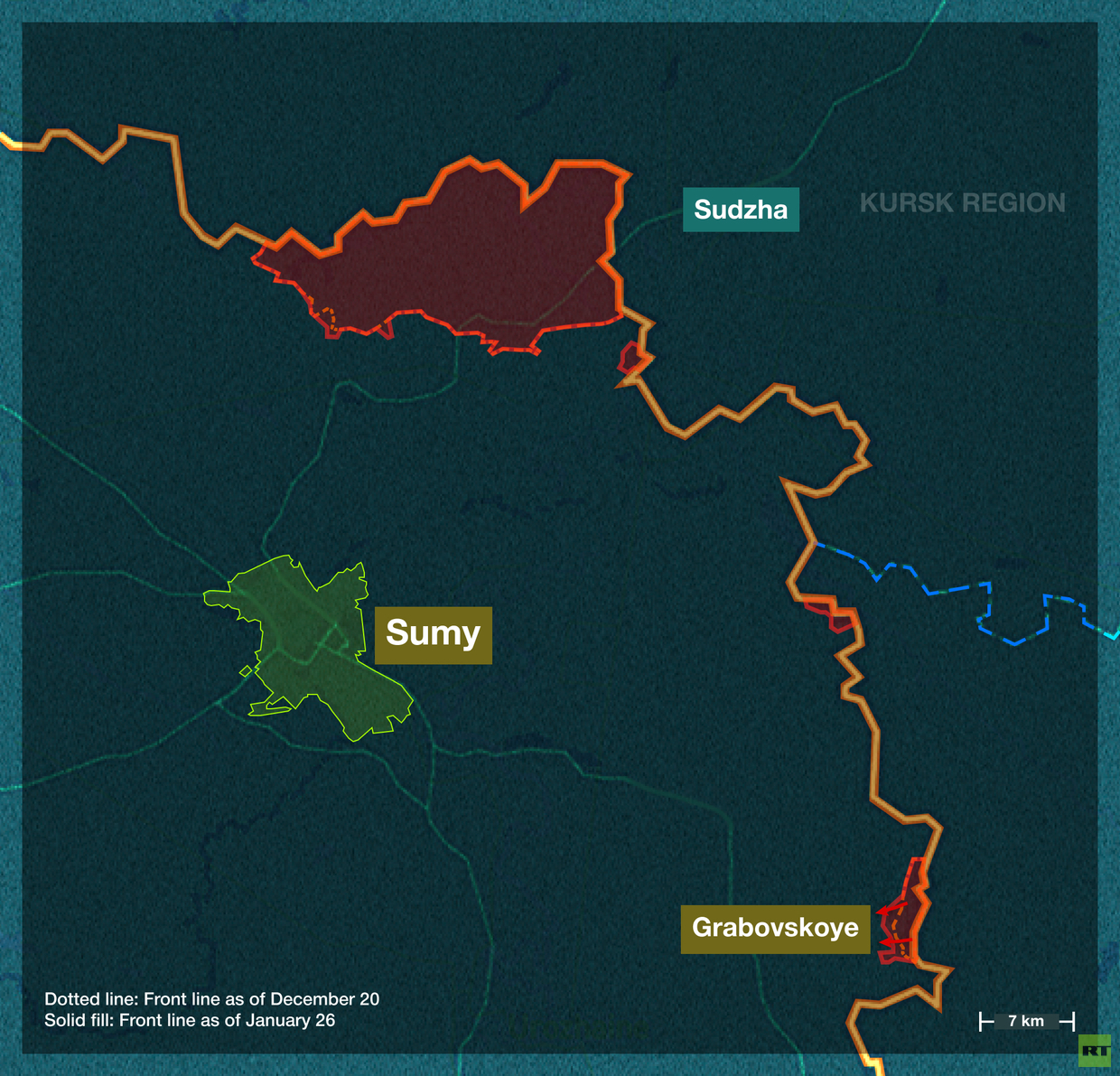
The buffer zone along the Ukrainian border was established following the destruction of the grouping of Ukrainian forces in Russia’s Kursk Region last spring. For a while, Ukrainian forces attempted counterattacks in this area without success, but gradually, things settled down. Then, in December, Russia’s North group of forces opened a new front here, capturing the large village of Grabovskoye without significant fighting.
It is likely that the Sumy front will continue to serve as a secondary front compared to others; the Russian Army lacks the strength and resources for a major offensive here. Apparently, the Russian Army’s actions in Grabovskoye are aimed at stretching Ukrainian reserves and preventing their redeployment elsewhere.
Kharkov Region: Battles for logistics
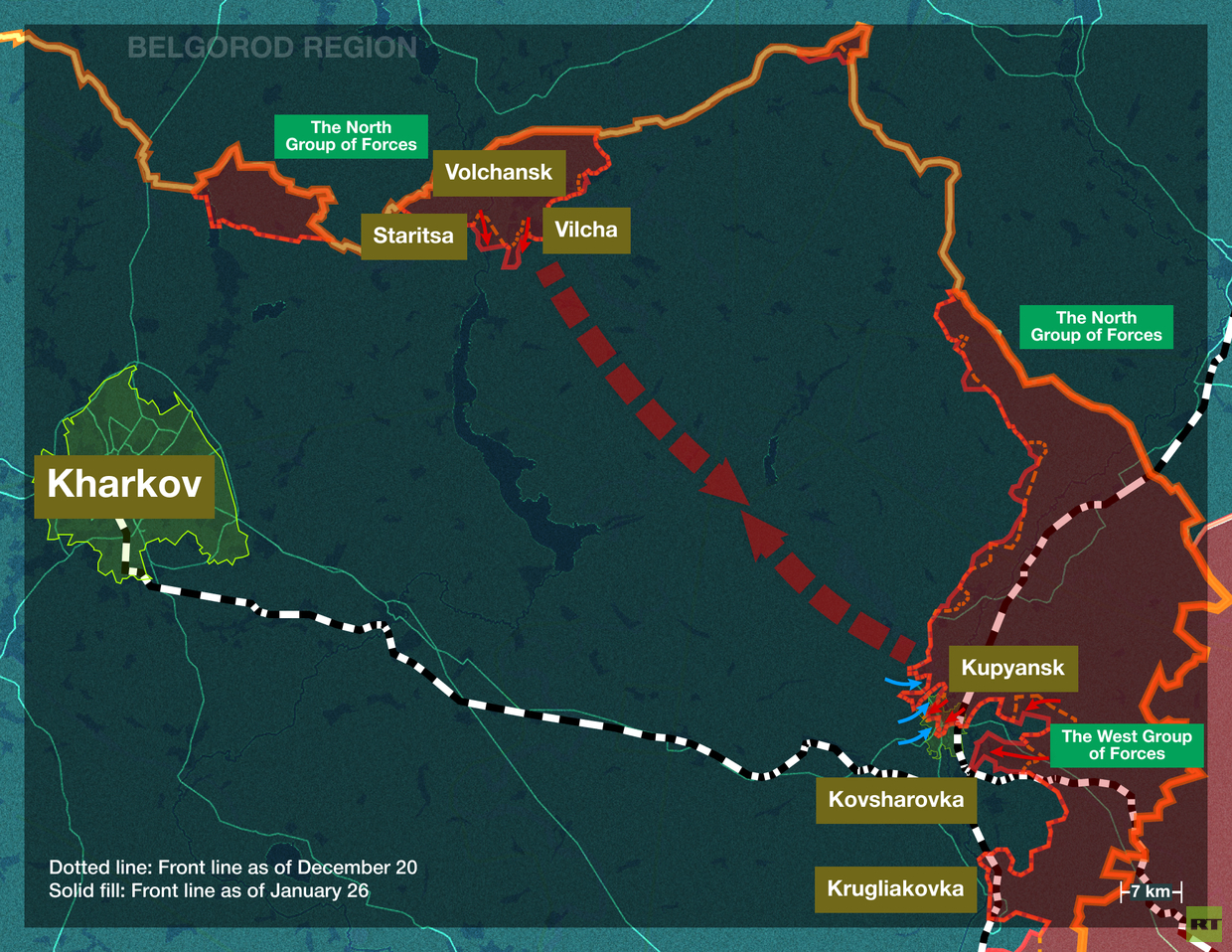
At the end of 2025, we saw intense fighting for the city of Kupyansk. Control over the western part of the city was transferred several times, while east of the city, the Russian Army gradually tightened its grip around Krugliakovka, Kovsharovka, and the Kupyansk-Uzlovoy railway station. The station holds strategic importance: the Russian forces aim not only to capture it but also to push the front at least 15-20km to the west, away from Kupyansk. Achieving this would enable direct railway supplies from Russia’s Belgorod Region to the ‘West’ group of forces, significantly easing logistics for the Russian Army in both Kupyansk and Liman.
The localized offensive near Volchansk has similar goals. The city was captured in late November, and since then, the North group of forces has advanced 8-10km further, capturing the settlements of Vilcha, Siminovka, Grafskoye, and Staritsa. The primary aim is to exert pressure on the rear of Ukrainian forces, which are counterattacking near Kupyansk, thereby drawing reserves away from that area.
Until Kupyansk and the railway station are fully liberated, this axis will likely remain secondary. At some point, the two groupings (one from Volchansk and the other from Kupyansk) may move toward each other, but that is not likely to happen soon.
Liman: On the way to the Seversky Donets River
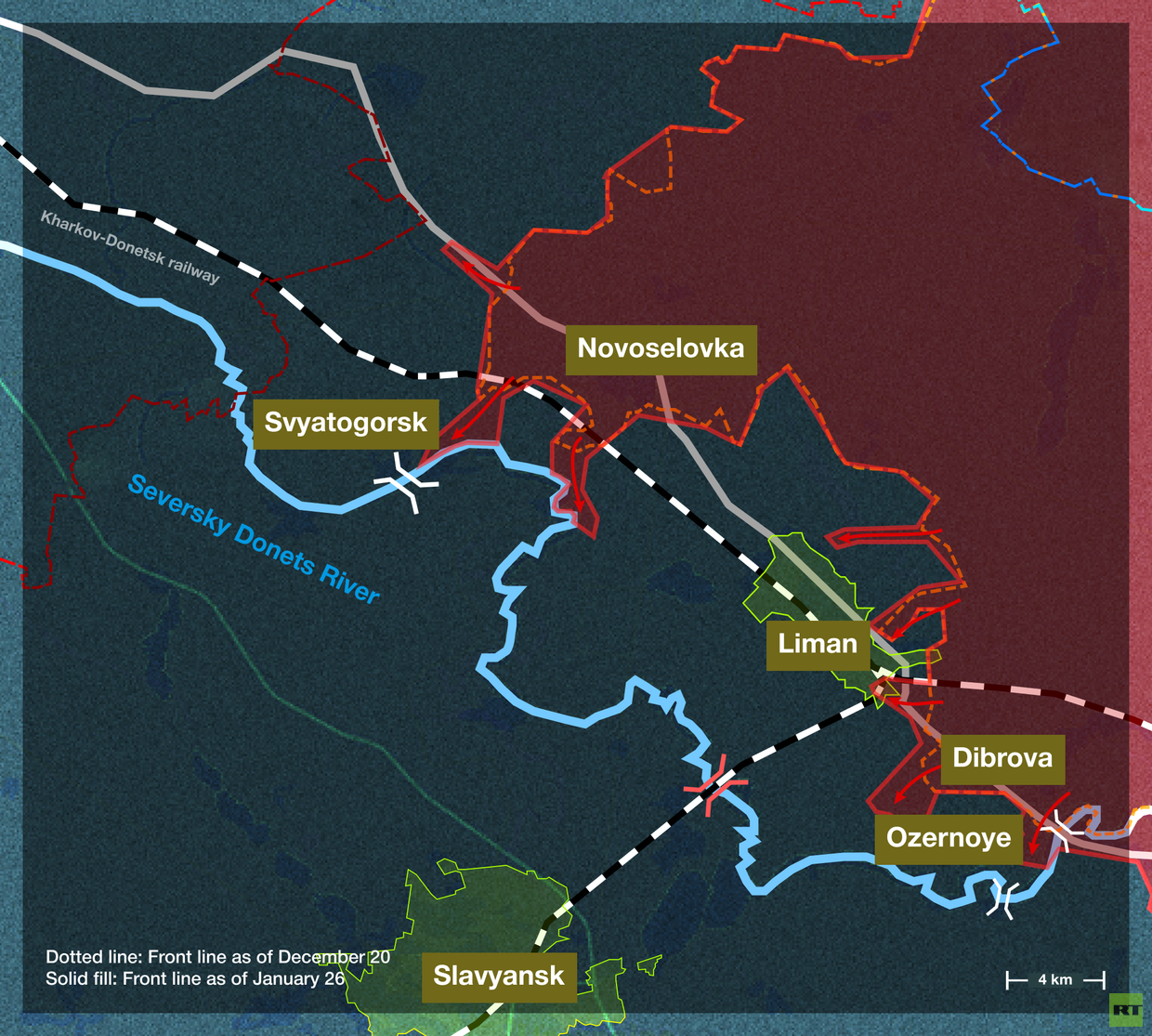
The ‘West’ group of forces is also involved in battles for Liman, which was abandoned by the Russian army in 2022. Since last year, the city has been partially encircled, and in January, the last remaining crossings over the Seversky Donets River were destroyed. This indicates that the Russian Army is attempting to exhaust the Ukrainian garrison in Liman.
The Russian Army has also advanced to the banks of the Seversky Donets River in several locations: in Sviatogorsk, near Novoselovka, in Dibrova, and Ozernoye. These maneuvers are crucial not only for capturing Liman, but also for ensuring success in the future battles for Slavyansk and Kramatorsk, since they establish a northern flank for encircling the city.
In 2022, the Russian military struggled to cross the Seversky Donets River; we’ll see how things unfold this time.
Seversk, Chasov Yar, Konstantinovka: Moving towards Slavyansk-Kramatorsk
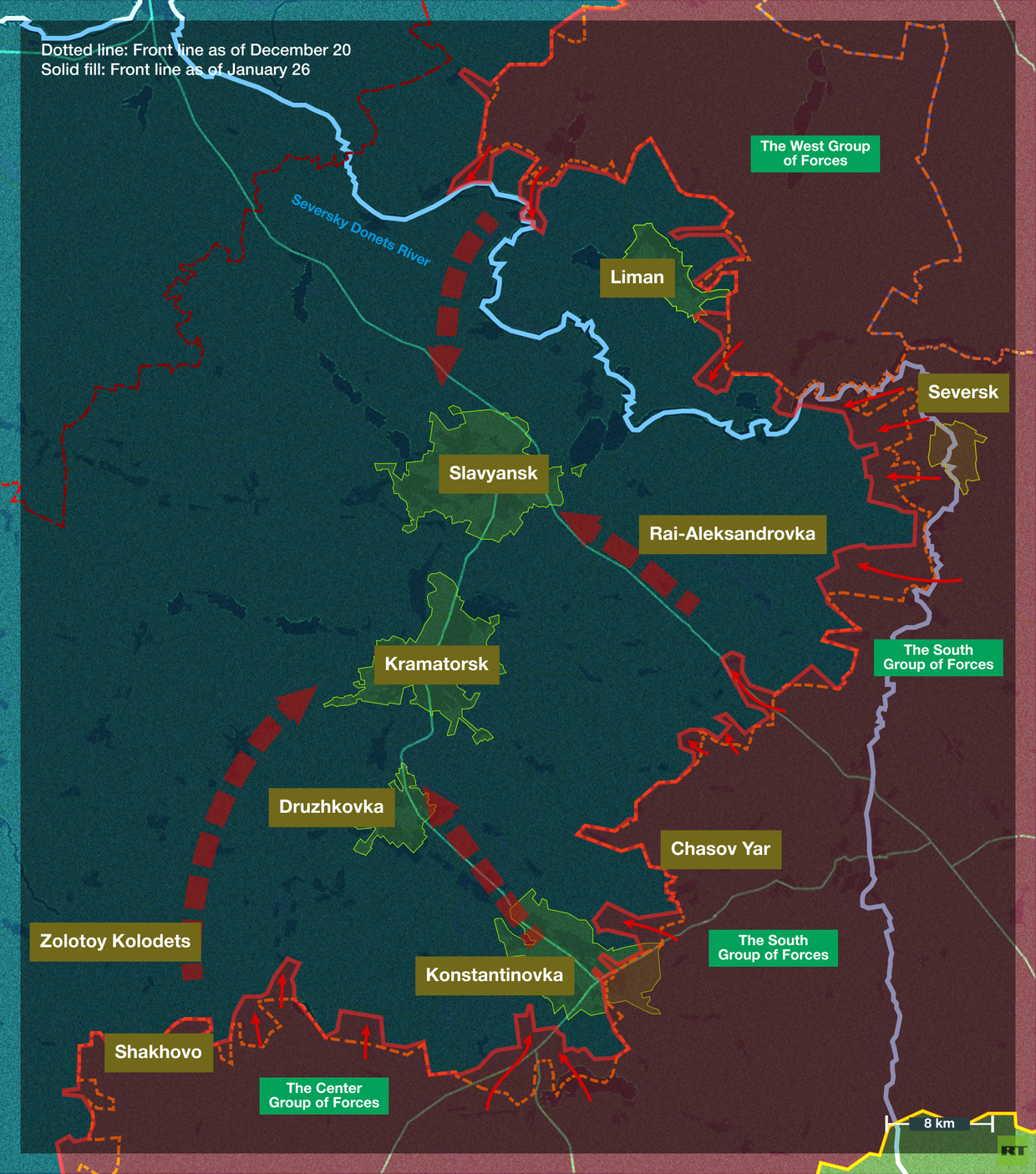
This is one of the active areas of the front as of January. From Seversk, the South group of forces is pushing west along the Severskiy Donets river toward Slavyansk. Key settlements like Reznikovka and Zakotnoye have been captured, and the next major objective is Rai-Aleksandrovka.
Fighting also continues in Konstantinovka. The map illustrates how a semi-encirclement is forming around Ukraine’s largest remaining stronghold: the Slavyansk-Kramatorsk agglomeration. If Russian forces successfully cross the Seversky Donets River south of Liman and liberate Konstantinovka, they will be able to close in around Slavyansk-Kramatorsk (and nearby Druzhkovka) from three sides.
This may potentially become one of the most significant operations not only of the year, but of the entire Special Military Operation. Of course, we don’t know the plans of the Russian General Staff. However, such a strategy would demand coordinated actions from three military groups: The West Group of Forces will have to move from Liman across the river; the South Group of Forces – from Seversk, Chasov Yar, and Konstantinovka; and the Center Group of Forces – from Shakhovo-Zolotoy Kolodets. It seems unlikely that such an operation could occur before the middle or the second half of the year.
Pokrovsk-Mirnograd: At a crossroads
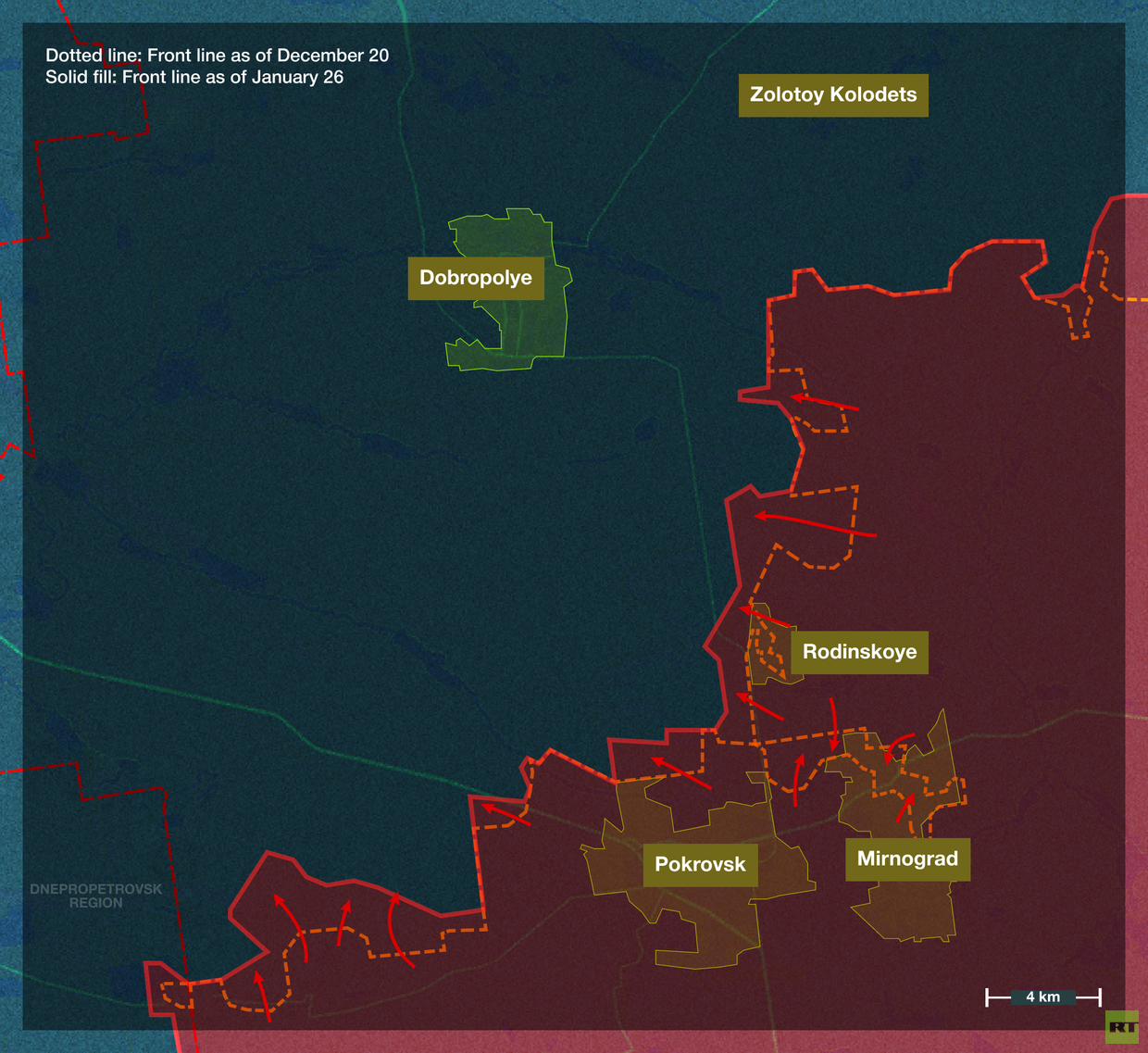
At the end of December 2025, the Mirnograd pocket was eliminated. Two Ukrainian brigades (a total of 3,000-4,000 troops) found themselves encircled in Mirnograd. Ukrainian attempts to break through via Rodninskoye were unsuccessful. A small portion of the surrounded troops managed to traverse the fields and find the way back to their army; some surrendered; but the rest had no way out.
In December and January, Russian forces also captured the small but strategically important town of Rodninskoye, and cleared the northern and western outskirts of Pokrovsk. This marked the end of the Russian Army’s major operation of 2025. The Center group of forces, which carried out the operation, is currently being replenished and is undergoing regrouping.
What’s next? From Pokrovsk-Mirnograd, there are two possible directions of advance. First, it’s possible to move north towards Dobropolye and Slavyansk-Kramatorsk, thereby forming a southern flank for encircling this major Ukrainian stronghold. The prospects of such an offensive were discussed earlier and it likely won’t happen until the latter half of the year.
There’s also the option to move westward toward the border with Dnepropetrovsk Region where there are no substantial fortifications. We will soon learn what objectives the General Staff chooses for this sector.
Dnieper River area and Gulaipole: The last stronghold on the way to Zaporozhye
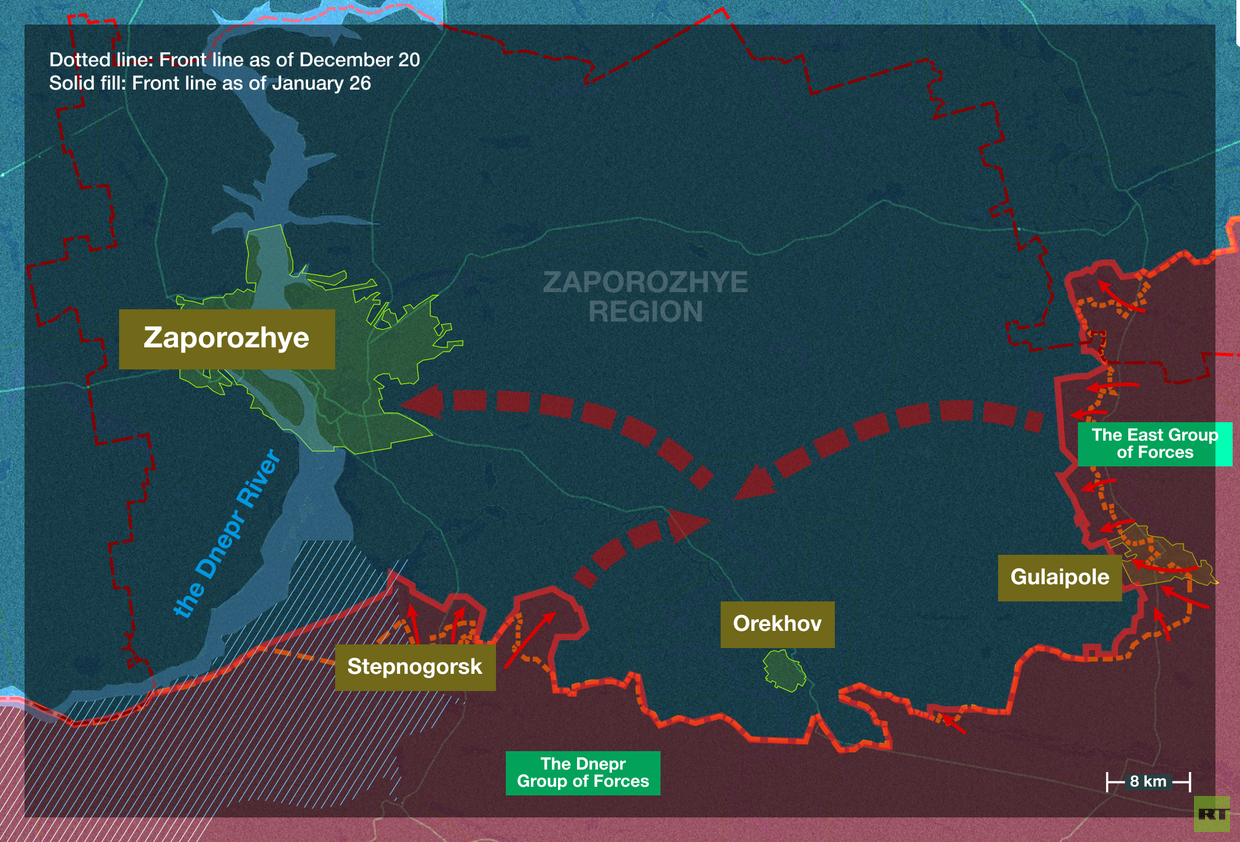
According to the Russian constitution, Zaporozhye Region and its capital, the city of Zaporozhye, are considered occupied by Ukrainian forces. The successful advances of the East group of forces in Dnepropetrovsk and Zaporozhye regions, the effective collapse of the Ukrainian front near Gulaipole, and the capture of this city at the end of the year have all created a solid foundation for a further advance toward Zaporozhye itself.
At the same time, the long-stagnant front along the Dnieper River has become active again. The Dnepr group of forces has liberated the strategically important town of Stepnogorsk and is advancing further along a wide front.
The main Ukrainian stronghold on the way to Zaporozhye is the city of Orekhov, which was the center of the Ukrainian counteroffensive in 2023. Approaching Orekhov from the south is challenging due to a formidable line of Ukrainian defenses, but a glance at the map reveals that the city is gradually becoming encircled from the sides of Gulaipole (from the east) and Stepnogorsk (from the west). If Ukrainian forces suffer losses comparable to those in Pokrovsk-Mirnograd during the fighting for Orekhov, they may find themselves unable to defend Zaporozhye, at least its left bank.
Given how rapidly the Ukrainian front crumbled in Gulaipole, the situation in this sector looks grim for Kiev. To patch up the holes, Ukrainian Commander-in Chief Aleksandr Syrsky had to pull reserves from other fronts – primarily Pokrovsk and Seversk.
***
In summary, an analysis of the front suggests that the Russian Army could launch two major offensives this year: one towards Slavyansk-Kramatorsk and another towards Orekhov, which would open the way to Zaporozhye. Both operations will require coordination and joint action from several groups of forces. In scale, they may surpass anything we’ve seen on the front since spring 2022.
It’s likely that these operations will begin simultaneously, although the first is more ambitious and will take longer to execute; troops will first need to reach Slavyansk-Kramatorsk. As in 2025, we may expect results and significant achievements towards the end of the year.


