US lawmakers fail in senate to curb Trump’s war powers
Published 4 hours ago
Source: rt.com
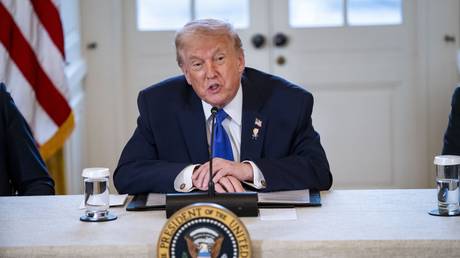
Vice President J.D. Vance cast the deciding vote to block a resolution that would have limited the president’s options to act against Venezuela
US Vice President J.D. Vance cast a tie-breaking vote on Wednesday to defeat a War Powers Resolution that would have prohibited President Donald Trump from using military force “within or against” Venezuela. The decisive vote came after two Republican senators reversed their positions following direct pressure from the president.
Senators Josh Hawley and Todd Young, who had supported the resolution a week earlier, voted against it. Hawley stated he changed his vote after receiving “personal assurances” from Secretary of State Marco Rubio that no US troops are in Venezuela and that the administration would seek separate congressional authorization for any future deployment.
Trump previously called for GOP senators who supported the bill, including Hawley, Young, as well as Susan Collins, Lisa Murkowski, and Rand Paul, to “never be elected to office again.”
The resolution, introduced by Democratic Senator Tim Kaine, sought to ensure the termination of US hostilities in Venezuela by invoking the War Powers Act. Its supporters viewed it as a critical check on executive power after the January 3 airstrikes on Caracas and the capture of Venezuelan President Nicolas Maduro and his wife Cilia Flores.
Opponents of the bill, like Republican Senator Jim Risch, argued the measure was unnecessary, stating that “what we are debating is trying to stop something that is not happening.”
Following Maduro’s capture, Trump stated the US would “run” Venezuela during a transitional period and needs “total access… to the oil and to other things in their country.” US Energy Secretary Chris Wright stated that Washington intends to control Venezuela’s oil sales “indefinitely.”
After a Wednesday phone call with Venezuela’s interim president, Delcy Rodriguez, Trump announced plans for a “spectacular” partnership with Caracas on oil and national security.
The military operation and subsequent US moves against Venezuela have sparked international condemnation. Brazilian president Luiz Inacio Lula da Silva said they crossed an “unacceptable line” and warned that the US military operation had set an “extremely dangerous precedent for the entire international community.”
Russia has called the capture of Maduro a “flagrant violation” of international law and has reaffirmed its solidarity with Venezuela “in the face of blatant neo-colonial threats and external armed aggression,” calling for Maduro’s immediate release.