
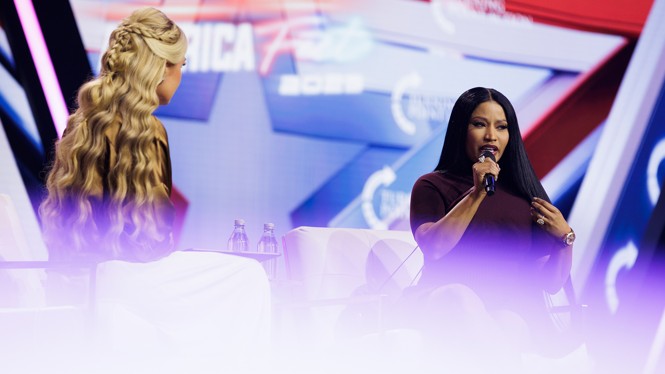
Sparklers sizzled, boom-badoom-boom bass thumped, and Nicki Minaj emerged onstage at Turning Point USA’s AmericaFest last month to deliver the latest plot twist in an exhausting year for politics and pop culture. The rapper—whose straight black hair reached the hem of her sleek minidress—sat down with Charlie Kirk’s widow, Erika Kirk, who sported medieval-princess blond braids and waves. Then Minaj tore into previous presidential administrations for being un-Christian and uncool. “We can’t let people like that be in power, you guys,” she said, flaring her eyes like she does in the video for her song “Stupid Hoe.”
Minaj arrived in America at age 5 as an undocumented immigrant from Trinidad, and is still not, she said in 2024, an American citizen. Her music uses pornographic profanity to assert herself as a man-eating empress, and her fans—many of them queer—don pink wigs and call themselves “Barbz,” after Barbie. Yet here she was at a conference co-founded by Charlie Kirk, a defender of traditional gender roles who just last year called Minaj a poor role model for young Black women. Here she was, praising Donald Trump as the handsome redeemer of American pride.
Ever since the president danced with the Village People during last year’s inauguration weekend, the Trumpian right has been disorienting America with this kind of spectacle. Trolling and tackiness, often crossbred with left-coded pop songs and hot memes, have served to wish a new zeitgeist into existence. Consume only the output of MAGA’s multi-front media efforts, and you may come to feel that the country is coalescing into pep-rally unity on Trump’s behalf. Minaj’s appearance at the Turning Point event gave the right a trophy to flaunt, signaling who the popular kids really are.
Any follower of Minaj’s knows what’s behind this kind of bravado. Like the killer doll Chucky, which she often references, or perhaps like Elon Musk wielding a chainsaw, her persona—big grin, nasty words—conveys cheerful cruelty. But it’s a performance of embattlement, not dominance—the offensive defense of someone everyone thinks of as “the bad guy,” per her song “Chun-Li.” She constantly seems beset by haters, rivals, and (in recent years) a public that doesn’t stream her music as much as she demands. Seeing her onstage drove home the desperation that has also defined MAGA’s imagery this past year, whether the example was ICE arrests turned into adorable anime or recruitment posters drawn in the same pastoral style as 1930s Germany. The president’s aesthetics are wackily fascist—but American culture, for now, remains peskily democratic.
Trump’s return to office was widely portrayed as christening a new definition of chic. Young voters and voters of color had swung in his direction, thanks partly to the influence of podcasts, livestreams, and other media formats that now compete with traditional news outlets and cultural institutions. The attendance of tech barons, comedians, and content creators at Trump’s inauguration indicated that the so-called alternative media was now the mainstream—and openly pro-Trump. Its touchstones appeared to be recently booming phenomena including country music, TikTok tradwives, and mixed martial arts.
Trump quickly began consolidating his cultural power by focusing on the old media that hadn’t fallen in line. He strong-armed news networks, intervened in Hollywood mergers, overtook and renamed the Kennedy Center, slashed public-broadcasting budgets, and recast the White House press corp. These efforts have borne results: sycophantic press conferences, DEI rollbacks at movie studios, a news chief at CBS whose nightly broadcast has delivered a “salute” to Marco Rubio and spent a mere 16 seconds covering the fifth anniversary of January 6.
These authoritarian-scented measures, combined with MAGA’s apparent command of new media, gestured at what Trump really needed to achieve his full agenda: cultural pacification and control. His policies are, however else you describe them, disruptive. Mass deporting migrants, brazenly axing federal grants and jobs, pursuing an inflationary trade war, risking the lives of soldiers to trouble the sovereignty of hemispheric neighbors—these things are shaking the everyday lives of Americans. Seeking a third term, as he has hinted at doing, would redefine the presidency itself. Such drastic measures should mean, in a free and open democracy, powerful pushback vented not only through the political process but also through artists and audiences.
Outcry has, indeed, resulted—though less of it, and less sharply rendered, than one might expect. Trump’s first term spurred the indefatigable and angry Resistance, with its mocking “tiny hands” imagery and battalion of celebrities. This time, the popular protest movement is “No Kings,” which has made a point of presenting itself as a vague and upbeat pro-democracy effort. Once-outspoken entertainers have been a bit quieter of late as well. The actor Jennifer Lawrence told The New York Times that the past decade has discouraged her from using her platform for politics.
The animated pushback to ICE in Minneapolis over recent weeks marks a return to a more confrontational style of protest. But the situation in that city has also demonstrated MAGA’s methods for stigmatizing dissent. The death of the activist Renee Nicole Good at the hands of an immigration agent has been justified on the right in a fashionable tone of detachment. The right-wing pundit Erick Erickson labeling Good an “AWFUL”—an Affluent White Female Urban Liberal—stereotypes the opposition as not just wrongheaded but cringe, so cringe it doesn’t matter at all.
Yet, in important ways, the cultural feedback loop remains intact and significant. Take the Jimmy Kimmel incident. In September, the talk-show host seemed to imply, incorrectly, that Kirk’s killer was a MAGA supporter. The Federal Communications Commission chair, Brendan Carr, threatened ABC, Kimmel’s network, which announced his show’s indefinite removal from its time slot. The ensuing outcry from the public, including from alt-media figures such as Joe Rogan, was deafening, and Kimmel quickly returned to the air. One lesson from that episode: Whatever motives underlay ABC’s initial decision, they were not powerful enough to justify the mess it caused.
Another lesson is that the same ecosystem that helped elect Trump is also independent from him. Rogan, the superstar podcaster credited with helping sway the 2024 election, has not only griped about Kimmel; he’s also questioned the White House’s immigration crackdown and tariffs. Andrew Schulz, another popular comedian and podcaster, declared that Trump’s foreign policy and spending bills are “the exact opposite of everything I voted for.” The streamer Adin Ross, who gave Trump a car during the 2024 campaign, now says he regrets ever talking politics, because it’s had the effect of tarnishing his brand.
[Read: Is this the worst-ever era of American pop culture?]
None of these figures has exactly gone blue, but their griping is in line with what polls have shown about Trump’s softening support among young people, men, and people of color. His appeal to those groups in 2024, it seems, was rooted in something other than stereotypical MAGA loyalty. The “freethinking” moniker that Rogan and others give themselves can seem risible—they’re so freethinking that they’re willing to entertain conspiracy theories and superstition—but it does, in fact, have some basis in truth.
And though the government can threaten the licenses of news networks, the internet is more difficult to tame. To be sure, Musk’s overhaul of X to make it friendlier to white nationalists, Mark Zuckerberg’s rollback of Meta’s moderation regime, and TikTok’s Trump-assisted sale to a group of investors led by the conservative billionaire Larry Ellison all suggest the extent to which web culture can be shaped and distorted by its platforms. But a podcaster is still just someone with a mic and an audience. Short of outright criminalizing dissent or resorting to mafioso intimidation—neither out of the question—Trump has no simple recourse against the online crowd other than the one he has always had, the one that politicians in a democracy are supposed to use: persuasion.
One person who understood persuasion was Charlie Kirk, whose killing might be the most culturally consequential development of the past year. Kirk grasped how the internet has changed America, but his death has demonstrated—and, disturbingly, may have resulted from—the fundamentally anarchic nature of those changes.
Kirk rose to prominence by bridging the roles of activist, influencer, and party spokesman in a manner that connected with young people and shaped consensus on the right. In early 2025, he helped diminish GOP opposition to RFK Jr.’s confirmation as health secretary by vowing to organize primary challengers. He later downplayed the delayed release of the Jeffrey Epstein files by saying he held “trust” in his “friends in the government to do what needs to be done”—a position that only someone who’d himself accrued enormous trust from his followers could possibly maintain.
After Kirk’s death, all sorts of narratives started to break down. For example, his alleged killer, Tyler Robinson, is a highly online young, white, male video gamer—which is to say, he is the kind of person who was thought to be driving America’s conservative wave. But according to evidence cited by police, he saw Kirk as a font of “hate.” Immediately after the shooting, he logged on to the social network Discord to chat with his friends, suggesting that he was performing for the sort of micro-audience upon which the nation’s fragmented culture is now built. (Robinson has not yet entered a plea of guilt or innocence.)
Kirk’s allies quickly tried to tell a new story—one of Kirk as sacred martyr. When others questioned that portrayal by citing Kirk’s more callous stances—on immigrants, guns, and trans people—Trump saw an opportunity to further pursue his anti-dissent agenda. His administration began labeling liberal advocacy groups as terrorists. J. D. Vance encouraged the punishment of anyone seen celebrating Kirk’s death. At least 600 people were subsequently fired from their jobs for social-media posts and public statements, some of which extolled the murder and some of which just quoted the victim’s own words.
But months later, the campaign to sanctify Kirk appears to have backfired in some ways. Gen Z and Gen Alpha’s highly ironic meme ecosystem has embraced what’s called “Kirkification”: the use of AI to meld Kirk’s face with all sorts of characters—superheroes, rappers, porn actors. The intentions of the Kirkifiers vary wildly. Some meme makers are admirers of Kirk who want to valorize him; some are neo-Nazis out to mock Kirk for not being extreme enough (while also drawing attention to their cause); some are liberals trying to troll conservatives; many are surely apolitical types having a nonsensical laugh. In most cases, the effect is to flout any top-down insistence on reverence, a party line, or a unified myth.
The assassination of Trump’s best mouthpiece also destabilized the online right. With Kirk gone, doubts and disagreements about Israel, tariffs, and—the big one—Epstein have spun out in a variety of directions. They’ve been stoked by a class of influencer pundits, such as Candace Owens and Nick Fuentes, who are angling to fill the cultural vacuum left by Kirk. But unlike him, they profess no particular fealty to a party establishment. They are moving by the logic of online entertainment, which, at this moment, is driven by demand for conspiracy theories and conflict—in opposition, at times, to MAGA itself.
Meanwhile, traditional opposition has been enduring a demoralization campaign via federally funded trolling. Stunts such as taking over the Kennedy Center and snarkily relabeling presidential portraits should be understood partly as efforts to exhaust opponents while letting supporters feel like they’re in on a joke. The maxims “Don’t feed the trolls” and “Don’t take the bait” can seem like enlightened responses—but in effect, they serve Trump’s need for cultural pacification.
Perhaps this is why the administration has taken the bizarre step of actively seeking confrontations with celebrities. Government-run social-media accounts have been posting political “fancams”—highlight reels that stans make to celebrate their obsessions—set to music and sounds by popular entertainers. One video pairs photos of Trump with the swooning sound of a Taylor Swift song; another mashes up a video snippet of the comedian Theo Von and shots of immigrants getting deported.
These clips work on the level of propaganda by portraying Trump’s agenda as swashbuckling and hip. But they also create ultimatums for entertainers. Should stars who object to the use of their work publicly complain—as did Von, a Trump-friendly podcaster who nevertheless didn’t like being associated with the immigration crackdowns? Or should they stay above the fray—as has Swift, a onetime Trump critic whose silence on politics over the past year has unnerved some of her fans? Or should they go meta—as did the singer SZA, who wrote on X that the administration was “rage baiting artists for free promo”?
Complaining certainly seems like a headache. In December, in another video, Sabrina Carpenter’s puppy-love anthem “Juno” was paired with deportation imagery. In response, the singer posted, “This video is evil and disgusting. Do not ever involve me or my music to benefit your inhumane agenda.” The White House then shot back a statement that referenced her lyrics, asking whether she was “stupid” or “slow.” When Variety asked the government about its use of Swift’s music, a spokesperson said, “We made this video because we knew fake-news media brands like Variety would breathlessly amplify them. Congrats, you got played.”
Obnoxiousness like that is probably best understood as an attempt at reverse psychology. The administration’s fancam videos generate millions of views, and many attempts to not “amplify” Trump have only proved counterproductive. To a casual internet scroller, seeing these videos circulate without controversy might imply acquiescence from the performers featured in them. And acquiescence can be contagious. In other words, the administration may be systematically testing cultural figures out of the understanding that they still hold sway. They can still speak out, and it still matters if they do, or if they don’t. So they probably should.
As for Minaj, she’s an example of what MAGA leaders likely dream of gaining from their trolling efforts: support. The rapper began her open flirtation with the right in November by reposting an official White House video that used one of her songs. After she publicly expressed concern about reports of persecution of Christians in Nigeria, the administration brought her to address a United Nations panel on the topic. Soon she was writing on X that Trump and Vance were “the good guys,” and she started feuding with Gavin Newsom.
During Trump’s first administration, Minaj expressed horror at his immigration policies. Theories now abound as to what changed since she said, in 2020, that she’s “not gonna jump on the Donald Trump bandwagon.” One common explanation is that she’s shopping for a pardon for her husband, who was convicted of attempted rape in 1995. Others point out that she has alienated much of the music industry by feuding with liberal stars including Jay-Z, Cardi B, and Megan Thee Stallion. Jay-Z is the head of the team that programs the Super Bowl halftime show; might Minaj want to headline Turning Point USA’s alternative halftime show?
But maybe her conversion is genuine. As she talked onstage with Erika Kirk, Minaj’s voice ached while she described her own journey with Christianity. She was raised as a devout churchgoer, lapsed in her faith as she rose to stardom, and now wants to come back into the fold. I thought of Little Richard, Prince, Ye, and other colorful, crass pop predecessors of Minaj’s who were shaped by the church in early life and turned to conservative Christianity in midlife. Maybe Minaj is undergoing a very normal journey for someone like her—simply at an abnormal time in American history.
When I opened up social media after her Turning Point appearance, my feeds were full of Barbz renouncing their membership in what had been the most loyal and fervent of all pop fandoms. I saw Minaj sparring with critics and critics sparring with one another. I had the strange thought that Minaj and the dustup around her is an example of the speech rights that have survived the past year—and I felt grateful for all of the competing forces and factions that remain too complex for politics to control.


