
In 2023, I went to New York to see Tom Stoppard’s play Leopoldstadt, about a Jewish family in Vienna before World War II. It was the final work Stoppard produced before his death late last year, at the age of 88, and the most personal play of his career. By the time the story ends, in the 1950s, only three members of the family are still alive, including Leo, who escaped to Britain as a child refugee and has no knowledge of his Jewish heritage. Leo’s story mirrors Stoppard’s own: Born in 1937 as Tomas Straussler, his family fled the Nazi occupation of Czechoslovakia and eventually settled in London. Not until he was in his 50s did Stoppard learn that he was Jewish and that his grandparents had been murdered in the Holocaust.
I bought tickets to Leopoldstadt because Stoppard was a giant of the theater, but I was also hoping to recover some of my own family history. I, too, have Jewish roots that were kept hidden from me for much of my life. That day in the theater, I caught a glimpse of what it must have been like in my mother’s family’s living room in Berlin before they were forced to flee Germany.
[Adam Begley: Tom Stoppard made a spectacle of history]
Growing up, I knew that my mother, Anita, had been born in Germany. My father, Karl, was an American on a whirlwind tour of Europe when he met her in a Swiss train station a few years after World War II. He swept her off her feet and they got married in the United States, where my sister and I were born. But my parents divorced when I was seven, and my father took me and my sister out of the country to prevent our mother from seeing us. After three years, she finally relinquished custody rights in exchange for the chance to see her children once or twice a year. Much later I found out that she also promised my father never to tell us that she was Jewish.
Not until my senior year in college, on a long-distance phone call with my maternal grandmother in London, did I discover the truth about my ancestry. She was shocked when I told her I was working that summer as an evangelical missionary. I hadn’t grown up in a religious family, but I was captivated by the teachings of Jesus, which were being spread on campus by an evangelical group called Campus Crusade for Christ. I knew something in me needed saving and it seemed that Jesus, who’d overcome the worst human cruelty with love, could do that for me.
“How can you be a Christian missionary?” my grandmother asked me, incredulous, in her thick German accent. “You’re a Jew.”
My father didn’t like Jews. He told my sister and me that they couldn’t be trusted. In my high school years, he forbade me from babysitting for the Jewish family next door. Once he even challenged my sister’s world history teacher, insisting that Hitler had been a great leader. Now the terrible secret beneath my father’s hatred broke open: his own children were Jewish.
What was I to do with the part of me my father had taught me to hate? Whenever I tried to speak to him about it, he shut me down, denying that my mother was Jewish and warning me never to mention it again. My mother, still fragile from her divorce and years of loss, would not talk about her past, suggesting I call her sister in London instead. But Aunt Dorothy angrily told me I was cruel for asking her to unearth painful memories. I didn’t know then that silence, for many Holocaust survivors, was a form of survival—a way to keep from relieving the trauma. Eventually the traumas in my mother’s life caught up with her, and she died by suicide when I was 26.
Over the years, my grandmother and aunt filled in some of the missing pieces of my mother’s history. I learned that she was born in Germany in 1925 to a family that considered themselves German, not Jewish, and worked hard to assimilate. In the 1920s, my grandfather, an attorney in Berlin, changed the family’s name from Cohn to Koch and had his four children baptized into the Episcopal Church. But it wasn’t enough to protect them, and after the Nazis came to power the family fled to England. After the war my mother studied at the London School of Economics and worked for the U.N. in Geneva, where she met my father.
My curiosity about my Jewish roots eventually waned as I married and built a family and career of my own. My husband came from generations of Christian missionaries and ministers, and we sent our daughters to a private Christian school. I became a religion reporter. Looking back now, I see how this may have grown out of a longing to make sense of my own religious identity.
In 1994, ABC News sent me to Billings, Montana, where neo-Nazis were terrorizing the town’s small Jewish community. Headstones in the Jewish cemetery were desecrated, and someone hurled a brick through the window of a Jewish family’s home. I managed to convince the prime suspect, a skinhead in his twenties, to speak with me on camera.
“Why are people throwing rocks through the windows of Jewish families here?” I asked him.
“Maybe some people don’t like Jews being here,” he said, with a malevolent smirk.
That’s when it struck me: I was blonde and green-eyed, but if the stranger sitting across from me had known I was Jewish, he’d have wanted to hurt me too. The fear and unease I felt in that interview were a bittersweet gift–a visceral connection to the family that had been stolen from me.
For most of my life I avoided movies, books and museums about the Holocaust-–partly out of guilt, partly because of the sheer terror of the stories. But seeing Leopoldstadt felt different. Stoppard wasn’t telling a story of Nazis and gas chambers; he was exploring the psychological danger of hiding one’s Jewish identity. A month after seeing the play, I decided to fly to London in search of some of my own hidden pieces.
My first stop was the Wiener Holocaust Library in London, one of Europe’s largest Holocaust archives. For a week I went through stacks of documents detailing the lives of my mother’s mother’s family, the Ullsteins. I discovered that they were the owners of a vast media empire that employed 10,000 people and included major newspapers, magazines, and book publishers. It comforted me to think that the tug I’d felt toward journalism was evidence I really belonged to the family I’d lost.
Poring over photos and letters from grandparents, great-grandparents, and distant aunts and uncles, I was able to trace the growing threat of antisemitism in Germany in the 1920s. Like many assimilated Jews, the Ullsteins believed their contributions to German society would protect them from the Nazis. Of course, it wasn’t enough. The Nazi government stripped them of their German citizenship and forced them to sell their business to new “Aryan” owners for a fraction of its true value.
Members of the Ullstein family who escaped the Nazis ended up all over the world, including the U.K. Today, two of my second cousins, Bartholomew and Augustus Ullstein, live in the countryside outside London, and they invited me to come for a visit. When I arrived at Bart’s home, he and his wife Helen welcomed me warmly, like long-lost family. They also had a surprise for me. “Helen and I wondered if you’d be interested in meeting a close friend of ours in a neighboring village,” Bart said one morning. “His story is much like yours and we’ve arranged for the two of you to have tea.”
He was talking about Tom Stoppard. I met him and his wife, Sabrina Guinness, at their historic Georgian vicarage in Dorset. It was May 2023, and he was preparing to go to New York for the Tony Awards the following month, where “Leopoldstadt” would win Best Play. When Tom came down to the garden to join us he was a little disheveled but very calm. His gaze was intense, but with a quiet warmth and a penetrating curiosity that caught me off guard.
He asked me about my family’s story and shared his own. After his father died, his mother married a British officer named Stoppard, who adopted Tom and his brother. They grew up thinking of themselves as thoroughly British school boys. We talked about having our Jewish heritage hidden from us and how that had shaped us as adults.
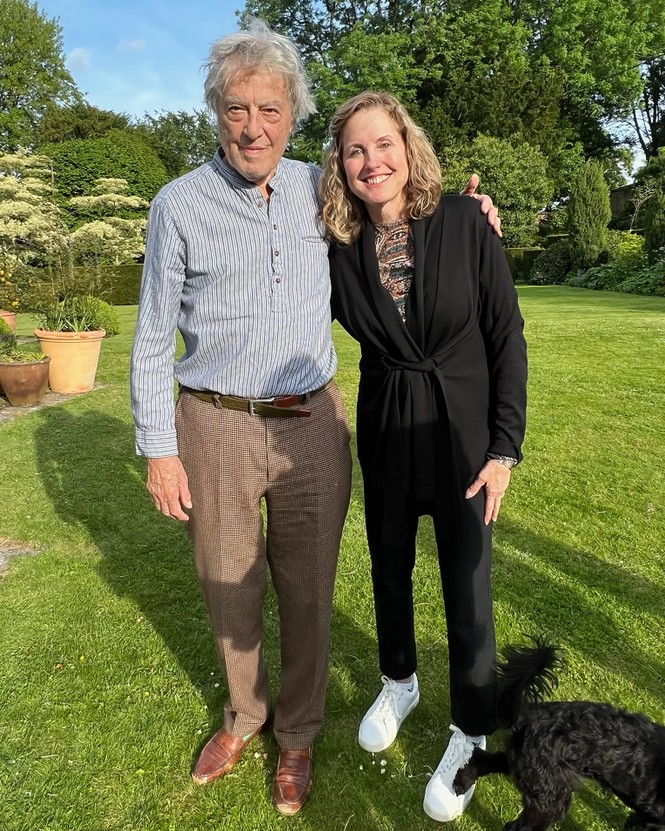
“So, what are you now?” he asked. “Do you consider yourself Christian or Jewish?”
I’d struggled with that question for decades. How could I renounce the Christian faith that had given my life such purpose and meaning? Yet how could I deny the Jewish faith of my ancestors who had suffered so profoundly? For years I’ve chosen to quietly consider myself both Jewish and Christian. After all, Jesus and his earliest followers were Jews. To me, Jews are like the grandparents of Christianity: Christians inherited their faith and should honor it.
[Sarah Hurwitz: The Judaism I thought I knew]
When I try to explain this to my Christian friends, many react as though I’ve won some rare theological trophy. “Oh,” they say, “so you’re a completed Jew?” That’s the term some Christians use for people who are Jewish by descent yet believe Jesus is the Messiah. But it offends anyone who’s Jewish, and it makes me uncomfortable.
My Jewish friends have a different problem with my profession of a mixed faith. “You can’t be both,” they say. One rabbi put it bluntly: “You need to come home!”
That was the problem. What home? For most of my adult life I’ve felt like an outsider. But that afternoon in Dorset, sitting with one of the theater’s most brilliant storytellers, I found a kindred spirit. Neither of us were Holocaust survivors, but we’d both inherited its aftershocks. As I finished telling my story, the garden grew quiet. Tom’s face softened as he nodded quietly, as though no explanation was necessary.


