By Luminous Jannamike, Abuja
THREE weeks ago, Peter Obi walked into Enugu with people who mattered. Former governors. Serving senators, Regional power brokers. Political elders from the South-East and South-South. It was not a rally and it was not theatre. It was a signal.
Read Also: Fubara is APC leader in Rivers — Presidency
In Nigerian politics, walking in alone doesn’t always pay. Walking in with people who can make calls, influence delegates, and move blocs of votes sends a different message: this is not just one man; this is a structure.
What Is Really Holding ADC Back
Privately, some ADC leaders admit the problem is not popularity or vision. It is money, and the reality of Nigerian politics.
ADC does not have the funds to run a heavily monetised presidential primary. There is no money to chase delegates. No billions to “settle” loyalty. No appetite for the $20,000 to $30,000 per delegate inducements that have become normal in major parties.
In this situation, many party members believe that if ADC adopts open primaries, their contestants may struggle. Because of this uncertainty, fundraising has slowed. Donors are hesitant. Coalition talks are dragging. Everyone is waiting for clarity before committing.
The party wants a fresh direction.
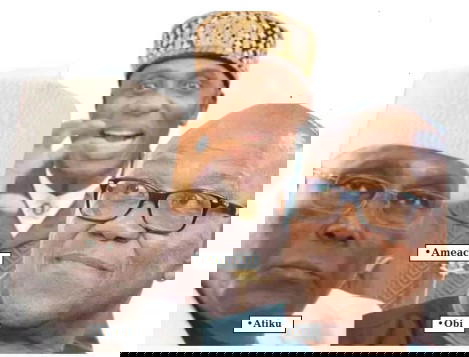
Atiku wants another attempt. Those two goals are pulling ADC in opposite directions.
Atiku
Winning a Nigerian presidential election follows a clear pattern.
You need the North. But you also need real support in the South, especially the South-East and South-South. Many analysts say Atiku no longer has that balance.
Over time, his relationship with the South has weakened. Critics argue he does not engage the region deeply or deploy its support when it matters. As a result, his political strategy now leans heavily on the North.
Several political observers project that President Bola Tinubu still holds major advantages: firm control of the South-West, competitive strength in the North, and enough votes elsewhere to win outright if the opposition remains divided.
In that scenario, Atiku does not stop Tinubu. He divides the people trying to stop Tinubu.
Why Tinubu Is Not in a Hurry
Within opposition circles, a common belief has taken hold: the ruling party benefits from confusion on the other side. As long as opposition parties argue internally, coalitions stall. Messaging weakens. Donors wait. Time slips away.
Money has always shaped Nigerian politics, and analysts often point out that financial strength influences how quickly alliances form and how long disagreements last. Even without hard evidence of interference, perceptions alone can shape political behaviour. In politics, what people believe is happening can matter almost as much as what is actually happening.
Obi
Peter Obi appears to have understood this early. He did not approach ADC as a lone aspirant hoping for goodwill. Before appearing publicly, he consulted widely with party leaders. According to people familiar with the discussions, he made his position clear: he would only proceed if there was a clear path and broad agreement.
If that path did not exist, he was prepared to walk away. He was advised and he listened.
By arriving with a bloc, Obi changed the conversation. He was no longer asking for permission. He was negotiating terms. That alone strengthened his position inside the party.
Others Watching Carefully
ADC’s internal uncertainty has made other opposition figures cautious. Former Sokoto governor Aminu Tambuwal remains part of the conversation. Former Kano governor Rabiu Kwankwaso is watching closely. Talks about possible alliances exist, but nothing has been decided.
For politicians at that level, committing to a party that has not resolved its internal direction is risky. Some observers believe even engaging ADC carries reputational costs. Others argue that time itself is weakening older political movements. In Nigerian politics, waiting too long can be as dangerous as moving too fast.
What the Public Is Saying
Public reaction reflects growing frustration. Many Nigerians see Atiku’s persistence as selfish, outdated, and politically destructive. Some openly accuse him of acting as a spoiler, intentionally or not, blocking a younger and more viable candidate.
Others trace today’s mess back to 2023, arguing that Atiku misread power, underestimated Tinubu, and mishandled key alliances, especially with Nyesom Wike. But there are many who say the north will back him to defeat Tinubu if he gets the ADC ticket. He has lost support from the south but the north may stand with him.
Across regions and professions, one message keeps repeating: opposition confusion is Tinubu’s greatest advantage.
Political strategist Godwin Oyibode warned: “The same people you dismiss as noise-makers will decide 2027. Atiku doesn’t understand modern politics. Must he contest every presidential election in Nigeria?”
Architect Ditimiya Victor said: “Any serious analysis of 2027 that doesn’t present Peter Obi as flag bearer is self-deception. Tinubu is counting on this confusion.”
Dele N’ÍnÍdå says this is the best chance for Atiku to emerge President since the north that ensured Tinubu’s victory is no longer with him.
Community organiser Daniel Nwofia observed: “Tinubu has locked down the Middle Belt and fragmented the East, while Atiku controls the core North. 2027 won’t be like 2023.”
Civic advocate Charles Okoyomon added: “It’s becoming obvious Atiku is working for Tinubu, as a spoiler blocking Obi.”
Public affairs commentator Ibrahim Sadiq listed the warning signs: “(Atiku) Ignoring zoning, insisting on contesting close to 80, refusing to support a younger candidate, it all points one way.”
Network engineer Taiwo Ajakaye traced the roots back to the last election: “Atiku thought he already had backing from Aso Rock. Tinubu played chess. He needed a chunk of PDP, and Wike delivered.”
Where This Leaves ADC
ADC is not yet an opposition force. It is a disagreement waiting for resolution. Until its internal questions are answered, momentum will remain weak. Coalitions will hesitate. Supporters will wait.
The ruling party, meanwhile, has the luxury of time. And in Nigerian politics, when one side is calm, it is often because the other side is doing the damage for them.
The post Today’s posers for ADC! appeared first on Vanguard News.
