
Last week, I wept a little when listening to Christmas music.
Very few works of culture make me shed actual tears. Over dinner after a screening of the new film Hamnet, my friend Nancy told me she was surprised that the movie, which concerns the agonizing death of William Shakespeare’s only son, didn’t make me cry. “I don’t know what to tell you,” I said. Then I went home, opened Spotify on my phone, and hit “Play” on the soundtrack to A Charlie Brown Christmas. I fell asleep to the record with wet eyes.
This always happens to me with A Charlie Brown Christmas, which is celebrating its 60th anniversary this year. Getting verklempt, that is. Perhaps it’s nostalgia for Christmases past (it was my difficult mother’s favorite holiday) or a longing for a Christmas that never was (like I said, it was my difficult mother’s favorite holiday). Mostly, I think, it’s the mood the album evokes, one that feels familiar but foreign; cold but cozy; festive but reflective; spiritual but secular. The soft piano strokes and wire brushes of “Christmas Time Is Here” convey a lament and a welcoming: sorrow, perhaps, for the difficulty of the season, and the offer of a soft place to land. The descending, twinkling notes of “Skating” impart an aura of quiet wonder. The percussive energy of “Christmas Is Coming” is convivial and anticipatory. The cover of “What Child Is This” isn’t bad either.
This might all sound a bit sentimental, but I’d wager I’m not the only person whose experience of the holidays was profoundly shaped by the 1965 Christmas album (and the special, of course). I grew up near Sacramento, California, where it doesn’t snow, but our family had a few rituals that helped define the unfolding of the season: buying a fir tree, placing our stockings above the fireplace, and gathering around the television to watch A Charlie Brown Christmas, which transported us to a flat, wintry world where snowflakes fall on kids skating around frozen ponds who will later spiritedly debate the meaning of the holiday.
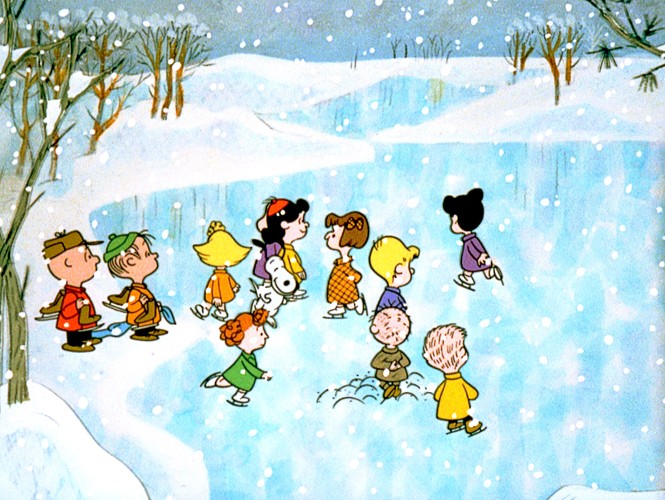
Things have changed. I no longer live at home, my school years are long behind me, and the collapse of linear television has made communal viewing, of the sort that we did with A Charlie Brown Christmas, largely a thing of the past. When the special first aired, it got a 45 share in the Nielsen ratings, meaning that nearly half—half!—of the households watching TV at that moment in the United States were watching it. As Caitlin Flanagan wrote in The Atlantic, “In those days you had three networks, and if one of them was broadcasting a show for children at night, you can bet that the news had been shouted down school stairwells and across playgrounds, and you can bet that all of us were in position, sitting on family-room carpets and living-room couches, breathing as one, soaking it all in.”
[Read: Charlie Brown’s inside job]
Now, thanks to the primacy of streaming services, that collective experience has become a lot more difficult, if not impossible, to accomplish. In 2020, Apple snapped up the exclusive TV rights to the whole Peanuts library, which means that A Charlie Brown Christmas now streams behind a paywall on Apple TV, except for the two days in December when the platform makes it available for free.
Which brings me back to the soundtrack. We might not be able to watch A Charlie Brown Christmas together like we once used to—“breathing as one, soaking it all in”—but we can still listen to it: out and about shopping; at home wrapping presents or sipping spiced beverages. It’s the attendant music, I think, that remains most pregnant with communal possibility, a soundtrack to the season that endures as a delightful piece of mid-century pop-cultural history. It is that rare artistic artifact that transcends what it was made to accompany: Though the TV special can’t exist without the music, the music can certainly exist without the TV special.
The story of the Charlie Brown Christmas soundtrack starts in Northern California. In early 1965, a producer named Lee Mendelson, who had been commissioned by the Coca-Cola Company to make a Peanuts Christmas special, approached Charles M. Schulz, a Sonoma County resident, to see if the Peanuts creator was into the idea of the project. After Schulz gave the go-ahead, Mendelson hired an animator, Bill Melendez, to design the look, actors to give voice to the characters, and a composer to build a soundscape for the half-hour program.
That composer was the Grammy Award–winning pianist Vince Guaraldi, who’d been engaged by Mendelson a couple of years earlier to score a documentary about Schulz. Mendelson had heard Guaraldi’s 1962 song “Cast Your Fate to the Wind” on a local Bay Area radio station as he drove across the Golden Gate Bridge. The documentary never happened, but Guaraldi’s sound—“melodic and open,” Mendelson said—seemed perfect for the Christmas special, which would be the first of dozens of animated programs inspired by the popular comic strip.
Guaraldi had very little time to write and record the music for A Charlie Brown Christmas. Though he met Mendelson in 1963, he wasn’t contracted to score the Christmas special until the spring of 1965. Guaraldi had just five sessions in which to record the music, according to Mendelson’s son Jason, the chairman of Lee Mendelson Film Productions (which, alongside Peanuts Worldwide, jointly licenses the exhibition rights for the Peanuts Classic Specials, and is the music publisher of much of Guaraldi’s catalog, including the Peanuts-associated music). Benjamin Clark, the curator of the Charles Schulz Museum in Santa Rosa, California, told me that Guaraldi was still recording music for the show in October of that year, just weeks before it premiered on CBS. Talk about cutting it close.
Schulz had also issued an edict for the sound of A Charlie Brown Christmas: no laugh tracks, which Schulz believed were off-putting to audiences. It was, as Clark explained it, “a really kind of out-there idea” for the time, but an auspicious one. No laugh track meant that Guaraldi’s music was brought to the fore; its prominence, perhaps more than the sparse dialogue, gave viewers cues about how to feel, or about a particular scene’s meaning. (The script for the half-hour show ran only 10 pages.)
Also unusual was the idea that jazz would accompany a children’s animated special. CBS execs were reportedly unhappy about the choice. And so, perhaps (or perhaps not?), was Schulz himself. Derrick Bang, a biographer of Guaraldi and a Northern California–based Peanuts historian, told me that Mendelson’s choice of Guaraldi was “radical,” and explained that, though some Americans at the time still regarded jazz as the “devil’s music,” the influence of bossa nova on Guaraldi’s compositions for the special offered a version of the genre to audiences that felt more gentle. “It conveys emotion beautifully,” Bang said of Guaraldi’s score. “I mean, have you ever heard anything musically that sounds like falling snow better than the composition ‘Skating’?”
[Read: The paradox of Peanuts]
Perhaps ironically, Guaraldi was a native of San Francisco, where snowfall is rare. But his soundtrack transports listeners to a particular geography; Clark, who, like Schulz, grew up in the Midwest, told me that, as a child of the plains, he thought of the story and its environs as “my thing.”
For others, like myself, who weren’t raised in those sorts of landscapes, the album rendered more like a whimsical yet pensive reverie, an aspiration to a time of year and a mood that half-existed, if at all. It evoked a place we’d been to but never lived in. It’s what a music critic once called “perfect dysfunctional holiday music” with “small, observant miracles,” or, as another wrote in the Los Angeles Times in 2012, a demonstration of “how a piano, bass and drums can capture a feeling and character in living color, particularly if those feelings are complex, conflicted or even simply too beautiful for words.”
Bang remembers watching the premiere of A Charlie Brown Christmas on December 9, 1965. He was 10, and he remembers that he wore pajamas. He remembers being “transfixed” by the music, and that the end credits rolled very quickly—too quickly, in fact, for him to figure out who had composed what he’d just heard. A few years later, when he realized that the soundtrack was something he could actually own, he went out and bought a copy of the album. He still listens to it, he said, and not only during the holiday season.
In Bang’s estimation, Guaraldi will, within a few decades, be as beloved and revered as George Gershwin or Irving Berlin, a part of the American musical tradition. “I defy anybody to listen to an hour of Guaraldi’s music without smiling,” he said, adding that one of the people he interviewed for his book about Guaraldi told him that the pianist was “the most famous jazz musician whose name most people don’t know.”
“One interesting test is that when you encounter somebody who says they don’t like jazz,” you ask them, “‘Have you watched A Charlie Brown Christmas?’” Bang suggested. Many, of course, have, and some say that the album was, in fact, their first taste of jazz—a gateway drug, if you will. It was certainly the first jazz music I’d ever heard, though my real introduction would come decades later, when I encountered the pianist Keith Jarrett’s The Köln Concert—a very different work that nonetheless imparts its own feeling of melancholy. (I asked Bang for a definitive answer to the question of whether Schulz actually liked the Guaraldi score. He explained that Schulz was a classical-music fan, but that he respected his collaborators’ talents and the group did not argue over artistic choices. “That’s why they were able to collaborate successfully for so long,” he explained. “And, over time, Schulz came to enjoy Guaraldi’s style of jazz.”)
The soundtrack has become only more omnipresent over the years: In 1998, Starbucks began selling the album in stores; in 2012, the Grammy Hall of Fame composition was recognized by the Library of Congress’s National Recording Registry, which deemed it “culturally, historically or aesthetically significant.” (A Prince album made it into the registry that same year.) In 2020, more than half a century after its initial release, A Charlie Brown Christmas hit the Billboard Top 10 for the first time; in 2021, Billboard ranked it the greatest holiday album ever.
The year after that, the Recording Industry Association of America certified sales of 5 million units, making A Charlie Brown Christmas the second-best-selling jazz album in history. The top spot goes to Miles Davis’s Kind of Blue, but Sig Sigworth, the president of Craft Recordings, told me that the Charlie Brown Christmas soundtrack may surpass Kind of Blue by hitting the 6 million mark as early as next month. I told him this sounds like a big deal. “It’s a nice competition,” he said. On the day I spoke with Sigworth, A Charlie Brown Christmas was the No. 1 record on Amazon, ahead of Taylor Swift and the K-Pop Demon Hunters soundtrack.
David Benoit is part of the reason. The jazz pianist’s 1985 version of “Linus and Lucy,” which appeared on his album This Side Up, is said to have contributed to a swell of interest in the original album. Songs from A Charlie Brown Christmas have, at this point, been covered by a wide variety of musicians, including Norah Jones, Mariah Carey, Wynton Marsalis, Dave Brubeck, and Stone Temple Pilots. In 2000, the pianist Cyrus Chestnut released an album-length interpretation of the soundtrack, which he still tours with; he told me that he saw the special when he was only 3 years old, and that Guaraldi was his very first jazz influence. Trisha Yearwood just released a cover of “Christmas Time Is Here,” one of what Jason Mendelson told me is more than 24,000 covers of the song. He also has plans for symphony performances of Guaraldi’s music next year.
“If I go to a restaurant that has a piano, without fail, somebody plays ‘Linus and Lucy,’” said Mendelson, who briefly voiced the character of Peppermint Patty. (He had to stop once he hit puberty and his voice changed.) He told me about driving a group of 10-year-old boys from a Golden State Warriors game in San Francisco to his home in Redwood City a few years ago. The kids were acting up, so he put on some of the music Guaraldi had composed for the Peanuts specials.
“They listened to an entire jazz album with one vocal and the rest was instrumental for 40 minutes,” he said. “They’re like, ‘What’s that?’” It “shut up these 10-year-olds and got them to pay attention to jazz.”
Benoit, like Bang, told me that Guaraldi isn’t quite given the due he deserves, “especially in the world of straight-ahead jazz.” Everyone, he said, “talks about Monk and, of course, Bill Evans and Oscar Peterson.” But Guaraldi “should be right up there when you speak about the piano greats and the great jazz composers.”
And like Chestnut, Benoit, who was 12 when he first saw the special, and who began learning the piano soon after, credits Guaraldi’s music for getting him interested in jazz in the first place. “I said, ‘That is what I want to do,’” he told me. “I almost owe my career to that show.”


