
Heinrich Himmler and other Third Reich occultists in the 1930s latched onto the strange idea that the Aryan race was not the product of evolution but descended from semidivine beings who left the heavens and established a secret civilization on Earth, possibly beneath Central Asia. Himmler, the head of the SS, was so enthralled by the possibility of what he considered celestial proof of the superiority of the white race that he provided funding for an SS expedition to Tibet in 1938 in the hope of locating his utopia, according to Black Sun, a 2001 history of Nazi occultism by the British historian Nicholas Goodrick-Clarke.
Almost a century later, this idea of a lost Aryan civilization, called Agartha, has caught on again, this time with teenagers posting memes online. If you’re older than 25, you likely missed it. But over the past year, memes about Agartha—a mystical, underground city in the center of the Earth full of flaxen-haired, blue-eyed people—kept going viral and have become a staple of the youth internet. If you search for Agartha on Instagram, you’ll find dozens of videos with view counts in the millions, and many more in the tens of thousands and hundreds of thousands. (Searches for hyperborea and vril, myths that overlap with Agartha, yield similar results.)
Before Christmas, the White House shared a Department of Homeland Security meme that has many of the attributes of the Agartha phenomenon but with a festive theme: Santa in front of a subterranean snowy workshop with Earth’s core in the background, overlaid with the text Christmas After Mass Deportations. Jon Lewis, a researcher at George Washington University’s Program on Extremism who has written about neo-Nazism, told me he saw the image as a clear reference to online Agartha content.
When I asked whether this was an Agartha reference, the White House press office responded by email that “4 people had to Google what Agartha is and we’re still not sure. What are you talking about?” and sent me a GIF of a character from the cartoon Bob’s Burgers, suggesting I was grasping at straws.
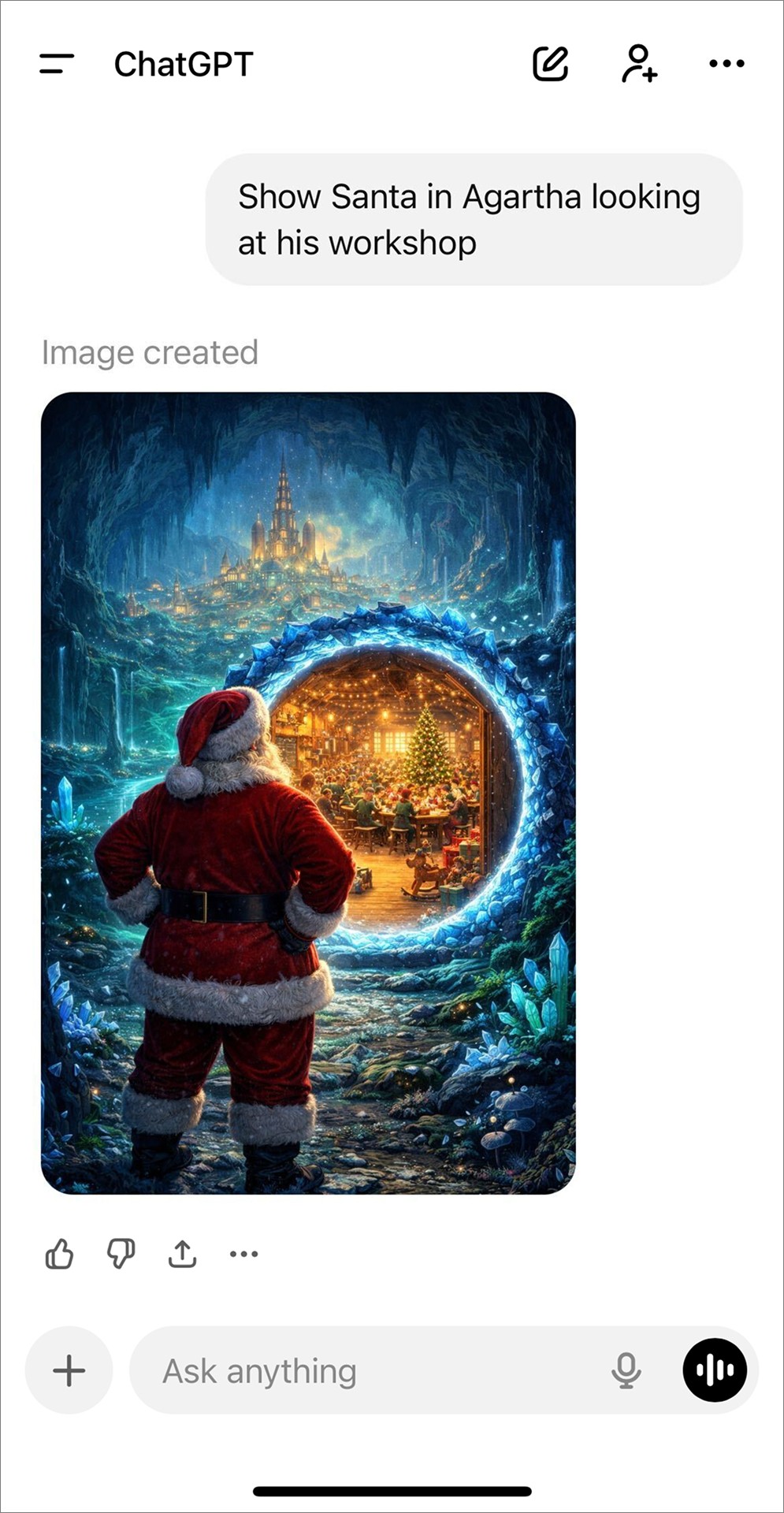
I then typed the prompt “show Santa in Agartha looking at his workshop” into ChatGPT, and got an image bearing a resemblance to the one sent out by the administration (on the left below). When I typed the prompt without the words in Agartha, ChatGPT created the image on the right.

Agartha memes usually feature supercuts—a video of short clips—comprising UFOs in the Antarctic, pyramid-laden civilizations, digitally altered images of Charlie Kirk with blond hair and chiseled features, stereotypical Nordic-looking people, and sugar-free Monster Energy drinks in white cans. The memes are almost always set to the same pulsing drum-and-bass electronic dance remix of the 1981 Men at Work song “Down Under.” Others feature the extremely anti-Semitic “happy merchant” depiction of a Jewish person. But all of the Agartha memes share in common the concept of the subterranean Aryan paradise that Himmler yearned for.
Many of the posters pushing the memes are avowedly racist and anti-Semitic. Others are not. The 25-year-old creator of an Agartha memecoin (a cryptocurrency with a fluctuating value that can correspond to a meme’s salience in culture) told me the images resonated with him because he is right-wing and likes “blonde aryan sigma vibes.” He declined to give me his real name, but said he was blond and white, and lives in Europe. (Sigma is a category of memes about successful loners who operate outside the concept of “alpha” and “beta” males.) When I asked him about Agartha’s far-right associations, he said, “I don’t think it’s that deep.” Still others, including a teenager I spoke with who runs an Instagram account that posts Agartha memes, told me that he thinks the memes are funny but not inherently a problem.
Whatever the motivation, the result is the same: Agartha memes and the bigotry they encode are spreading fast.
Agartha was first developed as a mythical fantasy by French writers in the late 1800s but had no far-right associations at the time. After Himmler co-opted Agartha, neo-Nazis carried it and other Third Reich racist myths into the postwar era by creating a new philosophy and value system called “esoteric Hitlerism,” a fusion of racialist ideology and wacky mysticism. In the early 2020s, white supremacists turned those myths into internet propaganda.
The memes have become so pervasive that some people online have started making their own Agartha-like posts to mock white supremacists. Others appear to have simply adopted the style to make their own memes about teachers at their high school or college. (Some are innocuous; some are not.) There are even accounts that post Agartha memes about college and professional football.
[Read: The Trump administration is publishing a stream of Nazi propaganda]
I reached out to more than a dozen Agartha social-media accounts. Outside of the Agartha-memecoin creator, only one other, “Westhoughton High Friends of Agartha”—a satirical meme page for a high school in the United Kingdom—responded. The person behind the account told me by direct message that they saw the content merely as “absurd brainrot humour,” and that they “can’t imagine many people take this seriously.” When I noted the Nazi associations of Agartha, they said that “It’s absurd humor 💀” and clarified that they themselves are “extremely left wing” and that they “hate all far right people.”
One way to read that is as a sign of the integration of Agartha content into mainstream culture, where its noxious antecedents are no longer meaningful. Who knows how many people sharing the word Agartha online are aware of its history? How many would care if they were? This sort of transformation has happened before. Pepe the Frog and Wojak (the bald, numb-looking cartoon character used to express ennui) were incubated in extremist circles on the image board 4chan. They eventually became ubiquitous on the wider internet, with little indication of their origins.
But another way to interpret the “Westhoughton High” Agartha account and others that might consider themselves harmless is as a cultural victory for the far right. Even if a viewer doesn’t understand the underlying ideology, the memes can lead to more, and more overt, neo-Nazi dreck.
“Now you have normies playing with what was fringe, esoteric Nazi memes,” George Washington University’s Lewis said. “It just broadened the aperture of people clicking on the video and the sound, who will consume even worse neo-Nazi content.”
The spread of Agartha memes is consistent with broader trends among young people. Recent polling found that 18 percent of 18-to-22-year-olds believe that Jewish people have a “negative” impact on the United States, a level 10 percentage points higher than the response among all age groups. The same poll found that 27 percent of 18-to-22-year-olds agree with the statement that “Jews in the United States have too much power,” compared with 16 percent of all age groups. As my colleague Yair Rosenberg recently wrote, “The research collectively suggests that America is becoming more anti-Semitic because its young people are becoming more anti-Semitic.”
At the same time, the word goy is becoming normalized in youth slang. Goy is a Hebrew and Yiddish term for “gentile,” but 4chan users co-opted it in the 2010s. Posters on the platform often used the term in anti-Semitic ways, such as in the terms goyslop (unhealthy foods that these conspiracy theorists believed were a Jewish plot to hinder gentiles) and goycattle (the unthinking masses who are constantly being manipulated by Jewish people). Like Agartha, such variations of goy have moved from the fringes of the internet in the past year, and posts using the term have accrued millions of views on TikTok and Instagram.
Nick Fuentes, the white-supremacist influencer, has also made a name for himself with anti-Semitic statements, including calling Jewish people a “transnational gang.” After operating on the fringes for years, his content now routinely collects millions of views across social media, and he casts a long shadow of influence over young right-wingers in politics. The ascent of Agartha memes and terms like goy suggests that anti-Semitic ideas now have purchase beyond Fuentes’s fellow travelers.
When I sought out and interacted with Agartha meme accounts, social-media algorithms started directing me to far-right accounts that posted other racist and anti-Semitic content. “What comes with Agartha is its provenance within a racist, anti-Semitic community,” Cody Zoschak, a researcher at the Institute for Strategic Dialogue Global, an anti-extremism think tank, told me. Zoschak, in his research, has observed that whenever he sees an Agartha meme, even from someone who isn’t obviously on the far right, he “can trace a line back to what is almost certainly a neo-Nazi community.”
White supremacists seem to think that this is a win for them. Lewis said that neo-Nazi and white-supremacist groups he monitors were elated after they saw the Trump administration sharing the Christmas Agartha meme: “They would write ‘Hail victory.’”
In November, Martin Sellner, an Austrian ethno-nationalist and prominent figure in far-right European politics, noticed that Agartha was going viral. In a later thread on X, Sellner called the memes a “metaphysical homeland for a ‘lost generation’ of isolated disenfranchised white boys.” Agartha, as depicted in memes, Sellner wrote, “is a place without immigrants, white guilt, a ‘white Wakanda,’ that symbolizes destiny and ancestral ties.” (Sellner added that he tried to make sure any illegal Nazi symbols were removed from Agartha meme examples in his thread, in compliance with German and Austrian law.)
Sellner positioned the memes as something that could be taken in jest. “Irony is the glue that holds this whole meme-universe together. Anyone who takes things deadly seriously or gets triggered has lost,” he wrote. This is the tone that a lot of people online have taken regarding the Agartha memes. No matter the underlying content, you’re not supposed to take the joke seriously, and if you do, the joke’s on you.
[Read: The firewall against Nick Fuentes is crumbling]
It’s a well-worn tactic, but also a common excuse used to launder noxious content. It’s not ironic or satirical for ethno-nationalists to joke about a mythical ethno-state when that fantasy is reflective of their extreme beliefs.
In November, a teenager set off bombs inside a mosque at a high school in Jakarta, injuring 96 people. The bomber was carrying a toy gun with neo-Nazi references written all over it, including the words For Agartha scrawled across the barrel, according to investigators. The Agartha reference looked like an example of “memetic radicalisation” according to a report from the Global Network on Extremism and Technology. In other words, the bomber may have been inspired by the memes of chaos, nihilism, and wanton destruction he saw online, even if he didn’t fully understand their origin or significance.
“There’s unfortunately no shortage of angry, largely white men who are looking for justifications to commit violence; we’ve seen anti-Semitism be that driver so many times,” Lewis said, recalling several mass shootings in the past decade—Buffalo, Charleston, Pittsburgh—that were carried out by white supremacists who had been at least partially radicalized online.
Nearly everyone posting about Agartha knows it’s not a real place. A certain subset, though, want Agartha to be more than a myth, as Himmler did, and for the United States to be the white ethno-state of their fantasies. Regardless of the politics of any individual poster, that’s the ultimate point—to finally make Agartha real.
Will Gottsegen contributed reporting for this story.


