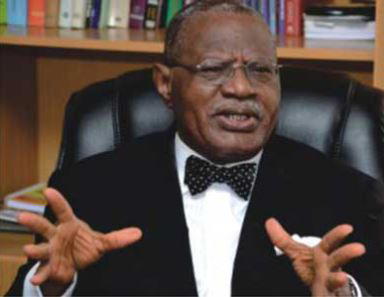
By Adetutu Audu
Sir Steve Bamidele Omojafor, an advertising titan, is the Chairman of STB-MCann, a former President of the Association of Advertising Agencies of Nigeria, AAAN, and a former Chairman of Zenith Bank Plc. Omojafor speaks in this interview on his 80th birthday and 50th wedding anniversary
How do you feel celebrating 80?
These are momentous occasions that we need to make a little noise, but we won’t go overboard. I am used to doing things in moderation. I started my career as a reporter in Daily Times after my university education in Akoka. I was there for two years. I became a sub-editor. I didn’t leave because the pay was not good, money was not too much of our problems in those days; our needs were few.
I was going to be moved to the position of Assistant Editor, Products and Publications and I discovered there was a lot of politics being played. And again, the Murtala administration that took over was something that affected many of us because some members of the senior staff were contacted to see how they could remove the late Alhaji Babatunde Jose, the doyen of journalism in those days, as Chairman of Daily Times, because the government thought he was so powerful, he was like a mini-Nigeria.
Some of us didn’t like it, the staff grew into two camps and it became problematic. Things were not going the way they should, so I said to myself “I am too early to be bogged down by these political shenanigans”. So I walked across to Lintas Advertising which was almost on the same street, a couple of my friends from Akoka were already working there. The interview process took so long, but eventually I got the job and that is how I quit Daily Times. Although I still maintained some columns then in Lagos Weekend and Evening Times, which was edited by Alan Aroyewun, I left journalism, but journalism didn’t leave me. I enjoy writing till now in my quiet moment.
Some of my biggest experiences in journalism, there are some good stories I did as a sub editor, you have the freewill to write features. Sam Amuka was the Editor of Sunday Times, he always wanted exclusive stories. I was part of those who reported the declaration by Gowon that 1976 was unrealistic for the military to quit power. I had to be on the field to do the story and at the same time conduct interviews on what Nigerians felt. The military had stayed for too long. That was a big story for me. I interviewed a Nigerian who came from Iceland, a very cold arctic part of the world, he was visiting the country for the first time, it was a big story which I wrote for Sunday Times and Sam Amuka was extremely grateful.
After Sam Amuka left, another Editor, Gbolabo Ogunsanwo, took over. For Lagos Weekend, I wrote two spectacular stories about a burial ground, when they dug the ground and then heavy rains fell and coffins were floating. It was a big story. I also interviewed a guy we called Sunny Gbokugboku.
Sunny will pick the body of a dead person, clean it up, put it in a coffin and roll it to the burial ground; people thought Sunny was a ghost himself. Those were human interest stories that affected people. There was no computer then, no AI, you physically had to be there and write beautiful stories.
What would you say are your accomplishments at 80?
I studied mass communication which was not by accident. When you identify where you belong, in everything in this life, you have a lot of options ahead of you. One of them strikes you as being part of you and what you will like to do. Once you stick to it, nothing gets you out of it anymore, you just get stuck. Even at a young age, I used to contribute to the ‘Letter to the Editor page, right from high school. There was a time my Principal at St. Gregory’s College had to warn me that I was writing things about the college which should not be out. I didn’t have to apply to Daily Times because I was already writing for the publications.
So I walked in and said I just left university and wanted to work. Then life was straighter. Civil Service Commission would come and interview those who wanted to work in the civil service. I was lucky to be interviewed and I was employed by the Ministry of Information and I did resume. For three months, there was no work and at the end of the third month I said “I could not start my life with this one”. I went back to Daily Times where I had freelanced before I went to the university. Henry Odukomaiya, former Governor Segun Osoba, Areoye Oyebola were there then. I worked as a reporter; I was later moved to the Features Section and eventually I became the chief sub editor.
So, Daily Times was a good start for me and I enjoyed it very well. I had the opportunity to travel around when stories broke, although we had correspondents, we were the first set of graduates employed by the organization. From there I went into advertising. Advertising for me was like an extension of your job in the newspaper house. I could still write stories but shorter stories, more commercial than just entertainment. We wrote commercial scripts, worked with artists and creative people and, just like you wanted to see your byline in those days, I discovered that anytime our ads came out in the newspaper, it was always a thing of joy.
I was sent for six-month training in England to be able to catch up with the trend of advertising. Altogether I was in Lintas for four years. While I was in England for the six-month programme, the idea just struck me that I liked the way advertising was practiced in England and I had picked up so many things. It struck me that a time will come that I might want to set up my own agency, but something said “you were still too young”. I discussed with my mum and she said “you must be joking”. Anyway, two colleagues and I bite the bullet and set up Rosabel Advertising in 1978 which was another major milestone for me. It was pretty tough; nobody was ready to give me a kobo.
My mother said “no way, go back to Lintas” because Lintas was considered a part of UAC and, as far as people were concerned, UAC virtually owned Nigeria, so “how can you leave and start up a yeye business?” My boss at Lintas, Olu Falomo, told me when I was leaving “if you find it too cold out there, please come back, your desk will be waiting for you”. But I prayed that “once I go, I don’t want to come back”.
Thank God Rosabel grew, it was like a second generation agency after the ones owned by expatriates: OBM, Grant, etc. We have the second generation, Rosabel, Insight, Promoserve and a few others.
Three of us were classmates at University of Lagos: Akin Odunsi, Tunde Adelaja and I. Akin later left for the United States after university, Tunde went to England to do some courses but I stayed back and enjoyed my job. When they came back, Tunde Adelaja went to Lintas while Akin was in Admark. Usually we would meet at the end of the working week at Apapa Club to have some beer and socialize. So, when I came with the idea that we could set up our own agency, I contacted the two of them and they asked for time to sort out where they were at the moment.
And in 1978, we set up. It was a big success and while still there, we decided to set up a second agency, STB (Steve, Tunde and Babalola). Somewhere along the line, we had an affiliation with Mcann in England. I ran STB-Mcann for years and it was time to retire and I picked a successor because I had good staff.
I retired at age 60 from day-to-day operations. I wanted to correct the notion that agency owners don’t allow staff to grow. I picked Rufai Ladipo who now has his own agency. I told him “you have been with us for so long, you know the story and have been a very strong support”. I told the Board I had a successor, called him in, interviewed him and he took over. I got married in 1975 while in Lintas. We have three children. When I retired, I didn’t go into business all over. I had grown up with the philosophy that there is a limit to what a man needs in his life. When I read today how people are caught with billions, trillions, I wonder. I have always said to myself you sleep in one side of your bed most of the time, even when your partner is not there, occasionally you want to roll over, you come back.
So, it is one pace at a time, one vehicle, one house at a time. The spirit of contentment, if you have it, this country and our environment will be better. When I retired, the Catholic Diocese of Lagos was going to set up Augustine University. I was close to the Archbishop, now Cardinal, Olubunmi Okogie; he discussed with me and gave me the assignment. Three other elderly reverend fathers joined me to start up the project. The university took off in 2015 when I led the team to Abuja to pick up our certificate of approval by the NUC. I spent 95 or 80 percent of my time in making sure the university start.
I am involved in the appointment of the Chancellor and Vice Chancellor, appointment of the Board of Trustees and creation of the faculties. Apart from the management staff, no one got a kobo sitting allowance or whatever. It is like if you know you want to work for humanity come and join me. The cardinal somewhere along the line said “you have done enough to earn an honour from the Pope”. The Pope does not know you, but based on the recommendation of your parish or Bishop. I cherish it a lot. The next one is the national award. How it came I don’t know.
I don’t work for government. I am not in politics, if my mother woke up in her grave and she heard that I am all over the place talking about politics, she would change her position that that was not the boy I left behind. But I remember the Secretary of our organization said they needed names in our industry and asked for my CV. Initially, I was not too keen about it. I was in England when someone called to say they saw my name in the papers for national honour. I went online and when I saw the calibre of the people in the OON category, I said that makes a lot of sense. I really appreciate it and thank God for it because it was a good recognition. I was made a knight of St. Sylvester in 2014. That has been my journey and I must say I am fulfilled.
Was there any time you felt like “going back” after your exit from Lintas?
At the point the three of us were leaving, we knew it was not going to be a jolly ride. For example, how much did we start the business with? Each person was asked to go and look for N15, 000. We needed like N45, 000 to rent a three-bedroom apartment, buy a few equipment in Surulere and set up but getting hold of N15, 000 for each of us was not an easy thing. One uncle of mine told me to go to the bank and borrow, no collateral but we had to find it. We agreed we had to learn to swim or get drowned. One of the things we did, we called our wives individually: “For the next six months, you are going to be feeding us in the house”. Fortunately they were working.
Something told us “just get started there would be light at the end of the tunnel”. Today, everybody wants to be an employer, but it is more difficult to achieve. At that time, we were relatively few. When you start a business, money should be one of your least worries in terms of what you get out of the business. The major thing is to put in as much as you have and start working; get a right partner, get the right and best business tutors to shape your temperament and also take a look at your environment. Now, people get greedy. That is when business begins to fail because if you make one million naira today and all the partners sit down to share the money and wait until the next one comes, the business will fail. In fact, in the first three years of starting a business, don’t think of getting anything out of it. You have got to plough back; you have got to re-invest until you get to that comfort zone where you can start sharing. You must prepare to take risk and sacrifice. It was not an easy start.
So how were you able to raise your own N15, 000?
In my own case, my mum didn’t want to encourage me. She was a textile trader at Balogun and I know she had some money, but she didn’t just want to give me the money. So, she sent me to one of my uncles who said “no, go to back to your mum, if she just sells one of the lands she has, it’s enough for you”. When I reported back to her, she was very angry because these are people she had helped at some point. So, she sent me to another person. I later realized my mother had deposited the money in the account of the person and told him to give to me with the condition I paid back. The impression was that I may become complacent and said “it is my mother’s money”.
We agreed that I should pay back N500 every month whether the business succeeded or not. Every month I paid back N500 from whatever came in. After six months my mum was happy that I kept to the agreement and, one day, he told the man to stop collecting and opened up to me that she was the owner of the money. I felt bad and told my mum, “So you didn’t trust me”. She said she wanted to teach me what it means to make money, to invest it, work hard at it because I was still going to face that. If you borrow money, learn to pay back. So, to start a business, you need a good business plan and partners. Some partners can be greedy, some are going to make quarrels, some are going to compare their lifestyle with yours. Partnership is good, but ensure you have the right types of people.
How were you able to identify the woman you married and what has been sustaining the marriage for the past 50 years?
Growing up is extremely important. I was brought up in the Catholic Church by a mother (my father was not too keen about church) who was a staunch Catholic and took me to church, sometimes early in the morning, sometimes late in the evening. At some point I lived in the mission compound with the priest. Some people thought I would later be a priest, but that was not my vocation, so it didn’t happen. So, growing up in that kind of environment controlled and curtailed my orgies and all that. From Gregory’s College, we had girlfriends from either Holy Child or Queen’s College, but we usually met at inter-house sports and literary and debating society which was strong in those days.
We had friendship that did not degenerate into physical contact, we visited homes, our communication was good and parents knew us. When it was time to pick a wife, having grown up all my life in Lagos, I had met different ladies from different schools, some Muslim, some Christian, Pentecostalism was not around then. We all attended orthodox churches. I found myself in a drama group called the Neighborhood Peers which happened to be rehearsing in the compound of the lady I eventually married. She was not part of the group; we were only using their facility. She attended Anglican Girls Grammar School. Somewhere along the line, we contacted each other and afterwards she left for England. For three years, no communication until she came back and got in touch.
I am from Delta State, she is Yoruba; there were some disagreements. Although I was born in Lagos, they (parents) wanted me to go back home and pick a wife. On her part too, they (parents) didn’t want her to pick outside her tribe. This was 1972-73. We eventually got married in 1975. Marriage is one of the most difficult institutions created by God. Some will say God created marriage to make us suffer, you go into it for real and for good, some men will say, “Can we do this by contract, five-10 years, after that I moved on and you too will move on, everyone will be happy?” But the way we were trained, once you decide to get married, you must be sure of what you want to get into. Even if you courted for 10 years, it is not a panacea that it is going to be successful or you will have a happy marriage.
There is a limit to how much you can know your partner because human beings are extremely complex. You show only what you want to be seen. What you don’t want to be seen, you won’t show. So, during courtship, you appear good, nice, but you get married and see something else, different nature, different attitude, different picture that you never saw. So, what would you do? First make up your mind: This is going to be my wife/husband. The alternative to that is play the field: How can I keep this home for the benefit of everyone, find out what exactly makes her life what it is. There are things that make women happy that men don’t bother about. There are things that make men happy that women don’t know about. Let us study our partners. If you are able to know about 35 to 45 percent, good for you, the rest you will learn on the job. You must be ready to make sacrifices, be patient, trust and tolerate a lot of excesses.
This is what you want to do as a man and she said “sorry, that is not what I wanted”. Things as little in those days as “I want to watch a football match”, “I don’t want to watch” and we only had one TV set, so what do you do? The man has to say “okay, watch whatever you want, next time it is my turn to also watch whatever I wanted”. Compromise. You don’t have to quarrel. I have seen men taking the remote control and keep. Things as mundane as that. “I want to go to a party, let us go together”, “no I don’t want to go”. Two things could happen: When you go, be careful or must you go, can’t you stay at home? Those things look small but they do lead to quarrel. You must understand your partner and respect each other. 50 years of marriage is not the easiest thing in the world. It is work in progress even at this point that my wife is 75 and I am 80; there are things we still disagree on, things that are not that important but a woman is a woman. And a man is a man; in fact, if we don’t quarrel for a long time, something must be wrong.
“I said something the other day, you didn’t respond, but you know if you had responded it could have led to misunderstanding”. If you keep quiet it is a problem, you talk a problem. Honestly, I say to myself God has a reason for creating marriage. Tolerance is key, if you don’t have it you are going to break someone’s head one day and you won’t want that to happen.
How do you keep fit?
The grace of God. There is a time for everything, when you’re growing up, you drink and drink up to 30s, 50s and your body can take a lot of beatings (self-imposed); we eat too much, drink too much and play too much, but not too much of exercise. I was a party freak. No weekend passed without partying and it had to do with growing up in Lagos. In Lagos Island, Lafiaji, I was an “area boy”, you are either following the Fanti or be part of street dancing in Lagos.
I enjoyed parties a lot and I was a night club person. We went out a lot. When I got married, my wife knew what my life had been. She said she was not going to stop me. But by the time I was 60, I had to cut it down. And you know the normal alcohol thing, from beer to cognac, champagne, everything had to be reduced. There is still a lot to be reduced. It is a gradual process. In those days, when you get tired with beer, you said “bring whiskey or brandy” and we drank all of them together. The body will take it and, at some level, the body will start reacting and we must listen to our body so you start bringing it down. Do little exercise, you are not going to Olympics, if you have game, you play; lawn tennis, golf, something to keep your body system working.
As you grow older, you have arthritis to worry about, all forms of things, but be close to your medical people, take your medications.
The advertising industry and business generally seem to be going down. What is your take?
It is a worldwide phenomenon. In Nigeria, they say the young shall grow and the old, some say, shall die, or the old will prosper, they have a way of trying to make us happy. But the truth of the matter is that when we got into advertising, there were just about five foreign owned until 1973 when the indigenization decree came and Nigerians ventured into it. Ogilvy Benson, Lintas, Grant among others, the expatriates came and brought their agencies along.
The little group here was working with the big group in America and England, so that was how they were surviving. We were lucky, we got employed by them. Business was good, we competed with each other. But because agencies were few, everybody had enough. More agencies came on board after the indigenization decree and they were owned by Nigerians: Rosabel, Insight, and SO&U among others. We started to lose what I would call the rules of engagement; we formed the AAAN in those days to regulate the practice, to undergo certain tutelage before you set up an agency. We had enough experience (five to seven years) by the time we set up Rosabel for instance. But suddenly after two years, agency would be set up. You don’t need big capital. At some point, clients were ready to help agency to set up. So, we started losing our bearing and new, strong agencies were also coming up. Lintas where we all started, Lintas in Europe had its own problem, competition was extremely stiff that you either met some regulations or you couldn’t survive.
And the fact that they couldn’t survive affected the local agency. So, Lintas went off the scene. Ogilvy Benson was American owned and for some reasons businesses were no longer as they were, it affected us here. Clients also came to set up and were ready to influence everything, they wanted to know how you were working, how much you were making, how much could get back to them, especially the younger marketing directors who were now Nigerians. Competition became fierce, the rule said if MRS wanted to pick an agency, you talk to the agency that you want to go to, talk to the agency that you want to exit, find out if you are owing them, pay and if not agree to separate as friends. But they will owe you so much and go elsewhere. The rules of engagement went flat completely and there many agencies who could not join in this game. Now the second generation during my time, Insight, SO&U, STB, joined McCann and others; we also went into affiliation with current agencies in Europe and the U.S. It went well, but then you just wake up and three agencies have been formed out of your agency.
The guys were pretty smart, they knew how to walk up to a client and say “there is a problem with our agency, I want to set up my own”. They keep making promises they are not going to keep. So, we are being cut up into pieces. If you look at how many agencies have come out of Insight, STB, Rosabel, you will marvel. How did Rosabel die? We lost four major businesses and as a Board we sat down to say “we can’t win this fight with these younger guys, their attitude to business, to money was quite different from our own”. Rosabel closed down and I said “Mcann, no matter what happens, is not going to close down”.
What was the secret?
It was self-belief. I just believed in myself and my team. Maybe you were billing 10 million hypothetically and suddenly you are now billing 5 million. What do you do? You call your staff together. There was a year I called a general meeting and I said, “This is the situation: We either let people go and retain what we are earning or we retain them and get pay-cut”. Fortunately, people voted for pay-cut to retain the good ones among us. And, of course, you must be good to your staff, if you stay up there as god and you are pushing down others, they will get tired and go. I am off practice altogether now, we have had about four Managing Directors, I just sit as Chairman, come for Board meeting. But when they have issues, they reach out to me, we put heads together, businesses will come, businesses will go. But what your philosophy is and the way you want to run it will determine whether you are going to be part of those the flood will wash away.
You can always reduce your size. There was a time we retrenched and when things picked up, we called the retrenched staff back. We must be on top of it at all times, get to understand the nuances, understand the issues and be able to tackle them as they come.
Apart from advertising that you were known for, you were also former Chairman, Zenith Bank. Can you share your experience in the banking world with us?
I got a phone call one morning that the Managing Director of Zenith wanted to talk to me. I didn’t have account in Zenith and I couldn’t be owing, so what was the problem? They put him on and he said he was Jim Ovia and said, “Can we meet?” Initially, I thought he wanted to give me an advertising job to do. He told me the company was going public and they needed to bring in two Directors and he asked me if I could join. I said I didn’t study finance and I never worked in a bank. He said it did not matter. What they needed was the name and integrity. I told him “let me discuss with my wife, I will call back”. As it is usual with me, the first three meetings I was just listening and later got books on finance and I was able to fit in. I was Director for the Ghana and the Sierra Leone branches. A time came and the position of the Chairman was vacant and I was put in. I ran that for about four years.
Did you find the terrain strange, coming from your own background?
It was strange because we who were outside the banking system are more of banking people than people who are in there. People who are in there are only looking at what customers wanted, what can we do to improve our processes and our profit level? You coming from outside have a different perspective; you know all the things those inside may not know. Those are all the experience and having been a Chairman in a lot of companies before then, I didn’t have a problem and it was surprising to a lot of people that I was able to settle in fast.
What lesson(s) has life taught you?
Be yourself. I don’t want to be like anyone else. Know where you are coming from and keep to it. Don’t compare yourself to others. Know your capabilities, and accept the grace God has given unto you. Let us be contented. Live within your means, which makes one a man of principle. You cannot be an Island. In every community or group you find yourself, try to leave a little positive mark as to what you have done to help somebody else. Anytime I do something for somebody and I see the smile and contentment on his face, that is one very happy day for me. For me, the happiness of others gives me a lot of added happiness. Beyond that is the fact that you have lived different stages of your life: Being born, which you knew nothing about; you grew up two, three, four, five years old and you can now see around you that you are in some place, whether in the world or in a community, neighbourhood.
They tell you; you have to go to school not because you wanted to, whatever they ask you to do, you do at that point. That was in Obalende for me. I did everything little boys could do, and from there you finish your primary school and they say you have to go to secondary school. What you don’t know and where it is leading you to, you have no idea. You do entrance exam and you get into secondary school, at that point you get to discover who you really are, meet friends and it just goes on. You compare notes depending on what level of life you are with your family, but accepting things the way they are. The good about that time was that we were satisfied with things the way they were. Some came from very rich home, some not very rich, some very poor, but as far as we were concerned, we were just living a simple good life. Nobody looked down on anyone; we did things together, it was like a community of friends.
Having been a church boy who lived in the mission house, one would have thought you will end up a priest…
The calling probably was not strong and of course becoming a Catholic priest is not something you can just get up and be as it is with Pentecostal pastors. Honestly, if you are a Catholic, there is so much involved in becoming a priest. The major one is that you must be called. If you get there for another reason, it won’t work, so I knew that it was not my calling.
The post It was tough raising N45,000 to start Rosabel – Omojafor, ex-Zenith Bank Chairman appeared first on Vanguard News.
