The first events at the Milan-Cortina Olympics start in seven days. The Winter Games are almost here, and that means the Summer Games are a mere two and a half years away. Those will be in Los Angeles, where NFL players will be able to participate in a newly introduced Olympic sport, flag football.
NFLers have been in the Olympics before, though. Some of them even took part in the Winter Games.
With competition right around the corner in Italy, there’s no better time to brush up on the athletes who not only grinded on the gridiron but also worked toward finding a spot on an Olympic podium.
Here are some of the most notable in that exclusive club, in chronological order.
Jim Thorpe (1912, Stockholm): Decathlon
Thorpe is one of the greatest athletes ever, period. He’s also integral to NFL history. Back in 2022, he was restored as the sole winner of the decathlon and pentathlon at the 1912 Summer Olympics in Stockholm, Sweden. After dominating his events, Thorpe was originally stripped of his medals in an era of rigid amateurism, due to him making some money playing minor-league baseball briefly before his Olympic career. From 1913-19, he played in the majors as an outfielder. Then he focused on pro football. Thorpe did everything on the gridiron, including kicking. He and Bob Hayes (see below) share rare air, in that they’re both Olympic gold medalists in the Pro Football Hall of Fame.
Ollie Matson (1952, Helsinki): Sprinting
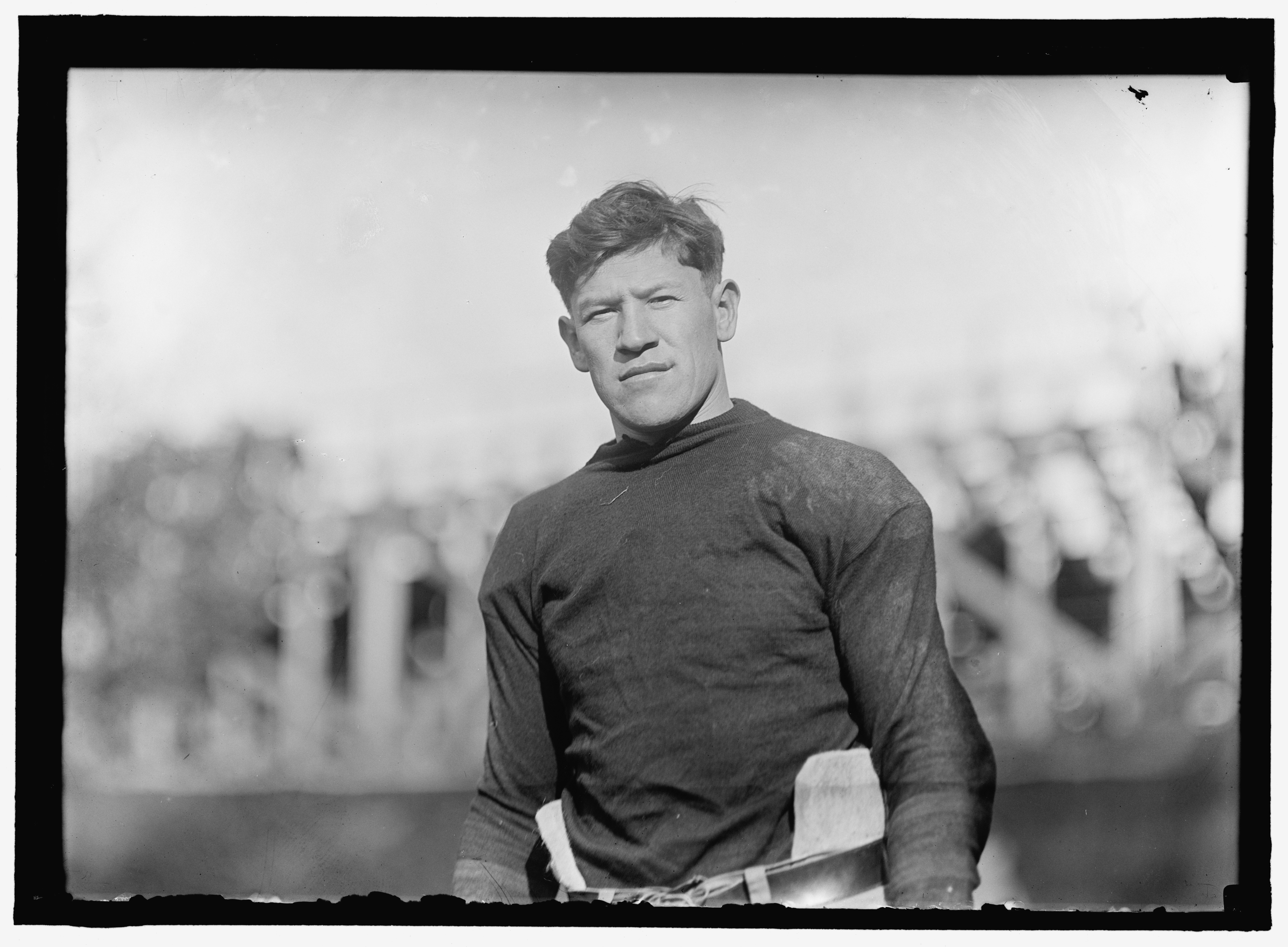
At the University of San Francisco, Matson scored 21 touchdowns as a running back during his senior season and finished top-10 in the Heisman Trophy voting. He went on to play for four NFL teams, starting with the Chicago Cardinals. He’s in the Cardinals’ Ring of Honor, as he made the Pro Bowl in each of his six seasons with the franchise. He’s also in the Philadelphia Eagles’ Hall of Fame. Matson wrapped his football career with the Eagles, scoring the final 10 of his 73 total touchdowns in Philly. Before all of that, he competed in the 1952 Summer Olympics in Helsinki, Finland, and won silver in the 4x400 relay and bronze in the 400.
Glenn Davis (1956, Melbourne; 1960, Rome): Sprinting
Davis won gold in the 400-meter hurdles at the 1956 Melbourne Olympics. Four years later, at the Summer Games in Rome, he added two more of those medals to his collection, taking first place in the 400-meter hurdles as well as in the 4x400 relay. Davis starred at Ohio State, where he became an eight-time Big Ten champion. He ended up playing pro football up north for the Detroit Lions. Davis spent two seasons as a receiver with the Lions.
Bob Hayes (1964, Tokyo): Sprinting
Like Carter, Hayes won an Olympic medal and a Super Bowl. Unlike Carter, though, Hayes won gold. Twice. Nicknamed “Bullet,” Hayes tied the then-world record in the 100-meter dash, finishing first with a time of 10.05 seconds. Plus, he brought home the 4x100 relay team, which crossed the line at a world-record 39.06. Hayes’ relay split was a jaw-dropping 8.6, as reported by ESPN. The Dallas Cowboys took a chance on the track star in the seventh round of the 1964 draft.
Teams had to adapt to account for his speed, shifting into zone defenses that are common in today’s game. He recorded at least 1,000 receiving yards and 12 touchdowns in each of his first two seasons. Over the course of his football career, all but one season of which he played for the Cowboys, he averaged 20 yards per reception, and he clocked out with 71 scoring grabs. Hayes was a three-time All-Pro and played a part in the Cowboys winning it all during the 1971 season. But, perhaps because of his struggles with drugs and alcohol, he wasn’t enshrined into the Pro Football Hall of Fame until he made it posthumously in 2009.
Sam Graddy (1984, Los Angeles): Sprinting
Before James Jett (see below) donned both the silver and black of the Raiders and Olympic gold, Sam Graddy donned them too. Graddy qualified for the 1980 Olympics, but because the U.S. boycotted the Summer Games in Moscow to protest the Soviet Union’s invasion of Afghanistan, he didn’t race on that stage until 1984. Still just 20 years old at the time, Graddy was coming off a 1983 NCAA title in the 4x100 relay, which he won while starring in track at Tennessee.
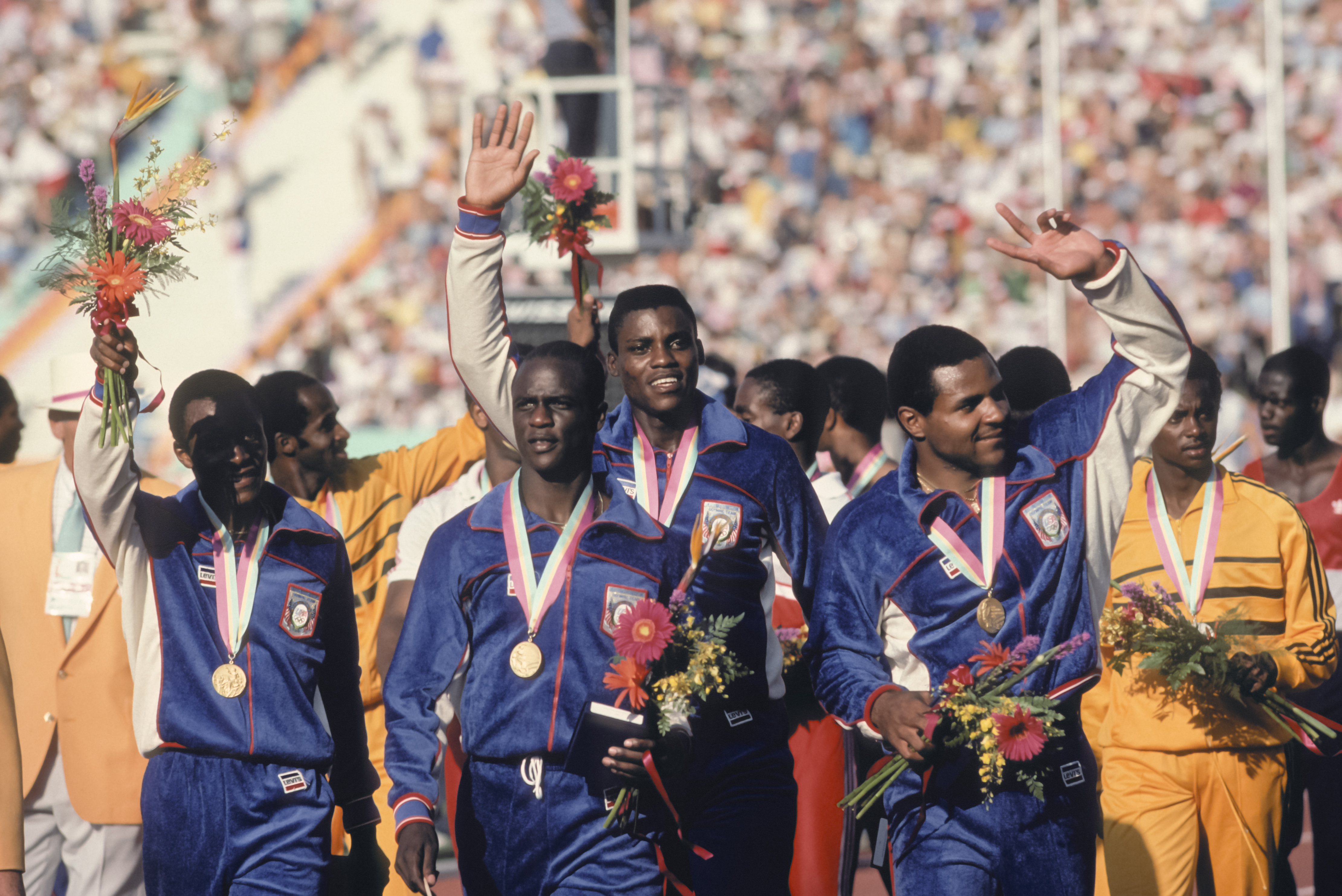
In Los Angeles, during the 1984 Summer Games, he won gold in the same event. He also took home a silver medal in the 100-meter dash, finishing only behind track legend Carl Lewis. Graddy ended up back in L.A. Memorial Coliseum in his career with the Raiders, where he was a receiver and return specialist from 1990-92. He also played two seasons for the Broncos.
Ron Brown (1984, Los Angeles): Sprinting
Brown was also part of that 4x100 relay team that won gold in the 1984 L.A. Olympics. Not only did he and Graddy help break a world record in that race, but they were once again teammates with the Raiders during the 1990 season. A dual-sport standout at Arizona State, Brown perhaps fittingly made an impact on both sides of the ball on the gridiron. He had seven interceptions over his first three seasons as a DB and then caught four touchdowns as a wide receiver his senior year. Meanwhile, he broke the school’s 100-meter record in 1981.
Three years later, at the U.S. Olympic Trials, he finished third in that event, behind Lewis and Graddy. That set the stage for Graddy handing him the baton in their record-breaking relay in the Summer Games. The Cleveland Browns drafted Brown in 1983, but he didn’t report to them while training for the Games. So the Rams, then in Los Angeles, picked up the rights to his contract. In 1985, Brown’s second season with the Rams, he scored six touchdowns — three as a receiver and three as a kick returner — earning All-Pro honors as a result.
Michael Carter (1984, Los Angeles): Shot put
Carter medaled in shot put in the 1984 Los Angeles Olympics, winning silver. That same year, the 49ers drafted him in the fifth round, and he collected the first of his three Super Bowl rings and went on to be named All-Pro as a nose tackle four times. After setting the national high school record in the shot put with a throw of more than 80 feet and then winning four indoor and three outdoor NCAA championships in the event, Carter spent nine seasons with the dynastic Niners. He finished his career with 22.5 sacks and, notably, a rumbling, 61-yard pick 6 in the divisional round of the playoffs during the 1990 season.
Willie Gault (1988, Calgary): Bobsled
Graddy credits Gault for recruiting him to Tennessee. They shared that 1983 NCAA championship in the 4x100 relay. Like Graddy, Gault qualified for the 1980 Moscow Games that the U.S. came to boycott. His Olympic dreams were sidelined as he pursued a NFL career as a wide receiver that featured a five-season stint with the Chicago Bears, who selected him in the first round of the draft in 1983. Two years later, he helped the Bears win the Super Bowl during the 1985 season, registering a career-high 577 kick-return yards and 253 receiving yards in the playoffs.
He later played with the Raiders too, and spent the 1990 season on the same team as Graddy and Brown. Gault and speed are synonymous. He found that speed on the track and football field and even in a bobsled. Gault made the 1988 Calgary Olympics as an alternate on the U.S. bobsled team.
Herschel Walker (1992, Albertville): Bobsled
Well into Walker’s 12-season career as an NFL running back, he was recruited to be the top brakeman, or pusher, for the two-man and four-man U.S. bobsled teams for the 1992 Winter Olympics in Albertville, France. In other words, his job was to push the sled as fast as he could for about 50 meters before hopping in and then applying the brakes after the sled crossed the finish line. Following his 1991 campaign with the Minnesota Vikings — who infamously traded for him during the 1989 season while giving up a haul of players and picks that the Dallas Cowboys used to fuel their ’90s dynasty — Walker trained with the bobsled teams. Walker eventually lost his spot on the four-man team. In the two-man competition, Walker’s sled placed seventh out of 46. He and his teammate missed the podium by only a third of a second.
Michael Bates (1992, Barcelona): Sprinting
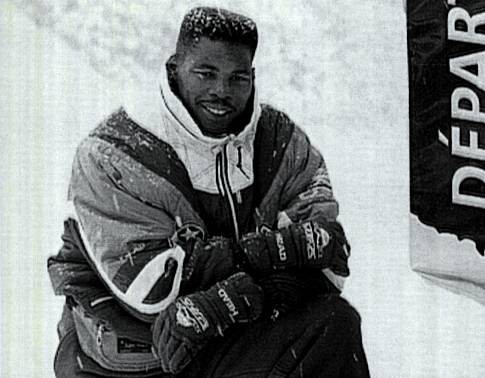
Bates reached the podium that year, winning bronze in the 200-meter dash in Barcelona during the Summer Games. 1992 marked the last time both the Winter and Summer Games were held in the same year. Bates was a highly touted football recruit in Tucson, Arizona. He stayed local and committed to Arizona, where he was a receiver and return man, and where he also became a two-time Pac-10 champion in the 100 meters, 200 meters and 4x100 relay.
Bates pressed pause on his college career to focus on the Olympics. It paid off. He made the U.S. team by beating nine-time Olympic gold medalist Carl Lewis in the 200 during the U.S. Olympic Trials. That paved the way for him placing third in Barcelona. Bates then hit resume on his football journey. The Seattle Seahawks selected him in the sixth round of the 1992 draft. He wound up starring for the Carolina Panthers in their infancy, making five Pro Bowls as a kick returner from 1996-2000.
James Jett (1992, Barcelona): Sprinting
Jett bested Carl Lewis in the U.S. Olympic Trials as well and then won a gold medal alongside him, as they both were part of the U.S. 4x100 team in Barcelona. Despite Jett beating Lewis in the qualifiers and then competing in the opening heats of the event at the Summer Games, his spot in the relay was given to Lewis for the final. That said, the team won gold, and Jett still got his medal.
His athletic feats kept on coming. After Jett impressed as a receiver and perennial track All-American at West Virginia, the Raiders took a flier on the flyer. He hit the ground running in the NFL, beginning a 30-touchdown, 10-season career with three scores and a league-high 23.4 yards per reception. He teamed up with Hall of Fame receiver Tim Brown to give the Raiders a dynamic duo downfield.
Jeremy Bloom (2002, Salt Lake; 2006, Turin): Freestyle skiing
Bloom would have thrived during the NIL era. He doubled as a professional skier and earned freshman All-America honors as a return man at Colorado. But he lost his college eligibility before his junior season after a longstanding battle with the NCAA that stemmed from him accepting skiing endorsements. At the time, NCAA rules permitted athletes to earn salaries as professionals in other sports, except they were prohibited from receiving money from sponsors. Bloom’s appeal was denied, and his Colorado career ended prematurely. In his two seasons, he notched three touchdowns on returns — two on punts and one on a kickoff — in addition to catching 24 passes for 458 yards and a pair of scores.
After his freshman campaign, he participated in the 2002 Salt Lake Games, and, four years later, he took part in Italy’s Turin Games. He finished ninth and sixth in those events, respectively. But over the years, Bloom won 12 World Cup events and three World Cup titles. The Philadelphia Eagles scooped him up in the fifth round of the 2006 draft. He spent that season with the Eagles but on injured reserve. Then he was with the Pittsburgh Steelers in 2007 and 2008. While Bloom never appeared in a regular-season NFL game, his dual stardom carving up moguls and the football field was unforgettable.
Marquise Goodwin (2012, London): Long jump
Leading up to Goodwin’s senior season on the Texas football team, he finished 10th in the long jump at the 2012 London Olympics, falling short of a medal round he seemed destined for after he leaped 8.33 meters at the U.S. Olympic Trials. That jump was longer than the one that ultimately won gold in that year’s Olympics. Goodwin had also won the NCAA outdoor championship that spring with an 8.23-meter jump.
The following year, he ran a 4.27 in the 40-yard dash at the NFL Combine, and the Buffalo Bills drafted him in the third round. Goodwin played 10 NFL seasons, most notably recording 1,006 yards from scrimmage for the San Francisco 49ers in 2017. He continued his track career too, though he didn’t qualify for the Olympics again.
Nate Ebner (2016, Rio de Janeiro): Rugby sevens
Rugby sevens debuted in the 2016 Rio Olympics. Ebner, a Super Bowl-winning special teamer for the New England Patriots at the time, scored a try in the group stages against Fiji, which eventually won gold that year, as well as five years later in the Tokyo Olympics. Ebner dedicated his NFL offseason in 2016 to training for rugby sevens, the sport he grew up playing and starred in before trying his hand at football. When he was just 17 years old, he became the youngest player to compete for the USA Sevens team.
At Ohio State, the Columbus-area native walked onto a football team full of former blue-chip recruits. He ended up earning a scholarship. Despite playing sparingly on defense as a DB, he was a special-teams menace for the Buckeyes. That’s why the New England Patriots took him in the sixth round of the 2012 draft. He replicated his success in that phase of the game at the next level, where he won three rings with the Patriots. The second one arrived after Rio, during the 2016 season, which also saw him earn second-team All-Pro honors.
Honorable mention: Renaldo Nehemiah
Although Nehemiah never made it to an Olympic Games, he would have in 1980. As was the case with others on this list, he lost his chance to participate in the Moscow Games when the U.S. boycotted them. But it’s still important to remember his accomplishments, especially because he was part of the 49ers’ second of four Super Bowl champions in the ’80s. Nehemiah set the world record in the 110-meter hurdles three times between 1979-81. But after catching 43 passes and four touchdowns in three seasons with the Niners, his amateur status was gone, meaning he couldn’t try his hand at another Olympics. Nevertheless, he resumed his track career.
