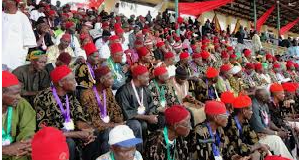
…Anambra, Enugu govts direct monarchs to get clearance before chieftaincy conferment
…They are overstepping their bounds —Abia monarch
…We intervene if conferee has questionable character —Chairman, Imo monarchs
…Govt has no business in chieftaincy conferment —Okolo
By Jeff Agbodo, Ukwueze Alumona, Emmanuel Iheaka & Chimaobi Nwaiwu
ENUGU—Should Igbo traditional rulers seek permission from their state governments before conferring chieftaincy titles on individuals they deem deserve to be so honoured? Some state governments in South-East have directed traditional rulers to get clearance and approval from the Ministry of Local Government and Chieftaincy Affairs, which supervises their affairs, before conferring a title on any individual, particularly a person outside such a monarch’s immediate community. The issue has raised concerns among some traditional rulers and Igbo leaders who see the idea as an interference on the rights and privileges of the traditional rulers.
Specifically, the Anambra and Enugu State governments have given such a directive to traditional rulers in their states. They are directed to submit names of potential conferees to the government for profiling and approval before going ahead to honour such individual. But the monarchs themselves and their colleagues in other states of the region seem not to be comfortable with the directive.
In fact, the Anambra Government made the directive part of the extant laws guiding the conduct of the traditional institution in the state. Although the State Commissioner for Local Government, Chieftaincy and Community Affairs, Tony Collins Nwabunwanne, admitted that the conferment of chieftaincy titles in the state is the exclusive prerogative of recognised/certified traditional rulers in their respective communities, he said they would confer such titles only to residents/indigenes of their communities.
He explained, however, that in the case of a person from outside of such community, the approval of the traditional ruler of the potential conferee’s community and the Commissioner for Local Government must be sought and obtained. He insists that this is in line with the State’s extant Traditional Rulers’ Code of Conduct.
Asking monarchs for such clearance is unacceptable —Enachioken Abiriba
Prominent Abia traditional ruler, the paramount traditional ruler of Abiriba Ancient kingdom, HRM Eze Kalu Kalu Ogbu (Enachioken Abiriba), frowns at the directive. He sees it as unnecessary meddlesomeness in the affairs of traditional rulers. According to him, monarchs have genuine reasons for considering bestowing an honour on someone, and they are usually very carefully scrutinised and selected together with members of the monarch’s cabinet. It is not a political selection.
Eze Ogbu described the directive as dictatorial and an unnecessary encroachment into the rights of the traditional institution as custodians of culture and tradition.
The monarch, however, said he was not surprised that such a draconian directive could come from Anambra State, which he alleges is known for so many bizarre things.
He said, “So many bizarre things are happening in Anambra, and I am not surprised that something like this will also come out from that place. I am not surprised at all. They are trying to overstep their bounds. They should know their limits. That is too much.
“Anambra State does not belong to the Governor. It belongs to the people of Anambra State, and the people are the ones who are headed by the traditional rulers. Even the Governor is a member of a community where an Igwe exists. So, assuming that you can talk to an Igwe in your place anyhow, you can also talk to the Igwe of other communities anyhow. It is unfortunate. It is unacceptable.
Get clearance before conferring chieftaincy titles —Enugu Govt to monarchs
Enugu State Government has also mandated traditional rulers in the state to get clearance from the Ministry of Local Government, Rural Development and Chieftaincy Affairs before conferring chieftaincy titles on individuals in the state.
In a letter signed by the Commissioner, Ministry of Local Government, Rural Development and Chieftaincy Affairs, Deacon Okey Ogbodo, and copied to all the chairmen of traditional rulers in the 17 local government areas in the state, as well as to the Chairman, Enugu State Traditional Rulers Council, HRM, Igwe Samuel Ikechukwu Asadu, the Government mandated traditional rulers to submit names, addresses and detailed curriculum vitae of a potential conferee to the office of the Commissioner, at least one month to the date of the proposed conferment of such title.
According to the Commissioner, this would enable the government to run due diligence and conduct security profiling on the proposed awardee. The letter further stated that the government took the step in order to forestall conferring chieftaincy titles on individuals with questionable public image.
Ebonyi monarchs confer chieftaincy titles without interference —Commissioner, monarch
However, in Ebonyi State, the law establishing the traditional institution allows a traditional ruler to confer a chieftaincy title on deserving persons without government’s interference.
The commissioner for local government and chieftaincy affairs, Chief Uchenna Igwe, affirmed that traditional rulers in the state can confer chieftaincy titles on any deserving individual without government interference.
“The traditional rulers have the power to confer chieftaincy title to anyone they deem fit, maybe someone who brings development to the community; somebody who has been known for his philanthropic gestures, somebody who has good character and has, in one way or another, contributed to the development of the community.
“The traditional rulers in the state can also confer a chieftaincy title on someone from outside his community, just like a traditional ruler in Enugu State conferred a chieftaincy title on our Governor, Chief Francis Nwifuru. So, Ndi Eze and Ezeogos have the right to do that without any interference from anybody,” Igwe stated.
Similarly, the traditional ruler of Nkaliki Unuhu Echara autonomous community, Ezeogo Sunday Oketa, confirmed this. He said they were given free rein to honour deserving citizens of any part of the country without government directives or approvals.
Oketa said those who were given a title in the community were nominated in the cabinet meeting, discussed and approved after looking at such persons’ pedigree and achievements.
“We don’t give a chieftaincy title anyhow in my community. We consider so many things such as the person’s achievements, character and developments attracted to the community. So, these qualifies someone to be given a chieftaincy title in my kingdom.
“We don’t give a chieftaincy title based on the money you have, but on what you have used the money to do for the community. You may be wealthy, going with convoys, but have not used the money to impact the community, no title for you. We can give a title to a farmer in the village who uses his farming to positively affect the lives of the people or have contributed to the community’s development.
“So, it is a community affair, not a government affair, because it is the traditional rulers who are closer to the people to know who merits a chieftaincy title. We can seek the opinion of a government appointee in my community if necessary, but not to take permission from him”, Ezeogo Oketa explained.
We intervene when conferee has questionable character —Eze Okeke
In Imo State, the Chairman, South-East Council of Traditional Rulers, Eze Emmanuel Okeke, said the monarchs’ Council in the state intervenes when the potential recipient of such a chieftaincy title is suspected to be of questionable character.
Eze Okeke, who doubles as the Chairman of the Imo State Council of Traditional Rulers and Community Policing, noted that it becomes a thing of concern when the monarch giving the title didn’t consult the royal father of the person receiving it. He said that a monarch is authorised to confer traditional titles on not more than three persons at a time, except in a peculiar situation.
“It depends on who is receiving the chieftaincy title and his relationship with his community. If the person has a questionable character and decides to take a chieftaincy title from another community, more so, a neighbouring community, it becomes a thing of concern, especially when the traditional ruler giving the title didn’t consult the traditional ruler of the person receiving the title. In such a situation, the person’s community might be angry, and we may intervene to address the situation.
“In Imo State, an Eze is authorised to confer traditional titles on not more than three persons at a time, and he is required to forward the names of the persons to the council. The only condition we allow more than that number is if some villages do not have chiefs to represent them in the community.
“What we have banned is anybody answering Eze outside his community or going by the name Eze Ndigbo’. That is an insult to our traditional institution,” Eze Okeke clarified.
Chief Johnson Okolo, former Chairman of Osakwe Industrial Cluster Awada, Anambra State, rejects such directive, saying it amounts to belittling the traditional institution in Igbo land.
“If the Sultan of Sokoto wants to confer a chieftaincy title on any individual in the country, will he take permission from the Governor of Sokoto State?
The directive is a manifestation of the little respect the South-East governors have for the traditional rulers.
“Since the governments in South-East forced our traditional rulers into politics, they now dictate to them how they live their lives and how they run the affairs of their office and the communities. Until the traditional rulers extricate themselves from the grips of the government and politicians, there will be no peace in Igbo communities.
The greatest disservice done to the traditional leadership is allowing the government to issue them a Certificate of Recognition and a Staff of Office. The government does not have such a right; it is the people, the communities that choose who lead, that should give them the staff of authority, not the government.
“What the whole thing boils down to is that traditional rulers in the South-East are not independent. They are now like slaves to the governors.
“Why will the government decide who a traditional ruler should confer a chieftaincy title on? What business does the government have with who the traditional rulers confer title on? This is shameful if traditional rulers succumb to such intimidation.
“Governments should stop harassing traditional rulers; enough is enough of that insult! Traditional rulers should rise up against such intimidation. It is impacting negatively on Ndigbo. Our traditional rulers do not have respect any more, even among their colleagues in other areas, because of what their governments have reduced them to.
“Can the Edo State Governor or Delta State Governor, and their Commissioners tell the Oba of Benin or the Olu of Warri who to honour with a chieftaincy title? This nonsense and insult to traditional rulers can only happen in the South-East. It is unfortunate. They should resist such intimidation and harassment now, or the little respect they command will soon vanish.
“How can the government dictate who should be given a chieftaincy title? What is in chieftaincy that the government wants to control, just to get at their political opponents? Somebody is helping a community, and the community wants to appreciate him with a chieftaincy title and the government is now demanding to give a license for such an honour to be given to the person. How?
The post Govts, monarchs clash over interference in chieftaincy conferment in Igbo land appeared first on Vanguard News.
