By Moses Effiong
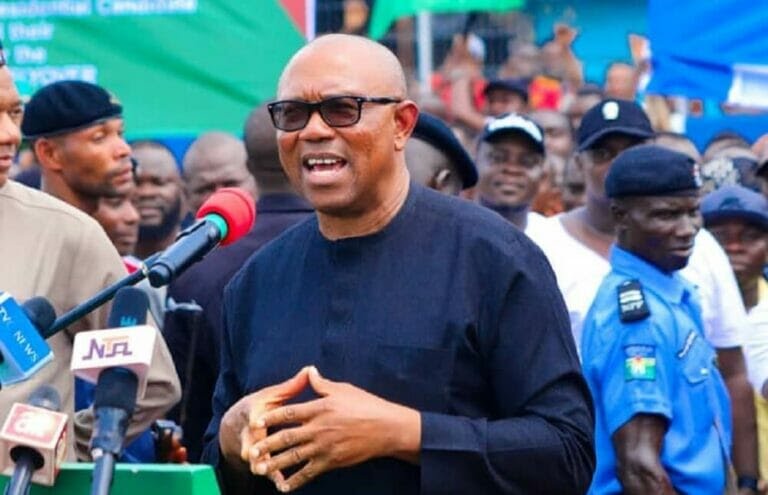
Recent developments in Nigeria’s political scene highlight an undeniable truth: Peter Obi, the 2023 Labour Party standard-bearer, is the individual the ruling All Progressives Congress (APC) and President Bola Tinubu are determined to undermine as we approach 2027. The narrative circulating in political circles is clear—the ruling party aims to leave Obi legally partyless by the conclusion of unfolding events.
Read Also: Today’s posers for ADC!
This deliberate crisis within Obi’s former party was orchestrated with a singular goal in mind. Skeptics may dismiss this view as simplistic, but the facts speak loudly. After Obi left the Labour Party on December 31, 2025, the Independent National Electoral Commission (INEC), which had previously ignored a Supreme Court ruling from April 2025, suddenly changed its posture. On January 21, 2026, an Abuja court, relying on that same Supreme Court ruling, declared that Julius Abure’s tenure had expired and affirmed Dr. Nenadi Usman’s caretaker committee as the legitimate leadership.
The collaboration between INEC and the judiciary has thus been exposed, suggesting that both institutions are executing a script designed to frustrate Peter Obi’s political aspirations. The APC has clearly recalibrated its strategy toward Obi as we move deeper into 2026. What once was a dismissive attitude—branding him merely as a “social media candidate”—has now become a coordinated assault aimed at dismantling every structure that could support his 2027 ambition.
The reason is obvious. Intelligence available to the ruling elite confirms who truly won the 2023 election, even if INEC and the courts declared otherwise. Obi has since emerged as a “Shadow President,” persistently interrogating Tinubu’s policies, exposing security failures, and criticizing economic mismanagement. In Nigerian political discourse, “the fear of Peter Obi” has become shorthand for the APC’s growing anxiety.
This fear has transformed into a full-scale offensive. The ruling party no longer mocks the Obidient movement as “four people in a room.” It now recognizes it as a formidable political force that must be neutralized if power is to be retained in Aso Rock in 2027.
The agenda is to portray Obi as an itinerant politician, incapable of managing a party, let alone governing a nation. Yet his political history contradicts this narrative. Obi has always been guided by principle. Leaving private life for politics, he joined the PDP in Anambra but was frustrated by entrenched interests threatened by his discipline and integrity.
Forced out of the PDP, he joined APGA and won the 2003 governorship election. Though initially denied his mandate, the judiciary then still stood as a bastion of justice and restored his victory. This was at a time when courts upheld democracy, not when they were perceived as extensions of executive power.
Even within APGA, Obi faced resistance because his governance style challenged those accustomed to abusing public funds. Yet he remained firm, insisting that public resources must be used for public good. After serving two successful terms as governor, he sought a wider platform and returned to the PDP, only to be sidelined once again.
Nonetheless, his political relevance could not be erased. In 2019, he emerged unexpectedly as Atiku Abubakar’s running mate, forming the strongest PDP ticket since the party lost power in 2015. Their performance signaled a serious threat to APC dominance.
In 2023, with power zoning favoring the South-East, Obi sought the PDP presidential ticket. When internal resistance became insurmountable, he moved to the Labour Party and ran one of the most impactful campaigns in Nigeria’s history. Though widely regarded as the popular choice, official results placed him third, a decision many Nigerians still contest.
Today, Obi is no longer just a social media phenomenon; he has become the moral conscience of the nation. The same tactics once used against him in Anambra are now being deployed nationally. The parties that might host him—LP and PDP—are being destabilized, clearly to deny him a stable political base.
His move to the African Democratic Congress (ADC) on December 31, 2025, sent shockwaves through the political establishment. Attention has now shifted to weakening the ADC, just as LP and PDP were weakened before. The APC’s objective is to force Obi into rebuilding from scratch as the primaries approach.
Despite all this, the ruling party remains uneasy. It understands that in a truly free and fair election, incumbency offers little protection against the force Obi represents. If he succeeds in uniting the opposition under the ADC or any viable coalition, 2027 will become a referendum between the Nigerian people and the APC.
In that contest, Peter Obi stands not merely as a candidate, but as the symbol and driving force of a national movement for political renewal.
•Dr. Effiong, a political scientist, writes from Uyo.
The post 2027: Peter Obi remains ruling party’s target appeared first on Vanguard News.
