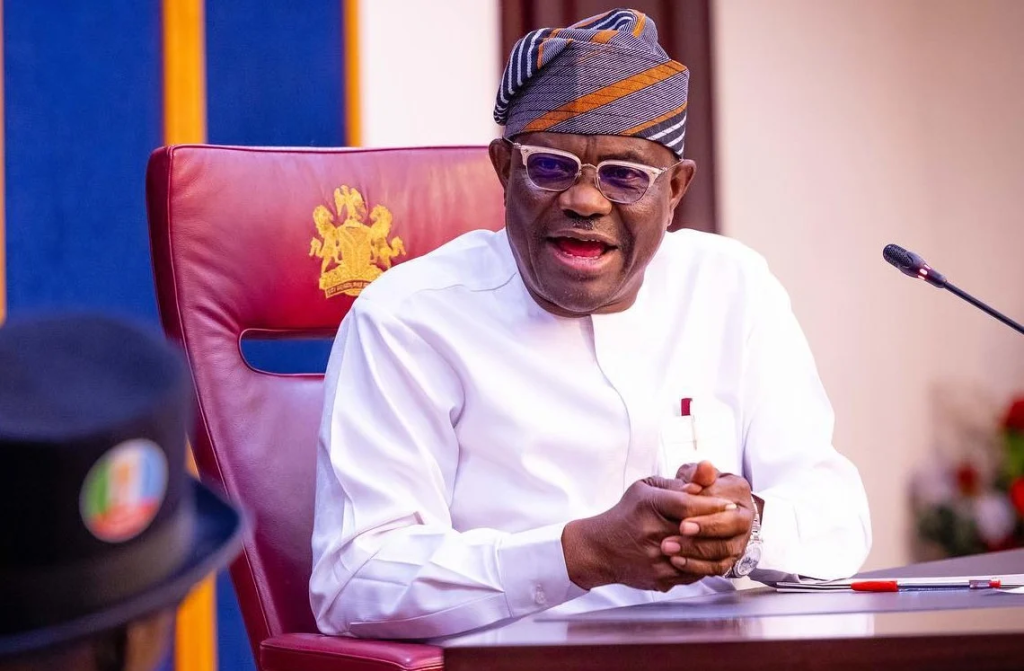
On paper, Nyesom Wike remains a member of the Peoples Democratic Party. In practice, Nigerian politics has long stopped obeying paper. Wike occupies a far more complex and unsettling space, one that exists beyond party boundaries. He is PDP by registration, APC by alignment, and something far more consequential by operation. A former governor who has refused to surrender control to time, office, or democratic transition.

Wike did not simply leave Government House in Port Harcourt. He carried it with him. Rivers State is not struggling with post-transition adjustment. It is contending with the prolonged authority of a man whose influence outlived tenure and reshaped power beyond constitutional limits. His relevance did not fade after leaving office. It hardened, embedding itself in political structures, loyalties, and institutions that were meant to move on without him.
Governor Siminalayi Fubara’s defection to the All Progressives Congress did not create this crisis. It only exposed it. The move was not ideological realignment. It was a survival response within a political environment where authority was already contested. By the time Fubara crossed party lines, the ground beneath governance had long shifted. The defection was not the beginning of the battle. It was an admission that the battle had been ongoing quietly and relentlessly.
Wike’s political structure is not built on shared philosophy or party loyalty. It is built on obedience. His circle is composed not of allies in the democratic sense of partnership, but of loyalists and political dependents whose careers were designed, funded, and protected within a single man’s orbit. That distinction matters because loyalty to a benefactor does not dissolve simply because the benefactor exits office.
This reality finds its clearest expression in the Rivers State House of Assembly. On paper, the Assembly has worn different party colours at different moments. In practice, its allegiance has been far more stable. Most of its members owe their political emergence not to party ideology or independent constituency strength, but to Wike’s political machinery. That origin story continues to shape their behaviour.
This is why the question of where the Assembly belongs has become unavoidable. It is not a legal puzzle. It is a political confession. A legislature that derives its loyalty from a former governor cannot be neutral toward a sitting one, even when both emerge from the same party lineage. The Assembly’s posture toward Governor Fubara did not change because he defected. The defection merely aligned party labels with existing behaviour. Opposition in Rivers is not defined by party arithmetic. It is defined by conduct. A House that obstructs governance not on policy disagreement but on inherited allegiance has already positioned itself.
What makes this moment especially dangerous is the precedent it reinforces. Wike’s continued dominance sends a message that elections are not enough. That attaining office does not guarantee authority. That political power in Nigeria can be retained indefinitely through loyal structures, even after constitutional tenure expires. This is not written in law, but it is increasingly enforced in practice.
Such a system corrodes political parties from within. Parties cease to function as vehicles for collective vision and become instruments for personal leverage. The Peoples Democratic Party in Rivers was not defeated by opposition from outside. It was immobilised by obedience from within. Loyalty to a former governor proved stronger than loyalty to the party’s sitting mandate, and the contradiction became unsustainable.
At the national level, the same logic explains how Wike could openly undermine his party’s presidential candidate, align himself with a rival government, accept a ministerial position, and still retain formal PDP membership without consequence. This is not because the rules permit it, but because Nigerian political culture rewards leverage over consistency and strength over principle. Wike is not an anomaly. He is the most refined expression of a familiar pattern.
But refinement does not make the model healthy. A democracy cannot mature when former governors behave like permanent power centres and sitting governors govern under supervision. Institutions cannot grow when individuals are allowed to overshadow them indefinitely. And voters cannot truly be said to have chosen when their choice remains under contest by the shadow of yesterday’s authority.
Rivers State is therefore more than a local drama. It is a national warning. It shows what happens when loyalty to individuals replaces loyalty to institutions, when political parties become shells, and when governance is trapped between past power and present mandate. One small but telling moment occurred last year when the Assembly publicly rejected a budgetary directive from the sitting governor, citing procedural pretexts but reflecting Wike’s lingering influence, a single act that captured the state’s broader power imbalance.
Governor Fubara’s defection may have changed party configurations, but it did not resolve the deeper question. Who truly governs Rivers State? The constitutionally elected governor, or the former governor whose political architecture still commands obedience? Until that question is answered honestly, stability will remain elusive.
Nigeria must confront this truth. Our political crisis is not defection. It is domination. It is the refusal to let go. It is the belief that power, once held, is never truly surrendered. Until institutions are allowed to stand taller than individuals, we will continue to change parties without changing direction.
Rivers State is simply the loudest mirror. What it reflects is a country still struggling to decide whether democracy belongs to the people or to the men who once ruled them.
The post Does democracy belong to the people or only men in power?, by Stephanie Shaakaa appeared first on Vanguard News.
