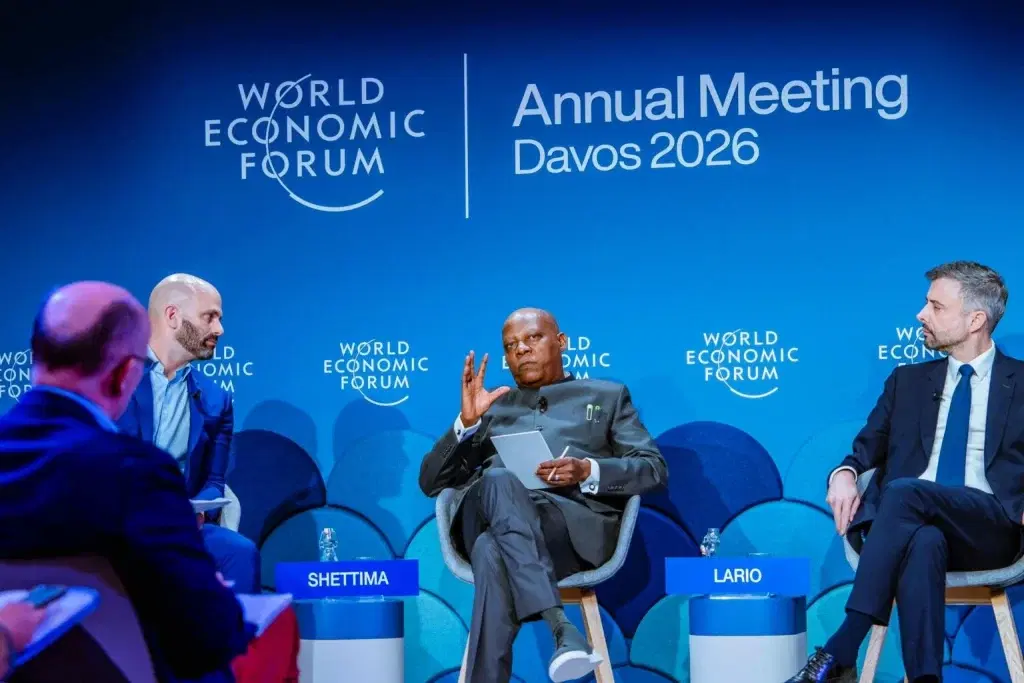
Vice-President Kashim Shettima has advocated home-grown solutions to Africa’s economic problems.
Shettima emphasised the need for innovative approaches for growth, development and prosperity on the continent.
He stated this during a High-level Accra Reset Initiative meeting held on the margins of the ongoing 2026 World Economic Forum (WEF) Annual Meeting in Davos, Switzerland.
Shettima welcomed the vision of the Accra Reset, describing the initiative as a bold reimagining of Africa’s shared future built through African-led cooperation, and rooted in sovereignty and self-definition.
He also said that the initiative was a call to action as well as a call to reset the mindset of African nations, “from dependency to dignity, from aid to investment, from rhetoric to results.
Shettima said, “It is a call to prosper together. And I am confident that if we answer this call, the world will witness an African boom built not on the sands of commodity cycles, but on the bedrock of innovation, industry, and interdependence.”
He stated that it was only by building domestic productive capacity that African nations could convert their population and natural talents into real, resilient wealth.
The vice president said instead of expecting prosperity to be parachuted in, “it must be homegrown and earned.”
He observed that Africa was no longer the periphery but the pulse of the world’s demographic and economic future.
Shettima, who cited Nigeria where the Dangote Refinery is gradually turning the nation into a major exporter of fuel as an instance, pointed out that Africa can only rise when countries on the continent build.
He added, “Africa cannot rise on applause alone. We rise when we build. After decades as a net importer of value, Nigeria is on the verge of becoming a net exporter of refined fuel, powered by Africa’s largest refinery in Lagos, Nigeria: the Dangote Refinery.
“This is what happens when African capital meets industrial ambition. This implies that Nations move from price takers to value makers when production is matched with infrastructure and policy clarity.
“Even as manufacturing’s share of Africa’s GDP fell from 16 percent in 1980 to under 10 percent by 2016, we chose not to retreat but to leapfrog.”
The vice-president underscored the benefits of modular factories, artificial intelligence, and robotics.
According to him, Africa can industrialise faster in the twenty-first century than ever before,” just as he said the era when the continent is “known only for what it digs or grows” is now giving way for the era when Africa is known for what it builds.
He recalled that “in 2024 alone, Africans abroad sent home about 95 billion dollars,” more than five per cent of our GDP and roughly equal to total foreign direct investment.
”That is not charity. This is why we are also championing free movement across Africa because mobility is a competitive advantage in a world where human capital is the most precious resource.
”Let skills and ideas flow as freely as goods and capital, and prosperity will follow,” he added.
Shettima maintained that the experience had been shaped by a simple lesson, that “prosperity is not imported; it is built,” adding that the nation has “seen the prosperity paradox up close.”
”Markets and talent exist, yet resilience remains thin until demand is translated into domestic capability.
”This means firms that produce, meet standards, and compete globally. Wealth given from outside is fragile. Wealth created from within is enduring.
“Nigeria’s own market of over 200 million people has taught us that latent demand means little unless we cultivate local supply.
”Only by building domestic productive capacity can we convert our population and natural endowments into real, resilient wealth. Prosperity cannot be parachuted in – it must be homegrown and earned,” Shettima said.
President John Mahama of Ghana explained that the introduction of the Accra Reset Initiative at the last United Nations General Assembly in New York was not another declaration or a wish list.
He said, “But a practical answer to a question millions of young Africans are asking about the continent’s future and response in changing global order.”
The president called for synergy and cooperation among African leaders, saying “though no specific name has been coined for the new global system that will emerge.
He added, ”Africa intends to be at the table in determining what that new global order will look like.”
Former President Olusegun Obasanjo dwelt on what Africa required to take its rightful place in the comity of nations, given the “new age of disruption, uncertainty and unpredictability.”
”The Accra Reset Initiative has come to inspire leaders to stop complaining about the system that has changed or is changing, and to build a way through it,” the former president added.
Former Vice President, Prof. Yemi Osinbajo, said that the essence of the forum was to galvanise support for governments in Africa to rethink their strategies for transforming economies and address challenges confronting the people. (NAN)
The post Dangote refinery to make Nigeria net exporter of refined fuel – Shettima appeared first on Vanguard News.
