
Archaeologists recently found the wreck of an enormous medieval cargo ship lying on the seafloor off the Danish coast, and it reveals new details of medieval trade and life at sea.
Archaeologists discovered the shipwreck while surveying the seabed in preparation for a construction project for the city of Copenhagen, Denmark. It lay on its side, half-buried in the sand, 12 meters below the choppy surface of the Øresund, the straight that runs between Denmark and Sweden. By comparing the tree rings in the wreck’s wooden planks and timbers with rings from other, precisely dated tree samples, the archaeologists concluded that the ship had been built around 1410 CE.
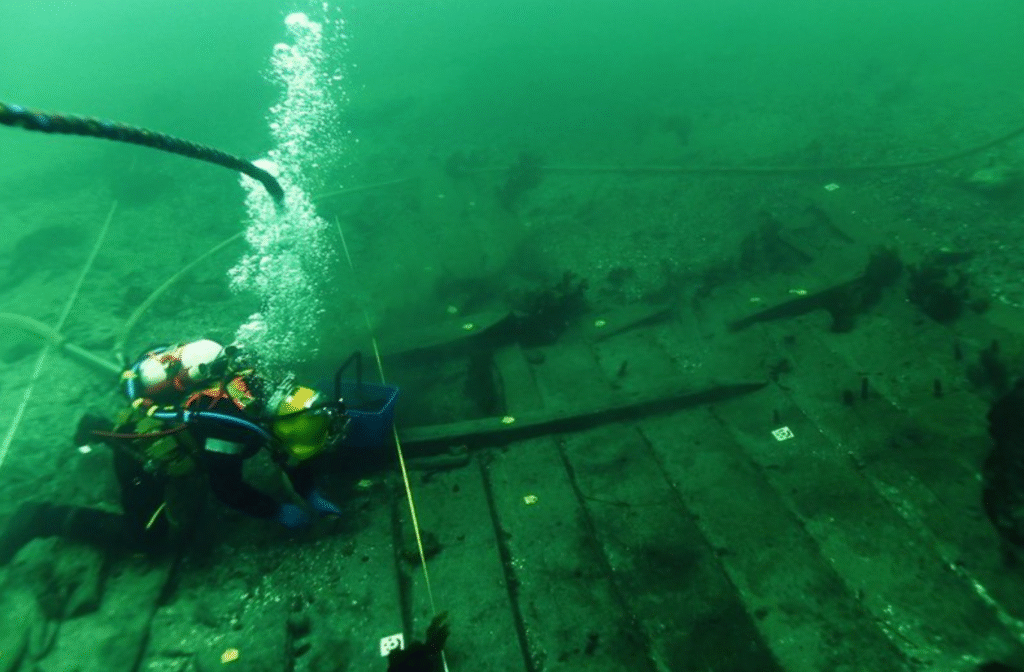 The Skaelget 2 shipwreck, with a diver for scale.
Credit:
Viking Ship Museum
The Skaelget 2 shipwreck, with a diver for scale.
Credit:
Viking Ship Museum
A medieval megaship
Svaelget 2, as archaeologists dubbed the wreck (its original name is long since lost to history), was a type of merchant ship called a cog: a wide, flat-bottomed, high-sided ship with an open cargo hold and a square sail on a single mast. A bigger, heavier, more advanced version of the Viking knarrs of centuries past, the cog was the high-tech supertanker of its day. It was built to carry bulky commodities from ports in the Netherlands, north around the coast of Denmark, and then south through the Øresund to trading ports on the Baltic Sea—but this one didn’t quite make it.


