…Seek urgent return to plural, federal constitution
…Tinubu, Sanwo-Olu, Osoba, others fete Opadokun
By Clifford Ndujihe, Osa Amadi, Wahab Adesina, Olayinka Ajayi & Henry Obetta
Sixty years after the January 15, 1966, aborted coup, eminent Nigerians, yesterday, reflected on the incident that they said had changed the course of Nigeria’s socio-economic and political development and urged a quick return to fiscal and true federalism to save the country.
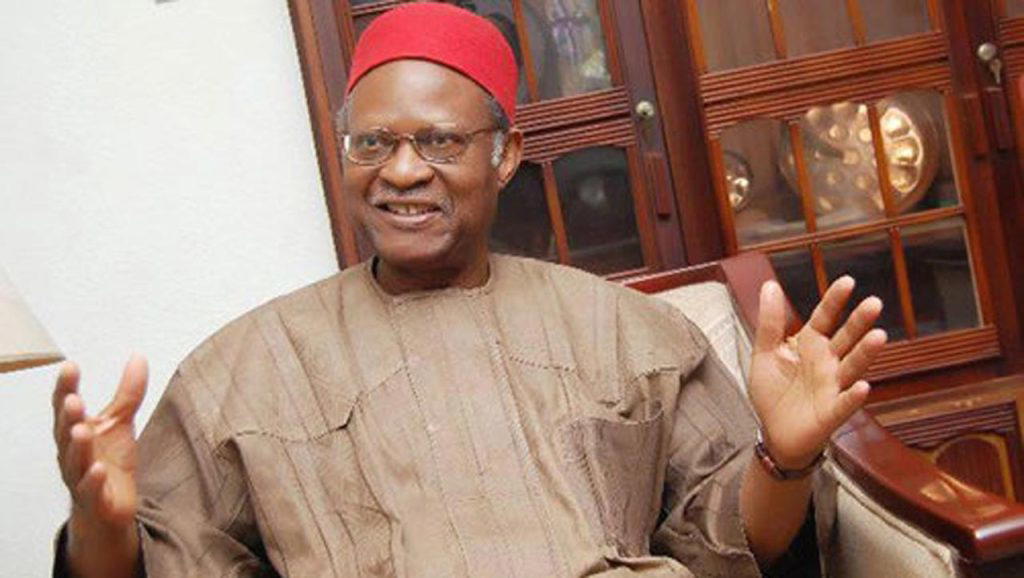
Eminent personalities and elder statesmen, who shared this view included former Commonwealth Secretary General, Chief Emeka Anyaoku; Chairman and Publisher of Vanguard Newspapers, Uncle Sam Amuka, Catholic Bishop of Sokoto Diocese, Mathhew Hassan Kukak, and National Democratic Coalition, NADECO, Secretary, Chief Ayo Opadokun among others.
They spoke in Lagos at the launching of Opadokun’s new book: ‘The Gun Hegemony’.
Other speakers include Sam Omatseye, the reviewer, who was represented by Prof. Sylvester Odion Akhaine, and Pa JK Randle.
Aside proffering suggestions on the way forward for Nigeria, speakers at the packed Agip Recital Hall, MUSON Centre heaped plaudits on Opadokun for his sacrificial contributions to the battle against military rule that led to the return of democracy in 1999.
Other dignitaries at the event include President Bola Tinubu, who was represented by his chief of staff, Mr Femi Gbajabiamila; Lagos Governor Babajide Sanwo-Olu, who was represented by the Attorney General, Mr Lawal Pedro, SAN; Pa JK Randle; Senator Gbenga Daniel; Aremo Olusegun Osoba; Otunba Niyi Adebayo; Chief Supo Shonibare; Dr Muiz Banire, SAN; Prof. Adebayo Williams; Prof. Ralph Akinfeleye; Mr Jimi Agbaje; Dr Kunle Adegoke, SAN; Dr Fred Agbeyegbe, and Chief Patrick Doyle.
There were also Prof. Itse Sagay,SAN, Senator Niyi Adegbonmire, Olori Victoria Haastrup, Mrs. Jumoke Anifowoshe, Mrs Dupe Adelaja, Chief Turner Ogboru, Mrs Irene Abiola, Mr. Opeyemi Agbaje, Chief Emeka Ugwu-Oju, and Senator Olorunnimbe Mamora, among others.
Nigeria’ll work if constitution reflects its pluralistic nature — Anyaoku, Sam Amuka
Uncle Sam Amuka, who chaired the occasion, said the use of gun as a coercive tool “is not only affecting the way we live but directing it.
“This book, for any Nigerian born over 60 years ago, is a detailed account of Nigeria’s political governance. For many of us over 60 years, it is a recording of the political journey we have witnessed. The Gun Hegemony is changing the rules the world over. Recently, we saw what gun hegemony can do with the capture of President Nicola Maduro of Venezuela and his wife in their bedroom by somebody I call the President General of the Universe.
“It showed power in its raw nakedness. For those of us over 60 years old, we know there was life before the gun hegemony. At one time, we had three high commissioners in the United Kingdom, but the gun hegemony has changed that. The earlier we realize certain things the better for us. If we call Nigeria a federation, the political system should reflect and manifest that. There is a need for us to agitate for another constitution for Nigeria that will represent the realities on ground; one that will take into account that we are a federation,” he opined.
In his remarks, Anyaoku toed and amplified Uncle Sam’s views, noting that nations, which are pluralistic in nature and hinge their political and economic growth on constitutions that reflect such, are thriving and others who fail to heed such have either stagnated or disintegrated.
His words Emeka Anyaoku narrated how members of NADECO used to visit him in his London home: “Ayo Opadokun is a stalwart for the promotion of democracy. And our Chairman of today (Uncle Sam Amuka) spoke about Nigeria before the military intervention in governance. I am old enough (the oldest in the hall at 93). So I will readily support what our Chairman said about Nigeria before the intervention of the military. Then, Nigeria was a progressive country. The Premiers of the four regions of the country we had were developing their regions.
“In the North, Sardauna of Sokoto was developing the region with revenue from groundnut pyramids, hides and skins that was of such quality that it was marketed abroad as Moroccan leather, and tin from Plateau State. Sardauna of Sokoto was keen on the development of the Northern region.
“And then, in the Western region, Chief Obafemi Awolowo performed the miracle of the education revolution. And he was the first to bring the television to Africa. And he did all that from revenue from cocoa. At that time, Nigeria was called the world leading cocoa producer.
“And in the Eastern region, Dr. Michael Okpara was developing the Eastern region, which was one of the fastest growing economic units in the world. And he did all that with revenue from palm produce. Nigeria was then the largest producer of palm produce in the world.
“In the Mid-West, Dennis Osadebe was developing the Mid-West region with revenue from rubber. The Mid-West was producing such quality rubber that the major tyre manufacturing companies such as Dunlop were attracted to Nigeria. But all that story has changed since the military intervened in politics and governance of our country.
“So, I have been, since I retired and relocated back to Nigeria, a strong advocate of a new constitution – a new truly federal constitution for Nigeria. And my reason for doing so is that Nigeria is a pluralistic country. Nigeria is not the only pluralistic country in the world. The world has a number of pluralistic countries. Those pluralistic countries that survived as individual political entities have been countries that have truly federal constitutions. You think of India. India has survived (for many years) because of its true federal constitution. Modern day Canada survived because of its constitution. You think of Switzerland which has also survived because of its true federal constitution.
“And those pluralistic countries that have disintegrated have done so because they refused to have a truly federal constitution. You think of Yugoslavia that broke up into seven states. You think of Czechoslovakia that peacefully separated into two states. And the USSR that broke up as many countries as I cannot readily remember. And nearer home in Africa, Sudan broke up into two countries – all because they refused to have a constitution that is in sync with the nature of their populations.
“And in Nigeria, the pluralism of Nigeria is beyond debate, because Nigeria is a country brought together by the Europeans when they met in Berlin in 1884-1885 and carved up Africa into different areas of European domination and interest. And then, we in Nigeria, actually became Nigeria only a little over 100 years ago, in 1914…. The people of Nigeria lived in their separate areas, separate cultures, and now we have different religions. And I believe that the only way Nigeria can be made to work is to have a constitution that reflects the pluralism of the country. And so I hope that the agitation for a new people democratic constitution…. I hope this agitation will succeed.”
Good governance’s antidote to coup — Kukah
Bishop Kukah, who spoke virtually, warned Nigerians against falling into the temptation of thinking that military government is the solution to Nigeria’s problem. He said irrespective of that, good governance is the only antidote to autocratic rule.
Tinubu, Sanwo-Olu fete Opadokun
President Bola Tinubu, who was represented by his Chief of Staff,. Femi Gbajabiamila, described the book as an act of love for our beloved nation.
“Its submissions are not theoretical but from the personal experiences of the author. He played many roles during the worst days of military rule as the Secretary of NADECO. I am sure that readers would learn a lot from many things that happened behind the scenes that the author has brought to public knowledge now,” he stated.
Lagos State Governor, Mr Babajide Sanwo-Olu, represented by the Commissioner for Justice, Mr Lawal Pedro, described the book as a gift by Opadokun to Nigerians, as he has drawn attention to the need to protect democracy being enjoyed now and which some fought with their lives to see manifest in the country.
Nigeria’ll not be what it is today if not for military intervention — Opadokun
Also speaking, author of the book, Ayo Opadokun, recalled how Uncle Sam Amuka, as the Editor-in-Chief of Punch Newspaper, accepted the scientific opinion poll he and Prof Idowu Sobowale initiated, when no other newspaper was ready to give them a chance.
The author also revealed that there are many novel things in the book which haven’t been written before. For instance, he said, no one has ever linked Odumegwu Ojukwu with the coup. “But in the book, you will see evidence that linked Ojukwu with the January 15, 1966 coup.”
Going into the details of the book, he said: “There are pages in the book that readers would be coming across for the first time. For instance, nobody has ever linked the late Col Odumegwu Ojukwu with the coup of 15th January, 1966. “But you will see in the account of this book concrete evidence not hearsay.”
Lamenting the rot caused by long years of the military and their appointees and the challenge before President Tinubu, he said: “You can blame President Tinubu for anything in the world, the military governed for 13 years in their first coming that is 1966 to 1979. In their second coming, they governed for 15 years. When we forced them to go back to the barracks, they imposed their commander-in-chief on us again, namely Chief Olusegun Obasanjo and late Gen. Muhamadu Buhari. They spent eight years each, that is 13 plus 15 plus eight, plus eight, that is 44 years. Alhaji Aliyu Shehu Shagari was the Minister of Works in the First Republic and when Obasanjo was going to hand over, he handed over to Shagari.
“Obasanjo knew that late Umaru Yar’Adua was challenged but he had ulterior motives for choosing him as successor.”
Also, if you add the years Yar’Adua, Jonathan and that of Shagari it is 13 years; 13 plus 44 years is 57 out of 66 years of independence. When they have ruled for such a long while, they have established a structure, including their surrogates, loyalists and sympathisers and entrenched them into the system. If the Army had not intervened in the affairs of Nigeria, the story of Nigeria would not be what it is today.”
The post The Gun Hegemony: How military incursions arrested Nigeria’s growth — Anyaoku, Amuka, Opadokun appeared first on Vanguard News.
