Fyodor Lukyanov: Trump’s Venezuela move may have just earned him a Nobel Peace Prize
Published 1 day ago
Source: rt.com
In a world where wars solve nothing, Trump’s brand of pressure politics may be the closest thing to modern peace
If there were an award for Most Unfulfilled Personal Wish of the Year, Donald Trump would be the runaway winner. His desire to receive the Nobel Peace Prize has been so overt – and his actions so clearly aligned with that goal – that the disappointment is palpable. Eight wars stopped (by his own count), a ninth supposedly in the works – all in less than a year. Has there ever been anything like it in world history? Exactly. And still no prize. Damn liberals.
Trump’s vanity is an easy target for irony, but in fairness, one point deserves acknowledgment. Thanks to this politician, the notion that war is abnormal – unnecessary, even – has been constantly present in the public discourse. Why he personally needs this is beside the point. Even given the fact that while rejecting full-scale wars, Trump is more than comfortable with muscle-flexing, shows of force, and its selective application.
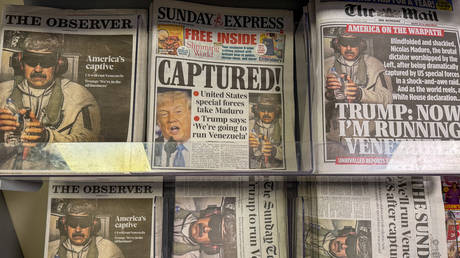
The mass casualties and destruction inherent in traditional warfare strike a New York real estate developer as simply pointless. There are other ways to compete and to coerce counterparts into agreements. Yes, they are often blunt, inelegant, and abrasive. But they are far less traumatic for states and societies. And that alone makes them preferable – everything is relative, after all. Even the outrageously brazen operation to seize Venezuela’s president, complete with strikes on military targets, turned out to be relatively precise and only moderately bloody.
Of the eight wars Trump claims to have stopped, some had nothing to do with him at all (the spring clash between India and Pakistan, for instance, or the oddly tacked-on cases of Egypt and Ethiopia), while others, predictably, did not actually end after Washington proclaimed yet another ‘lasting peace’. Trump does not resolve the underlying causes of conflicts; they simply do not interest him. What he tries to do – sometimes successfully – is to contain their most violent manifestations.
Why does this matter? A couple of decades ago, military force was written off as an anachronism. The assumption was that in a globalized world, ‘normal’ states no longer relied on such primitive tools. And yet force has returned to center stage in international affairs. The illusions of the turn of the century – sincere for some, performative for others – have dissipated. Countries have once again turned to the most familiar method. All the more so because not everyone disarmed even during the era when international relations were supposedly being ‘economized’. And with the decline of the ‘liberal world order’, many states exhaled in relief – doing things the old way is simply clearer. Meanwhile, the fear of a war that could be final and all-destroying has noticeably faded over the years of globalization.
But the idea that this means a simplification of international interaction is yet another illusion. War itself has changed, and past experience with armed conflicts applies only in limited ways to today’s reality. The most brutal and destructive element remains direct military confrontation between armies, often fought in cities. But it is far from the only component – and often not the most important one. The term ‘hybrid war’, commonly used to describe modern conflicts, is vague and imprecise, but in the absence of a better concept, it will do. It encompasses everything: economics, social structures, information in its many contemporary forms, and technologies of political control. The disruptive impact of each of these ‘non-standard’ components on a country’s overall capacity can exceed that of conventional combat operations.
The danger of hybrid war lies in the way it corrodes the foundations of almost all interaction, because it turns everything into a weapon – including diplomacy, which is supposed to rest on a baseline of trust. Trust in agreements reached with an adversary. In an era where the information environment is not only distorted but also total, it is increasingly unclear what can serve as a reliable point of reference at all.
This is a dangerous condition – one that fuels further fragmentation of the world, no longer even along bloc lines, but in a chaotic fashion. Hence the low predictability of conflicts. They start with one issue and then morph into a bundle of disparate, sometimes unrelated storylines that nonetheless catalyze and entangle one another. By now, everyone understands that interdependence – once seen as a guarantee of stability – has turned into something close to a mutual threat.
This inevitably raises the question: Does war actually achieve the goals for which it is launched? Of course, there have been, are, and will be contradictions that cannot be resolved without a direct test of force. But those cases are far from universal. If one looks at the record of military interventions since the end of the Cold War, there are remarkably few examples that can be unequivocally labeled as successes or victories – at best, relative ones. The purposelessness of US military operations in the 21st century has become a cliché. And a number of other confrontations, including ongoing ones such as those in the Middle East, do not actually resolve the core problems either.
Donald Trump does not shy away from conflict; he generates it. By every means available – from provocative personal behavior to punitive economic measures, from deals of extraordinary cynicism to personal intolerance toward specific individuals. The Venezuela operation made that abundantly clear. Yet he tends to be restrained when it comes to the most destructive element of all – the one that exacts the highest price, above all in human terms. And the prospect of prolonged entanglement seems to provoke in him something close to genuine idiosyncrasy.
Whether intentionally or not, more likely intuitively, Trump reflects the spirit of the contemporary world. It is a world that demands maximum effect at minimal cost, and where cutting through the many Gordian knots with a single stroke is no longer possible – only the slow, exhausting process of untangling them through competitive interaction with other actors. Nothing can be resolved once and for all, but extremes can be avoided by constantly managing tensions. Perhaps that is a formula worthy of a Nobel Prize in the second quarter of the 21st century.