
This is an edition of The Atlantic Daily, a newsletter that guides you through the biggest stories of the day, helps you discover new ideas, and recommends the best in culture. Sign up for it here.
Welcome back to The Daily’s Sunday culture edition, in which one Atlantic writer or editor reveals what’s keeping them entertained. Today’s special guest is Sara Krolewski, a deputy research chief who helps oversee fact-checking at The Atlantic and has worked on articles about a vanished kayaker, the second Trump administration (and the president’s phone calls with Atlantic reporters), and Benjamin Franklin’s relationship with his son.
Sara is excitedly awaiting the New York City premiere of Romeo & Juliet Suite in March. She also enjoys watching Crossing Delancey, refreshing her Depop feed, and revisiting Picasso’s Le Moulin de la Galette.
— Stephanie Bai, associate editor
A good recommendation I recently received: My friend put the 1988 film Crossing Delancey on an end-of-year recommendation list, and it turned out to be the perfect nightcap for a dreary winter’s day: a wry romantic comedy of errors that doubles as an ode to Manhattan’s Lower East Side. Its love interest is a pickle salesman—utterly charming! [Related: The 10 best movies of 2025]
The upcoming arts event I’m most looking forward to: Benjamin Millepied’s Romeo & Juliet Suite at the Park Avenue Armory in March. Millepied is best known outside of the dance world as the ex-husband of Natalie Portman; the two met when he worked on the choreography for her Oscar-winning turn in Black Swan. (He also has the most apposite name for a dancer: Millepied roughly translates to “thousand-footed” in French.) What tabloid dross tends to obscure is his impressive career—first as a star dancer at the New York City Ballet, then as a roving choreographer of complex, dynamic work that is rooted in balletic conventions but not restricted by them. Romeo & Juliet Suite riffs on the famous tragedy and promises to make use of the Armory’s cavernous Drill Hall, like a show I saw last year in the same space: the German artist Anne Imhof’s Doom: House of Hope. That, too, was partially based on Romeo and Juliet and featured a cast of elite dancers. Spectators were meant to wander the warehouse-like venue and mingle with the performers (think Sleep No More with pointe shoes).
Part of the appeal of restaging Romeo and Juliet lies in its familiarity. There’s room to play (both Imhof and Millepied have excised characters and incorporated live video into their performances), but the core of the narrative—forbidden love—remains the same, providing a kind of structural integrity. And I’ll never tire of Sergei Prokofiev’s brilliant score, which accompanies Millepied’s production. Prokofiev fiddled with the source material as well: His original ballet in 1935 had the two lovers reunite and live happily ever after. [Related: Hands off Shakespeare]
A favorite story I’ve read in The Atlantic: One of the perks of working in research is making sojourns to The Atlantic’s archive, where many gems are hidden. For one: Agnes de Mille, an icon of American dance, was an Atlantic contributor in the mid-20th century, and her ardent tribute to the choreographer Martha Graham is among the great works of American dance writing. It’s also a vivid profile of an irascible, legendary artist—one who “could not be bought or pushed or cajoled into toying with her principles,” and who “never slept for two nights” before a performance, apparently.
I’d be remiss if I didn’t also mention my former journalism professor Kate Bolick’s 2011 cover story, “All the Single Ladies.” It’s a terrifically engaging read—playful yet interrogatory—that remains as relevant as ever in our age of “heteropessimism” and dating-app malaise.
Best novel I’ve recently read: I just finished Barbara Comyns’s The Juniper Tree, a short but haunting novel loosely based on a lesser-known Brothers Grimm tale. Comyns is herself a lesser-known British writer whose eccentric work is reminiscent of Jean Rhys’s novels about female anomie, albeit with a distinctly British sensibility. The Juniper Tree’s protagonist carries on in the face of maternal abuse, a scandalous out-of-wedlock pregnancy, and a series of calamitous events that expose the dark underside of domesticity.
An actor I would watch in anything: The prolific British actor Peter Finch, whose range is unmatched. Most will recognize him as the crazed, prophetic newscaster Howard Beale in Network, but my favorite performance of his is in John Schlesinger’s Sunday Bloody Sunday, in which he portrays a prim-and-proper doctor locked in a very bohemian love triangle. (He also makes a scene-stealing appearance in Schlesinger’s sumptuous Far From the Madding Crowd.)
My favorite way of wasting time on my phone: Feeding my algorithm on Depop, an app that is sort of like a Room of Requirement for secondhand clothes. Although I’ve had little success in flogging my own wares, I’ve become a highly proficient purchaser.
A piece of journalism that recently changed my perspective on a topic: After two middle schoolers died while subway surfing in October, The New Yorker’s Doreen St. Félix wrote about the oft-fatal trend among New York City teens. She draws on her own experiences growing up in the city to shed light on what might be driving the phenomenon, and how deterrence methods tend to rely on aggressive surveillance practices that may be more punitive than effective.
A painting that I cherish: I’m partial to Picasso’s Le Moulin de la Galette (on view at the Guggenheim in New York City), which he painted around 1900. It bears the influence of Impressionism and is totally unlike any of his later, more famous work—but there is something surreal and captivating about the café patrons’ blurred, masklike faces, hinting at the experimentalism to come in his career. Plus, these folks seem to be having a really fun night.
An author I will read anything by: Elizabeth Hardwick is perhaps the only writer who could tackle such disparate subjects as the Menendez brothers, Herman Melville, and the city of Boston—which she despised enough to excoriate in a savage takedown—and make every essay sing. Open her Collected Essays to any page, and you’ll discover a sentence so authoritative and crystalline that reading it feels like a small religious experience. (Here’s one I just found: “Power, the most insidious of the passions, is also the most cunning.”)
Here are three Sunday reads from The Atlantic:
The Week Ahead
- Greenland 2: Migration, a postapocalyptic action movie starring Gerard Butler, about a family who fights to survive after a comet strikes Earth (in theaters Friday)
- Season 2 of The Pitt, a medical series in which each season covers a day working at a Pittsburgh hospital (premieres Thursday on HBO Max)
- American Reich, by Eric Lichtblau, a Pulitzer Prize winner who examines what a 2018 murder in Orange County, California, reveals about the resurgence of white supremacy (out Tuesday)
Essay
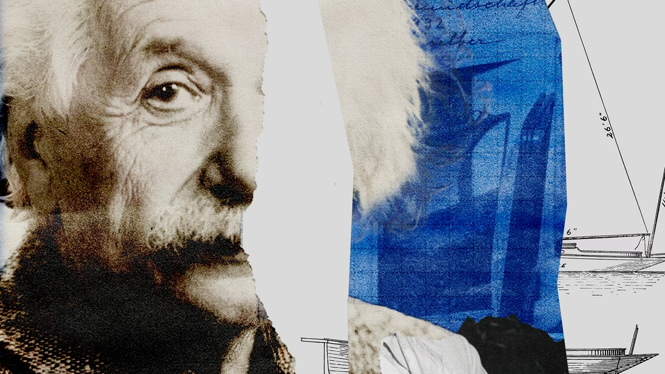
Albert Einstein’s Brilliant Politics
By Joshua Bennett
As Albert Einstein wrote elegantly about our experience of time and space, he also devoted his days to the process of social transformation: the question of how one world becomes another. He was concerned about not just the perils of progress—including modern science’s role in the creation of apocalyptic weapons—but also the promise of a more just society. From his very first years in the United States, Einstein wrote powerfully in opposition to American segregation, drawing on his personal experience of Nazi persecution as well as his ties to the long-standing African American community in Princeton, New Jersey, where he lived. In 1946, deep in the Jim Crow era, he visited the nation’s first degree-granting historically Black institution, Lincoln University, where he gave talks and accepted an honorary degree. Eighty years later, after searching through the archives of his correspondence that are housed in Princeton, I’m reflecting on the full scope of what we have inherited from him.
More in Culture
- A bizarre, challenging book more people should read
- Where Stranger Things lost itself
- The sad dads of Hollywood
- Five books about going out that are worth staying in for
Catch Up on The Atlantic
- Tom Nichols on Trump’s “Operation Iranian Freedom”
- Trump almost has a point about the Federal Reserve.
- The case of Alaa Abd el-Fattah is a test of Britain’s values.
Photo Album

These are scenes from the wide variety of volcanic activity on Earth over the past year.
Stephanie Bai contributed to this newsletter.
Explore all of our newsletters.
When you buy a book using a link in this newsletter, we receive a commission. Thank you for supporting The Atlantic.


