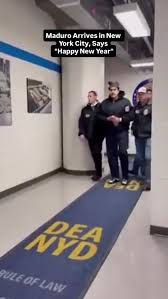
•UN, EU, others urge restraint
•Trump’s action challenges principles of int’l law, respect for sovereignty — Experts
By Nkiruka Nnorom and Olayinka Ajayi
The dramatic capture of President Nicolás Maduro of Venezuela by US forces has sent shockwaves around the world, raising questions about the principles of international law and respect for sovereignty.
Meanwhile, Maduro’s government has denounced the action as an “extremely serious military aggression” and declared a state of emergency, while several countries, including Russia, China, South Africa and Iran, among others, have expressed support for Venezuela’s sovereignty.
Condemnations have come primarily from Russia, China, Iran, and many Latin American governments, who see the U.S. strikes and capture of Maduro as a violation of sovereignty and international law. Calls for restraint and de-escalation have been echoed by the EU, Spain, the UK, and the UN. Meanwhile, some leaders, including Argentina’s president and Venezuelan opposition figures, have welcomed the outcome as a positive shift.
Venezuela’s UN Ambassador, Samuel Moncada, who also berated the military operation, described it as an attack against a country at peace,
Moncada said: “The deadly and treacherous U.S. military attack is being carried out against a country that is at peace.”
Russia’s Ministry of Foreign Affairs called it an “act of armed aggression” and deeply concerning.
The Ministry said: “The pretexts used to justify such actions are unfounded. Ideological hostility has prevailed over businesslike pragmatism and the willingness to build relationships based on trust and predictability.”
“Latin America must remain a zone of peace, as it declared itself to be in 2014. And Venezuela must be guaranteed the right to determine its own destiny without any destructive, let alone military, interference from outside.”
Similarly, Beijing said:
“China firmly opposes such hegemonic behaviour by the U.S., which seriously violates international law, violates Venezuela’s sovereignty, and threatens peace and security in Latin America and the Caribbean.”
“We urge the U.S. to abide by international law and the purposes and principles of the UN Charter and stop violating the sovereignty and security of other countries.”
Also, Iran stated that it “strongly condemns the American military attack on Venezuela and the flagrant violation of the national sovereignty and territorial integrity of the country.
that enemy.
We won’t give in to them. With reliance on God & confidence in the people’s support, we’ll bring the enemy to its knees.”
South Africa’s Department of International Relations and Cooperation called “on the UN Security Council, the body mandated to maintain international peace and security, to urgently convene to address this situation.”
“South Africa views these actions as a manifest violation of the Charter of the United Nations, which mandates that all Member States refrain from the threat or use of force against the territorial integrity or political independence of any State.”
Dangerous precedent
Meanwhile, UN Secretary-General António Guterres, in a statement by his Spokesperson, Stephane Dujarric, said: “These developments constitute a dangerous precedent. The Secretary-General continues to emphasise the importance of full respect by all of international law, including the UN Charter. He’s deeply concerned that the rules of international law have not been respected.”
The EU also called for restraint and respect for international law, with the EU’s top diplomat, Kaja Kallas, emphasising the importance of upholding the UN Charter.
Also, countries like Colombia, Mexico, and Brazil have condemned the US strikes, citing concerns about regional stability and sovereignty.
The EU reiterated that it does not recognise Maduro’s legitimacy, but emphasized that any political transitions and solutions must respect international law and be achieved peacefully.
Reacting, foreign affairs experts in Nigeria said it was a violation of Venezuela’s sovereignty and contravened the principles of international law.
Internal stability and cohesion
Speaking to Sunday Vanguard, Director General, Institute for Peace and Conflict Resolution, IPCR, Prof Joseph Ochogwu, said the US action in Venezuela was a signal to other countries about the importance of maintaining internal stability, building local cohesion, national consensus, and good governance to maintain sovereignty.
He said: “There is an extent to which we define sovereignty. You can maintain your sovereignty when everything about your country is in shape in terms of national cohesion, and in terms of the lives and properties of people to be safe. You can see that Venezuela is sharply divided.
“The popular vote of the people has been subverted, at least, in two electoral processes by Hugo Chavez and his groups. And also he’s increasing militarisation, suppression and repression of the Venezuelan people by a lot of his militias that he has set up over the years and all that.
“So, when you don’t follow domestic rules in the governance of your people, then, of course, you are calling for some level of intervention by, of course, powerful nations like America.
“I think that, largely, it sends signals to a lot of other countries on why they need to build local cohesion, national consensus, and begin to get people to build their nation in terms of development, good governance, rule of law, democracy, and all that.
“But once you don’t have that in place, you can have people question the issues of sovereignty because, first and foremost, there are people living within Venezuela who have been calling for this action for years. So, what the government needed to have done was to have increasingly and openly and transparently engaged in some kind of reforms to begin to rebuild.”
He, however, said that the US action in Venezuela had implications for the global order, potentially emboldening other powerful nations to pursue similar strategies.
Disregard
For Prof Babatunde Ayeleru of the Department of European Studies, University of Ibadan, he questioned the legitimacy of the action under international law.
He said: “It’s as if the so-called international law and the respect for the sovereignty of other countries are now put on trial. This action appears to be a clear disregard for the sovereignty of Venezuela, except it is confirmed that America had complied with all laid down regulations that are prerequisites for such an invasion and the attendant removal of the Venezuelan president. That is when such an action could be justified.
“It will, no doubt, send a strong signal to many countries that the United States of America can invade any country on a very slight provocation. This is a disguised form of re-colonisation.
“Obviously, this action will negatively impact global geopolitics and international relations. It will definitely breed suspicions, lack of trust, animosity and breakdown of diplomacy between the US and many countries. It must also be emphasised that there is a tendency for other countries to misinterpret or interrogate the genuineness of the intentions of the US in carrying out the invasion and regime change.”
Unipolar war
Conflict management expert, Lawrence Obisakin, described the invasion as a unipolar war that can only be carried out by the United States.
He said: “It used to be a bipolar war with two world superpowers, but now, it is a unipolar war that is controlled by the US alone. Nobody can delude themselves. Everybody in the world has the right to fight terrorism anywhere in the world. The US is the only controlling power in the world. It is better to be friends with the US. In international politics, you have to choose your friends and your enemies wisely.”
The post Tension as world reacts to Maduro’s arrest: Russia, China, S/Africa lead global backlash appeared first on Vanguard News.
