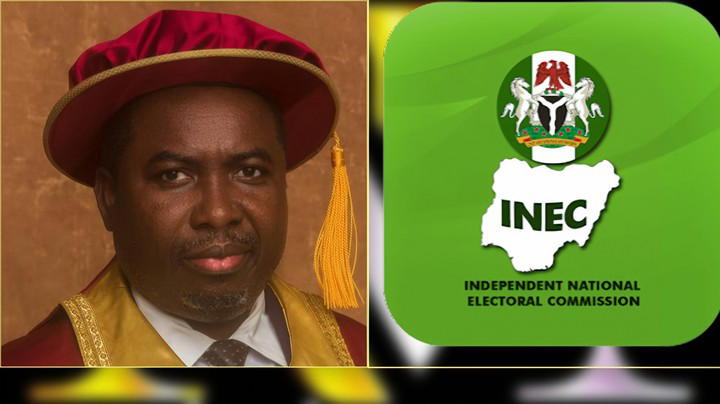
By Dr Michael Tidi
The Independent National Electoral Commission (INEC) occupies a constitutionally sensitive position in Nigeria’s democratic framework. Created by statute pursuant to the Constitution of the Federal Republic of Nigeria 1999 (as amended), INEC is not a sovereign authority.
It is a regulatory agency whose powers are donated, limited, and circumscribed by law. Any action outside those limits is ultra-vires, unlawful, and of no effect.
Recent conduct by INEC raises serious concerns about institutional overreach, threatening constitutionalism, separation of powers, and the rule of law. Independence, which INEC rightly enjoys, was never intended to translate into impunity or administrative lawlessness. As Chinua Achebe once warned, “The damage done in a society by those in positions of authority who act above the law is often irreparable.” INEC’s recent conduct exemplifies this risk, eroding public trust and the credibility of democratic institutions.
INEC derives its authority solely from the Constitution and the Electoral Act. Yet the Commission increasingly behaves as if it possesses powers not contemplated by law, particularly in relation to the administration and internal affairs of political parties. The Supreme Court decision in Senator Samuel Anyanwu v. Peoples Democratic Party (PDP) & Ors (SC, 2023) illustrates this clearly. A Supreme Court judgment is final and binding, and no administrative agency, including INEC, possesses the authority to delay, suspend, or reinterpret its effect.
Similarly, in Social Democratic Party (SDP) v. INEC (2019) 13 NWLR (Pt. 1689) 453 (SC), the Supreme Court unequivocally held that INEC has no business interfering in the internal affairs or leadership disputes of political parties beyond what the law expressly permits. Political parties are voluntary associations governed by their constitutions and the general law. Disputes arising therefrom are for the courts to resolve, not INEC.
A more recent and striking example is INEC’s unilateral exclusion of the Peoples Democratic Party’s duly elected candidate from the Ekiti Governorship primaries. No competent court has directed this action. By acting on its own, INEC has again arrogated judicial authority it does not possess, undermining the credibility of the electoral process. Equally concerning is that INEC, under Professor Joash Amupitan, has been carrying on as if pending cases involving the PDP before various courts did not exist, ignoring the fact that the law requires it to wait for competent judicial pronouncements before taking definitive administrative action.
Most painfully, INEC reportedly “ambushed” the duly elected National Working Committee (NWC) of the PDP, led by Dr. Tanimu Turaki, SAN, by inviting what has been described as a “Committee of Friends of Wike,” referring here to the FCT Minister, and subsequently issuing a statement rejecting correspondence from the Turaki-led NWC. That a professor of law should lead such misbehavior is particularly concerning. History will judge Professor Joash Amupitan and those who sponsor such acts, but the damage to public confidence in INEC is immediate and serious.
Equally troubling is INEC’s persistent disregard for statutory timelines, particularly in conducting by-elections. The Electoral Act stipulates clear deadlines, yet INEC has left constituencies unrepresented for years, citing insecurity or logistical challenges. A case in point is the Rivers State by-election, which has now been scheduled after a long delay for February 2026. Administrative difficulty does not confer the power to suspend statutory obligations. As Alexis de Tocqueville observed, “The health of a democratic society may be measured by the quality of functions performed by its public institutions.” By ignoring law and judicial pronouncements, INEC is endangering the health of Nigeria’s democracy.
At the core of these developments lies a constitutional question: is INEC subject to the law, or is the law subject to INEC? Independence does not confer absolutism. Discretion does not extend to rewriting statutes or reinterpreting Supreme Court judgments.
It is therefore imperative that INEC, under its current leadership led by Professor Amupitan, exercises utmost restraint and fidelity to the Constitution. Continued overreach risks plunging Nigeria’s hard-earned democracy into uncertainty. Electoral arbitrariness, however well-intentioned, is a dangerous substitute for the rule of law.
Beyond caution, there is an urgent need for comprehensive institutional reform. For INEC to be truly independent, the power to appoint its leadership must be removed from the President. An electoral body cannot command public confidence when its principal officers owe their emergence to the very authority whose electoral fortunes it is constitutionally mandated to regulate. True independence requires structural, administrative, and financial insulation from executive influence.
In the immediate term, the Peoples Democratic Party should commence urgent action in court compelling INEC to include its duly elected candidate in the Ekiti Governorship primaries, which the Commission itself previously monitored. This is not merely about one candidate or one election; it is about upholding the integrity of institutions rather than allowing them to be weakened by the government of the day. Strengthening our democratic institutions must take precedence over political convenience, and the judiciary remains the ultimate safeguard against administrative arbitrariness.
If INEC succeeds in Ekiti, there is no reason to believe it will not attempt the same in Osun. This cannot be allowed to go unchallenged. INEC should allow all parties’ candidates to test their popularity at the polls, rather than manipulating technicalities to sideline the PDP’s candidates in forthcoming elections. Such conduct portends grave dangers, as Nigerians may one day wake up to find that only the APC appears on the ballot come 2027. This must be resisted by all who value democracy.
Reform must strengthen INEC’s autonomy while reinforcing accountability strictly within constitutional and judicial parameters. An independent INEC must also be disciplined, obedient to the Constitution and law, not to political convenience. Until such reforms are undertaken, recurring institutional excesses, exemplified by the Ekiti Governorship primaries exclusion and the ambush of the PDP NWC, will persist, with grave consequences for Nigeria’s democratic stability. Electoral credibility cannot coexist with administrative arbitrariness, nor can democracy thrive where its principal referee operates without effective legal restraint.
•Dr. Tidi is a lawyer, economist, public affairs analyst, poet, and writer. He can be reached at [email protected]
The post INEC’s growing lawlessness endangers free, fair elections appeared first on Vanguard News.
