By Carl Obiefuna
By any honest reckoning, Nigerian politics has reached a defining crossroads. The country is no longer dealing only with economic hardship, insecurity, and institutional decay; it is confronting a deeper crisis of political purpose.
For decades, politics in Nigeria has been practised less as an instrument of governance and more as a contest for capture, less about service and more about survival. Power has been pursued not as a means to national development but as an end in itself, often insulated from accountability by ethnicity, propaganda, and patronage.
In this political culture, elections are frequently reduced to rituals stripped of moral meaning, while public office becomes an avenue for private accumulation. Political parties, rather than functioning as vehicles for ideology and policy, have largely operated as transactional platforms, easily abandoned when access to power is threatened. The result is a democracy in form but hollow in substance.
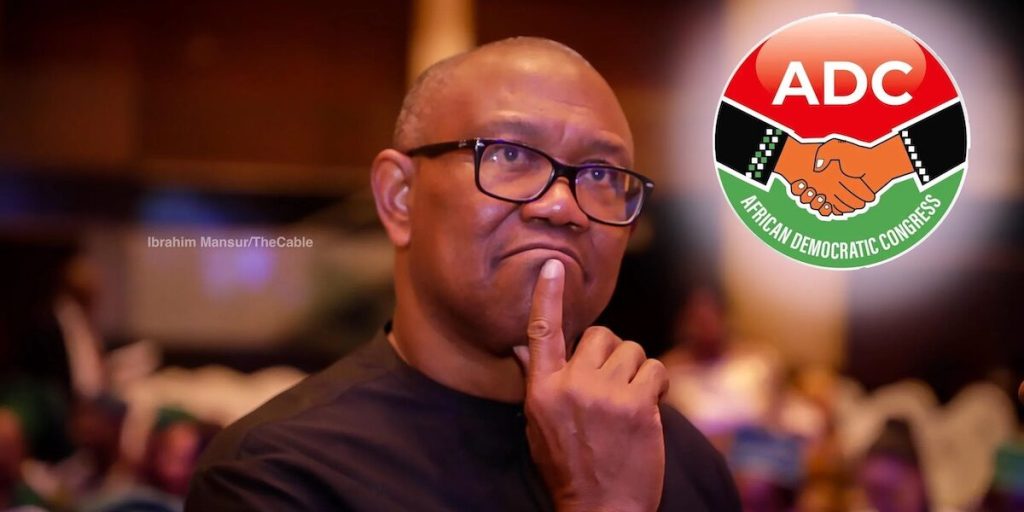
It is against this backdrop that the remarks of the 2023 Labour Party presidential candidate, Mr. Peter Obi, delivered on December 31, 2025, in Enugu, must be situated—not as an isolated speech, but as the centrepiece of a broader political convergence convened to forge a united opposition front, realign political forces under the African Democratic Congress (ADC), and articulate a collective strategy for rescuing Nigeria’s democracy and economy ahead of the 2027 general elections.
The gathering was also informed by growing concern over what many opposition figures perceive as deliberate federal attempts to weaken and emasculate existing parties through institutional pressure, legal attrition, and political co-optation—a trend that has made the ADC increasingly attractive as a comparatively intact, legally stable, and ideologically open platform for opposition reorganisation.
Enugu as Symbol and Signal
The choice of Enugu was far from incidental. On Wednesday, the 31st of December, 2025—a day, as Barr. Okoli Akirika observed, particularly suited for such a gathering so that its message could help shape the national agenda for 2026—the city assumed profound symbolic significance.
Its streets and halls, resonant with historical memory, provided more than a backdrop; they lent the gathering a sense of gravitas, as if the city itself sanctioned the conversations taking place within it. The setting resembled a mini national conference among the Igbo, a rare convergence aimed at charting their political future within Nigeria and signaling a renewed commitment to strategic engagement rather than sectional politics.
Opening the event, Chief Simeon Okeke, chairman of the occasion, spoke with the weight of a lifetime behind him, his words carrying the urgency of a 90-year-old Igbo man who had seen much and desired nothing more than the full flowering of his people’s potential. He reminded the gathering of Enugu’s historic role as the capital of the old Eastern Region, framing it not merely as a geographic fact but also as a symbol of memory, resilience, and responsibility.
His message was unmistakable: moments of national reflection and rethinking often emerge from places steeped in history, and the time for decisive action was now. He implored the Igbo political class not merely to listen, but to internalize and carry forward a message of unity, renewal, and purposeful engagement—so that his people might finally occupy their rightful place in the nation before the reaper comes, ensuring their destiny would not be left to chance or to the whims of history.
Anchoring the event, Senator Victor Umeh framed the gathering as both declarative and directional, emphasizing that this was more than a symbolic meeting—it was an effort to move opposition politics from reactive complaint to proactive coordination. His intervention underscored the seriousness of intent: this was not a rally of grievances or a platform for airing individual frustrations, but a deliberate, strategic meeting of political consequence, aimed at setting the tone for meaningful engagement in the coming year. Every speech, every interaction, carried the weight of purpose, reflecting a shared understanding that the discussions in Enugu were meant to ripple far beyond the city’s borders, shaping the political and developmental trajectory of the Igbo and the nation as a whole.
Politics as Practised in Nigeria
Nigeria’s post-independence political history has been a complex tapestry of hope, promise, and recurring disappointment. The early years after independence were marked by a surge of optimism, as citizens imagined a nation guided by principles of justice, equity, and inclusive development. Yet this promise was repeatedly interrupted by military interventions, which truncated fragile democratic experiments and left lasting scars on political culture.
Even during prolonged periods of civilian rule, governance has often been extractive rather than developmental, privileging personal enrichment over the welfare of the citizenry. Weak institutions, compromised electoral processes, and a political elite adept at exploiting ethnic, regional, and religious divides have conspired to stall national progress, leaving the country trapped in cycles of underperformance and unmet expectations.
This critique found resonance throughout the gathering. Former governors, senators, and legislators echoed the view that Nigeria’s crisis is not accidental but carefully engineered by a political culture that rewards loyalty over competence, patronage over principle, and impunity over genuine service.
Several speakers emphasized that governance in Nigeria has long been reduced to the management of elites rather than the advancement of the nation—a system in which public office is treated as a conduit for personal gain rather than a platform for transformative leadership. The discussions underscored a growing consensus: without a fundamental shift in political attitudes, institutional integrity, and civic responsibility, the nation’s developmental potential will remain perpetually unrealized.
It was into this charged atmosphere, heavy with reflection, expectation, and a palpable yearning for change, that Peter Obi’s address was delivered. His speech did not emerge in isolation; it was a deliberate intervention into a conversation about Nigeria’s future, one that sought not merely to critique, but to offer direction, hope, and a pathway toward reclaiming national purpose.
A Nation in Distress, A Call to Conscience
Obi’s speech laid out the statistics of national decline—mass poverty, youth unemployment, insecurity, and institutional breakdown—but his most pointed intervention was moral.
Nigeria, he argued, is not poor by nature but “looted into poverty.” This framing found affirmation from several speakers who described the country as betrayed rather than broken.
Former Senate President David Mark, now chairman of the African Democratic Congress (ADC), reinforced this point by arguing that Nigeria’s challenges persist not because solutions are unknown, but because leadership has lacked the discipline, fairness, and courage to implement them. He described the ADC as a platform founded on equality, justice, and progressiveness, insisting that internal democracy and respect for members would distinguish it from dominant parties.
A recurring theme across interventions was unity—not as rhetoric, but as strategy. High Chief Ben Obi explained that extensive consultations across the country revealed deep frustration among Nigerians and a growing consensus that credible leadership was urgently needed. He described the emerging coalition as a patriotic mission aimed at rescuing the country from leaders who profit from division while presiding over national decline. Chief Onyema Ugochukwu added a generational dimension, openly stating that it was time for older politicians to make room for younger leadership. His declaration that Peter Obi should become the presidential flagbearer of the ADC was greeted as symbolic of a broader sentiment: that Nigeria’s future cannot be indefinitely postponed with usual recycled politicians.
What distinguished the Enugu gathering from conventional elite meetings was the prominence given to youth and women’s voices. Chinonso Obasi, speaking for the youth, framed the moment in moral and generational terms, describing the movement as one that would be driven by young Nigerians determined to reclaim their future through the ballot.
Dr. Josephine Anineh, representing women, struck a similar note, arguing that political leadership must reflect empathy, inclusion, and social responsibility. She expressed confidence that Nigeria was approaching a political opening and that Peter Obi was best positioned to lead that transition.
Aisha Yusuf’s intervention was particularly striking. Declaring that she had never previously been a card-carrying member of any political party, she announced her decision to join the ADC, attributing it directly to Obi’s leadership and credibility. Her statement reflected a wider phenomenon: the mobilisation of previously disengaged citizens drawn into politics by moral conviction rather than patronage.
Several speakers addressed the issue of elections directly. Hon. Emeka Ihedioha moved a motion urging National Assembly members present to formally align with Obi within the ADC framework, a motion seconded by Prof. Osita Ogbuo and unanimously adopted.
These declarations reinforced Obi’s insistence that democracy must be defended, not merely celebrated. The collective mood of the gathering was defiant but disciplined: resistance would be lawful, strategic, and persistent.
The ADC, Atiku, and the Politics of Permutation
Beyond Enugu, attention has inevitably shifted to the evolving dynamics within the African Democratic Congress (ADC) and the broader opposition landscape. Reports of former Vice President Atiku Abubakar’s interest in the party have intensified speculation about ticket configuration, leadership direction, and the coalition’s strategic ambitions. Atiku’s supporters emphasize his wealth of political experience, national reach, and deep understanding of the intricacies of governance in Nigeria.
They argue that his involvement could significantly strengthen the coalition’s presence in the North and among electorally pivotal constituencies, potentially broadening the party’s appeal beyond its traditional strongholds.
Yet this perspective is not without its critiques. Observers point to Atiku’s political past, including associations with the status quo and allegations of transactional politics, as potential liabilities that could dilute the moral clarity and reformist energy that Peter Obi has brought to the movement.
While Atiku offers breadth of influence, some warn that his style of politics—steeped in negotiation and compromise—may undermine the principled, people-centered ethos that has become the hallmark of Obi’s appeal.
Beyond the gathering in Enugu, several analysts were candid about this tension. Many acknowledged Atiku’s potential strategic value, but they were equally unequivocal in asserting that the momentum of the movement rests squarely on Obi’s leadership and moral authority. Senator Enyinnaya Abaribe’s resignation from APGA and declaration of loyalty to Obi became a symbolic touchstone in this debate. It reflected a widely shared belief among attendees that the strength of the movement lies not simply in political arithmetic or alliances but in clarity of purpose, ethical leadership, and the courage to challenge entrenched political norms.
The conversation also revealed subtle generational and ideological fault lines. Younger activists and reform-minded stakeholders voiced concern that making experience a priority over vision could risk alienating a base energized by calls for transparency, accountability, and national renewal. Meanwhile, traditional politicians pointed to the pragmatism of alliances with established figures like Atiku as necessary to navigate the realities of Nigerian politics.
The interplay of these perspectives underscored a central dilemma for the ADC: how to balance strategic inclusivity with principled leadership, and how to channel broad-based support without compromising the moral and ideological foundations that have made Obi the emblematic figure of the movement.
In this context, the Enugu gathering functioned as both a litmus test and a manifesto-setting moment. It was a space where ideas were debated, loyalties clarified, and the direction of the coalition probed—not merely as a matter of party mechanics but as a conversation about the kind of politics the Igbo, and Nigeria at large, wish to pursue in the years ahead.
A Defining Political Moment
What ultimately distinguished the Enugu gathering was coherence. Despite diverse backgrounds, speakers converged around a shared diagnosis: Nigeria’s crisis is one of leadership, unity, and integrity—and around a shared conclusion: the status quo is unsustainable.
The repeated reference to Obi as “our leader” was less about personality than about symbolism—a rallying point for a coalition seeking to replace politics of division with politics of purpose. Nigeria today stands between two futures. One is the continuation of decay—elite capture, shrinking civic space, manipulated elections, and deepening poverty. The other is renewal—unity, honest leadership, institutional reform, and inclusive growth.
The Enugu gathering did not claim that change would be easy. But it insisted that it is possible—and that silence is no longer an option. Whether the ADC-led coalition becomes the vehicle for Nigeria’s rebirth will depend on choices yet to be made: who concedes, who unites, and who places country above ambition. But one thing is clear: the political conversation has shifted from resignation to resolve, from protest to structure, and from despair to possibility. And history, once again, is watching.
The post A Coalition at the Crossroads: Obi, ADC, and Nigeria’s Political Future appeared first on Vanguard News.
