
Warren Buffett has long been known and admired around the world for doing something that is, at its essence, mundane. He is not a brilliant artist or a great inventor or a record-setting athlete. Instead, his brilliance—a low-key, midwestern type of brilliance—found expression in the prosaic art of investing: buying this stock and avoiding that one. Buffett himself has called this task “simple, but not easy.” While millions upon millions of people buy and sell investments every day, no one has a record of doing it better than he has, as consistently as he has, and for as long as he has.
Buffett’s imminent retirement at the age of 95 is a moment to reflect on the qualities that have made him the most successful investor of all time. These qualities—relentless curiosity, analytical consistency, focused effort, and humility, along with high integrity, a personality unchanged by wealth or success, and a sunny optimism about the United States—have made him an American role model. He has also epitomized respect for old-fashioned American values—free markets, a democratic system of governance, patriotism, and plain old common sense—that today have lost some of their currency. Now, in a world alarmingly short of proper role models, Buffett is departing the scene. His voice and example will be deeply missed.
Since childhood, Warren Buffett has had a precocious investment mind and acumen for business. As a young man in Omaha, he became interested in the stock market and made his first investment (in Cities Service preferred shares) at age 11. He earned money selling peanuts and popcorn at college football games, as a newsboy delivering The Washington Post, and as the producer of a racetrack tip sheet. At age 17, he scraped together his savings to purchase pinball machines that he placed in barbershops, an investment that generated ongoing cash flow back to Buffett.
In his early 20s, he found out about a class he was interested in, at Columbia University, on value investing, the art of patiently searching for investment bargains. The class was taught by an immigrant genius and polymath, Benjamin Graham, who also ran a successful investment fund. Graham had co-written a book called Security Analysis in 1934 (I was involved as an editor of later editions), and in 1949 published The Intelligent Investor, which came to be known as the bible of value investing. Buffett was accepted into the class. He and Graham formed a close and enduring relationship, and, as they say, the rest is history.
Taking inspiration from Graham, in 1956 the 25-year-old Buffett opened an investment partnership, inviting in friends and neighbors. Buffett possessed great confidence from a young age that a value-investment approach would reliably compound capital far into the future at exceptional rates of return; it seemed as if he could see how his fortune would grow with the passage of time, if only he didn’t take his eye off the ball. He was determined to stay within his “circle of competence,” focusing all of his attention on investing in businesses he was certain he could understand. And indeed, this partnership produced extraordinary results over its nearly 15 years of operation.
[Jim Manzi: Is Warren Buffett brilliant or lucky?]
In 1962, Buffett’s investment partnership bought its first shares of Berkshire Hathaway, a holding that, over time, would take on increased personal importance for Buffett. Berkshire, then just a textile company, was superficially bargain-priced, trading at a low multiple of its book value and earnings. But it was a low-quality business, facing the challenge of high-cost domestic operations at a time when offshore competitors could make products at a fraction of the cost. Buffett’s plan was to persuade the company to jettison its textile operations, letting him capitalize on its discounted market valuation. Fast-forward eight years, and Buffett became chairman of Berkshire. He took the necessary steps to turn the declining manufacturer into an insurance and industrial conglomerate and a lifelong investment vehicle whose name (which he never changed) would eventually become synonymous with his own.
One of the reasons to own an insurance company was crystal clear in Buffett’s mind: Such companies generate a large pile of cash that grows when the business expands. This is known as “float” in the industry’s parlance—liquidity available to be deployed until it might someday be needed to settle insurance claims. Buffett knew that he could enhance Berkshire’s returns over time by investing the float.
Buffett transformed Berkshire into a holding company with “permanent capital” that would invest not only in common stocks but also in entire businesses. Berkshire grew to eventually own hundreds of businesses—including BNSF Railway, Geico, NetJets, and numerous energy and power companies—and concentrated stock positions in Apple, American Express, and Coca-Cola. This proved to be a winning formula: a platform in which Buffett soon concentrated the great majority of his net worth, a company upon which he could single-mindedly focus. Buffett held almost all of his original Berkshire Hathaway shares until recently, when he began to reduce his stake as part of his estate-planning and philanthropic efforts. Buffett’s personal investment in Berkshire Hathaway ultimately grew to be worth more than $125 billion, even after he had donated many tens of billions’ worth of shares to charity. No one else has ever built such an investment fortune from scratch; it was as if he hit a lottery with an ever-growing payoff, though one based not on luck but on the consistent application of skillful effort.
Buffett’s success is, to a large extent, attributable to his acumen as a value investor, always appraising stocks as fractional-ownership interests in businesses that he planned to hold over the long term. His process was to conduct extensive due diligence and analysis; operate from an instinctive mental model of the characteristics of “good businesses”; wait patiently for a “fat pitch” (the rare combination of a high-quality business and a share price that misvalued it); and then, and only then, take a big swing. If a stock that Buffett liked fell in price, he happily bought more—which is not at all how most people feel when their stocks decline.
Allow me to step back and note that value investors—and I count myself as one—are a quirky breed. They tend to be mathematically precocious and interested at an early age in collecting stamps or coins, handicapping racehorses, starting businesses, investing in the stock market, and finding ways to make money. They are consummate bargain hunters and have personalities that make them natural contrarians. They don’t gain comfort from consensus, and even become uncomfortable when their views go mainstream. Although most investors get excited by whispered tips or hot public offerings, value investors aim to remain disciplined and focus on the underlying worth of a business, its return on invested capital, the earnings and cash flow that is being generated, and the company’s future prospects.
They get excited not by the possibility of an instant gain but by the inexorable math of compounding capital over the long run. Financial pundits sometimes call the concept of compound interest (or compound returns) the “eighth wonder of the world”—the extraordinary result that comes from making wise and informed investments, sticking with them, and consistently taking the long view. This concept epitomizes Buffett, who never tried to get rich quick (which I’m quite sure he would say he didn’t know how to do) when going slower would produce a more certain and ultimately far more lucrative result. Compounding, if done successfully, would over time reliably increase Buffett’s net worth; on a graph showing wealth versus time, the plotted points would be steadily up and to the right.
Over the course of my own 45-year investment career, just about every value investor I’ve known has looked up to and admired Buffett. The value-investment community knows his record, tracks his latest purchases and sales, and gains insight into how he thinks from his shareholder letters. While some have chosen to use this information to replicate Buffett’s portfolio and others have made Berkshire Hathaway shares a core position, most have focused their attention not on his holdings but on his thought process and demeanor—patient, consistent, unemotional, and oriented toward the long term.
How did Buffett do it so well for so long? He’s brought five main traits to his investing:
An alert, quick, accurate, and decisive mind that gives him the ability to form reliable investment judgments.
Simplicity of thought, getting right to the heart of the matter in analyzing each investment.
The ability to distinguish good investments from bad ones, and great investments from merely good ones—and the insight and conviction to stick with the best ones over time. Buffett, to paraphrase the investment guru Peter Lynch, never cut his flowers or watered his weeds.
The ability to stay focused over long periods and avoid distraction.
The mental agility to alter his strategy when he found a way to improve, such as when he came to more significantly emphasize the quality of a business in his decision making.
Over the course of his career, Buffett successfully navigated market booms and busts, financial crises, wars, pandemics, and mind-boggling technological innovations that spawned countless businesses while disrupting, even displacing, a great many others. Through all of this, Buffett simply marched ahead, seemingly unfazed. Over the span of his career, competition among investors greatly intensified as investing became more institutionalized, more young people pursued investment professions, financial information became widely available, and ever larger sums of investment capital competed for excess returns. Buffett just kept on cranking out exceptional results.
[From the November 2004 Issue: American everyman]
People have a general sense that somebody can become rich by investing in (the right) common stocks, reinvesting the dividends along the way, and hanging on when other investors are panicking. We occasionally hear stories about a retired janitor, schoolteacher, or librarian who scrimped, saved, and invested wisely, leaving behind a small fortune. Buffett demonstrated something more startling—that you could become one of the richest people in the world by doing so, and not by using a wonky trading algorithm that scrapes a penny or two off every trade but by deploying a commonsensical plan to buy and hold shares in high-quality, publicly traded businesses. Buffett, in this way, was both a man apart—an investing unicorn—but also an Everyman, just another guy buying shares, usually in well-known companies. (The Average Joe, however, did not spend his days and evenings scouring stacks of corporate annual reports, footnote after footnote, for revealing insights.)
Buffett was typically a long-term holder of companies in which he invested. The bar he set for himself to own a new name was high, and he recommended that investors take new positions infrequently, because there are only so many worthwhile ideas. He was immune to the tendency of most investors to focus on the trendiest sector or the hottest new technology, and over time this served him exceedingly well. He invented the construct of an investing “punch card” for each aspiring investor, with only 20 punches to be used over a lifetime. No one actually follows this idea (few of us could realistically be that disciplined), but it is a good mental framework nonetheless: a reminder that when you find a really compelling investment, you shouldn’t be afraid to load up. This way of thinking is at odds with the contemporary investment practice of extensively diversifying one’s portfolio as a means of reducing risk, which has the effect of driving many to diversify away from their very best investment ideas.
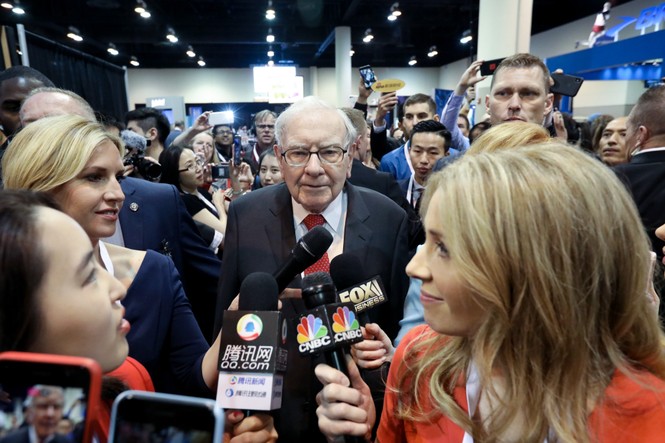
Warren Buffett speaks with reporters at an annual shareholder meeting in Omaha in 2019.
Buffett has often noted that he benefited from serendipity over his career, and in some ways he did. In his own lexicon, he was a winner of the “ovarian lottery,” born in good health and with a fine brain into a two-parent family that was reasonably prosperous. He was raised in Nebraska, a state where people take pride in thinking independently, and a place where old-fashioned virtues such as industry, thrift, and keeping your word were learned early. His father was a businessman and eventually served as a U.S. representative. Nebraska was sufficiently distant from Wall Street to make peer pressure not much of a factor in Buffett’s professional development. Indeed, Buffett noted in November, “The center of the United States was a very good place to be born, to raise a family, and to build a business.” Buffett has regularly pointed out that he was advantaged by being American. This focused him primarily on companies in the U.S., where the rule of law meant a reasonably level playing field and where there were marketable securities galore to analyze and choose among. And being long on American stocks in the second half of the American Century was a good thing indeed. Few major markets did as well as the U.S. equity market over the span of his career.
Buffett was not only an investor; he was also a deep investment thinker, consistently trying to improve, looking for new areas of advantage, and learning from his mistakes. While he remained a value investor throughout his career, Buffett came to be deeply influenced by the thinking of another investment luminary, Philip Fisher, as well as his longtime friend and collaborator Charlie Munger. As a result, he refined his approach to focus less on lower-quality companies trading at bottom-of-the-barrel valuations and more on the quality of the underlying businesses, even when that meant paying up, because the higher quality would likely lead to a growing and more valuable investment. Buffett acknowledged his new insight this way: “I try to invest in businesses that are so wonderful that an idiot can run them. Because sooner or later, one will.”
As his career took off in the 1960s and ’70s, Buffett was busily selecting investments one by one based on fundamental criteria such as earnings and cash flow. Contemporaneously, academics were pioneering a new theory—the “efficient-market hypothesis”—that posited that the financial markets must be efficient, because any new information that came about would be quickly reflected in securities prices. If you believed in market efficiency, you necessarily believed that no one could reliably beat the market. But Buffett was living proof that one could prosper by uncovering market inefficiencies. In 1984, Buffett argued in the Columbia Business School magazine that finance professors should put aside their theories and examine the records of eight investment funds (mostly run by friends of his), in addition to his own. Within the academy, Buffett came to be seen as one of a kind, an n of one. But rather than study Buffett and what he did, for decades finance professors clung to their theories and invented new ways to explain away his success. Even today, finance students continue to be taught the efficient-market hypothesis. Buffett has often noted that the greater the number of people who are taught that the markets are efficient, and that fundamental investment analysis is a waste of time, the more subdued the competition and the better it is to be a value investor.
While Buffett built an unprecedented fortune from scratch over the course of his investment career, this was not, in my view, his most extraordinary accomplishment. Rather, Buffett’s most significant feat was the way he vaulted as a young man to investment success and then managed to perform at the top of his game for his entire adult life, for nearly three-quarters of a century. We could debate whether Buffett was the investment MVP of any particular year; any investor’s performance is subject to the vicissitudes of the stock market and is thus best measured over longer-term horizons. But had any serious student of the financial markets between the mid-1960s and the mid-2020s been asked at any particular moment to vote for an investing All-Star team, Buffett likely would have been included on every ballot, every year.
[Clive Crook: On Warren Buffett and Stephen King]
Buffett was relentless; he rarely took time off, and he never allowed himself to drift from his disciplined approach or adopt new priorities. And for most of his career, he worked more or less alone—just Buffett and some accounting and administrative support. He was investing’s Cal Ripken: an iron man who was in the starting lineup every single day. He was also basically alone at the top; there was no other investor over that period who became as well known, and no one else with a record remotely as lengthy or exceptional as his. Like Secretariat winning the Belmont Stakes in 1973 by the length of the home stretch, it didn’t really matter which noncontender came in second.
Buffett is a gifted and inspiring teacher, and he has frequently taken the time to appear as a guest speaker in classrooms. Legions of student groups have flown out to Nebraska to meet, ask questions of, and have their picture taken with the Oracle of Omaha. Over the years, Buffett’s annual Berkshire Hathaway shareholder letters (and even his earlier partnership letters) became must-reads for investment professionals. Unlike most wonky and tedious Wall Street market commentators, Buffett became famous for making complicated subjects understandable. Buffett’s missives were eagerly awaited by the investment community; they were replete with memorable quips (such as the admonition about risk-taking that “It’s only when the tide goes out that you learn who’s been swimming naked,” and the time-tested advice to “Be fearful when others are greedy. Be greedy when others are fearful”), as well as quotes from the likes of Yogi Berra and Mae West.
Buffett’s annual letters became so influential that I believe they had the effect of upgrading the way that most professional investors communicate with their clients. Many hedge and some mutual-fund managers (myself included) have sought to emulate Buffett’s missives in two ways: by putting considerable effort into making their own letters thorough, informative, and readable, and by imagining they’re writing to a less knowledgeable relative (as Buffett did) who is nonetheless a major investor in their fund and deserves to know the thinking behind decisions. Buffett has lived into a saying often attributed to Albert Einstein: “If you can’t explain it to a 6-year-old, you don’t understand it yourself.”
As Buffett’s investment prowess became better known in the business community, he started using his well-publicized annual letters to advertise for corporate-acquisition candidates, suggesting that Berkshire would make a fine home for family businesses whose shareholders were seeking a reliable and supportive owner. Those who sold to Berkshire didn’t need to fear that their company would face a cultural shift or employee turnover (compared with those acquired by a typical private-equity buyer); Buffett’s approach was to oversee the capital allocation of his acquisitions but otherwise largely leave them alone. Unlike the “barbarians at the gate” private-equity buyers who sometimes break up companies for their component parts or slash head counts to increase short-term profits, Buffett reinvested capital into the acquired businesses in order to sustain and grow them. He had the humility to appreciate that an incumbent management team usually knew a lot more about a business than he did. He was a quick and accurate study of not only businesses but people. A close associate of his once told me that that was perhaps Buffett’s most exceptional ability.
Over time, Buffett became one of America’s most respected and admired CEOs, and his name became a highly regarded brand. He turned the regulatory requirement that public companies like Berkshire Hathaway hold annual shareholder meetings into an extravaganza that eventually became a pilgrimage. Some people, including many international investors, bought Berkshire shares just to get the invite. Attendance at most companies’ annual shareholder meetings is desultory, measured in the dozens or occasionally hundreds of attendees. Yet the crowd that went to see and hear from Buffett each year grew into the thousands and then the tens of thousands. By the 2000s, the gatherings had been christened the Woodstock of Capitalism. Value-investing junkies made a weekend of it, securities-analyst societies planned events around it, and parents brought aspiring teenage financial whizzes to witness and learn from the great man. Buffett and Munger, his lifelong thought partner, would take questions from the Omaha audience for more than five hours. The financial network CNBC started to cover the meetings live. They were the only shareholder meetings to merit national media attention.
The showman in Buffett arranged a display of Berkshire-company product offerings available for purchase at the meeting. These included See’s Candies, Borsheims jewelry, Nebraska Furniture Mart sofas and dining-room sets, and Geico insurance products—so much the better to please the attendees, get free advertising, build brands, and augment the bottom line on a Saturday in May. Buffett’s cult-figure status became so great that when folks were in town for the Berkshire annual meeting, they stopped at Buffett’s favorite restaurants and ordered his favorite dishes. If you ate like he ate, perhaps you would be able to invest like he invested—certainly, it couldn’t hurt. While I’ve never been to a Berkshire annual meeting and have never owned the stock, I did have lunch with Buffett at Gorat’s (a steakhouse, his choice) on my one trip to see him in Omaha 17 years ago.
Buffett’s flair for the dramatic extended to his recruiting practices. In 2007, he launched a highly publicized search for investment talent. After screening hundreds of candidates over several years, he ultimately hired two exceptional hedge-fund managers, Todd Combs and Ted Weschler, to join Berkshire in 2010 and 2011, respectively. Combs worked with Buffett through the end of 2025, and Weschler continues with him to this day, the result of what must be regarded as one of the most unconventional yet successful executive searches ever.
Buffett in many ways has been a modern-day J. P. Morgan, a business champion with the ability to calm turbulent markets by infusing capital into at-risk firms, such as Goldman Sachs during the 2008 financial crisis, thereby putting his imprimatur on their solvency. He helped restore confidence in the market during panicky moments by entering buy orders as favorite names traded down while offering public reassurance about markets, the country’s finances, and capitalism. He has been an unabashed cheerleader for the United States of America, and a firm believer that things would always work out over the long run (as they always had).
Buffett became an oft-quoted philosopher on subjects as diverse as the social safety net, philanthropy, and tax rates. He once commonsensically observed that he should not pay a lower tax rate than his secretary, and few could disagree. The respect for him in the business and investment communities (including among individual investors) was so widespread that ideas gained import simply because he had articulated or supported them.
Buffett’s accumulation of enormous wealth hasn’t changed him, something that most enormously wealthy people can’t claim. Throughout his working life, he remained fundamentally the same person he had been when he was a child: bright, curious, and upbeat. His unchanging nature extended not only to his diet of hamburgers and Cherry Cokes; over time, his business interests came to reflect his childhood attractions to newspapers, railroads, and Dairy Queen. Buffett has lived in the same house in Omaha his entire adult life. He generally maintained the same friendships over many decades. He didn’t accumulate fancy cars, yachts, expensive art, or multiple vacation properties, as many of the ultrarich do. His ever growing wealth was a way of keeping score (like an enormous and growing pile of poker chips), but for him it wasn’t a ticket to a new posh lifestyle. At one point, Buffett clearly felt a bit guilty about the purchase of a private airplane: He nicknamed it “The Indefensible.” Buffett’s enduring popularity, at least in part, is due to his enduring humility, sense of perspective, genuine wonder, and perpetual gratitude for how his life has turned out.
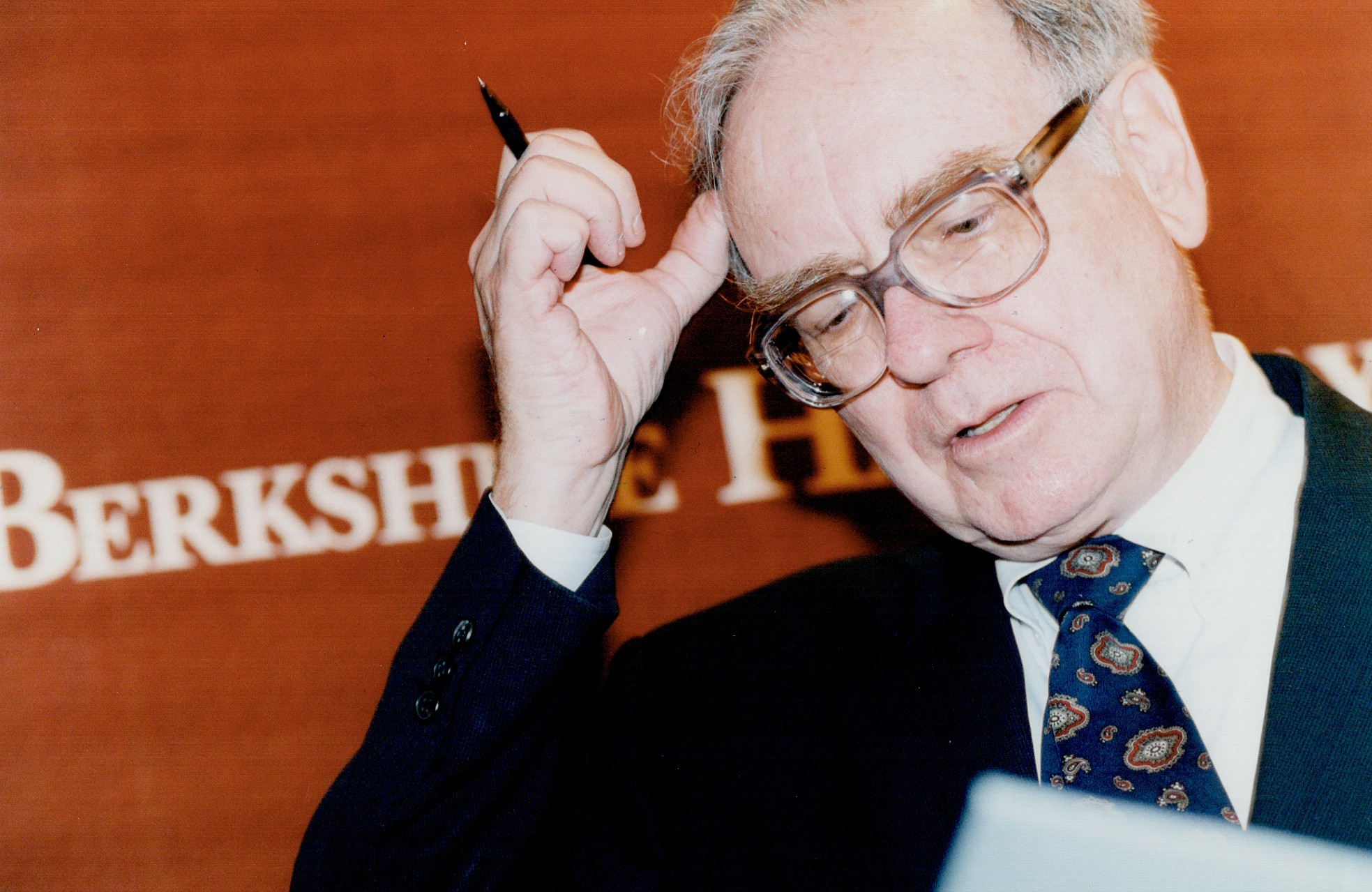
Warren Buffett in 1994
Like many other wealthy investors and businesspeople, for years Buffett focused his efforts almost exclusively on compounding his own capital, as well as the capital entrusted to him by other Berkshire shareholders, who’d basically hired the world’s best capital allocator effectively free of charge. (Buffett’s salary from Berkshire was minimal.) Buffett has said that one reason that he deferred significant personal philanthropy for many years was because he thought that, by waiting, he would have disproportionately more money to give away down the road.
[From the May 2016 Issue: How Warren Buffett’s son would feed the world]
Buffett had long anticipated eventually donating his wealth to charitable causes, but the unexpected death in 2004 of his first wife, Susan, disrupted his plans. He had imagined that she would be the one who made the family’s philanthropic decisions. It took him another few years to advance his plans to give away sizable sums, by joining forces with Bill and Melinda Gates. In 2006, Buffett donated an astounding $31 billion to the already well-endowed Gates Foundation, thereby doubling its annual grant-making capabilities. (This was, and still is, one of the largest philanthropic gifts in history, and Buffett gave more to the foundation over time.) Buffett joined the Gates Foundation board, and Bill Gates joined the Berkshire Hathaway board of directors, though both stepped back from these commitments several years ago.
In 2010, again joining forces with Bill and Melinda Gates, Buffett co-founded the Giving Pledge, an organization with the goal of signing up the world’s billionaires to the cause of philanthropy. Members needed to vow that they would give away half or more of their fortunes either during their lifetime or at their death. Buffett and Bill and Melinda Gates took the time to personally reach out to prospective members to persuade them to join, including arranging multiple meetings with me and my wife before we joined in 2013. At the most recent tally, the Giving Pledge had more than 250 members who have committed many hundreds of billions of dollars in future philanthropy, a number likely to grow over time—and a legacy that will have an impact far into the future. No one else has attempted, let alone accomplished, anything remotely comparable.
Buffett, from youth to old age, has loved to evaluate and understand businesses. He successfully navigated all market environments and easily traversed most types of investments—stocks but also bonds, public and private opportunities, domestic and global companies, even derivatives and reinsurance commitments. Although many professional investors narrowly focus on just one asset class, Buffett painted his masterpiece with the broadest palette on the widest of canvases. He formed lifelong relationships with top corporate executives whom he respected (most notably The Washington Post’s Katharine Graham), and famously delegated a great deal of operating responsibility to managers employed by Berkshire. And he kept performing even as Berkshire’s shareholders’ equity capital compounded to astonishing levels ($650 billion by 2025). Investing is a field in which size typically becomes a detriment to performance. But Berkshire’s size did not perceptibly diminish Buffett’s record. Under Buffett, Berkshire Hathaway grew from being an obscure participant in the dying U.S. textile industry into a trillion-dollar market-cap behemoth, one of the largest companies in the U.S. Like an All-Star center fielder making one highlight-reel catch after another, Buffett often made it look easy even when all of us knew it most definitely wasn’t.
Buffett has said that he’ll pull back from his day-to-day role leading Berkshire Hathaway at the end of 2025, though he will remain the company’s chairman. And he has indicated that he is “going quiet,” no longer writing shareholder letters or speaking at annual meetings. He has accelerated his estate planning by disbursing a significant portion of his personal fortune to his children’s foundations.
The world of investing will be different without Warren Buffett at the helm of Berkshire. Though I hope that he will still choose to make his voice heard, for many, myself included, his retirement means the waning of a north star: a consistent voice of calm and reason, a steady presence who can always place the latest unexpected market movement or economic or geopolitical development in its proper perspective.
Buffett’s commercial successes built his fortune, but I admire him most for the way he lived his life. He headed one of the world’s most successful and admired companies for more than half a century, and he did it not by caring about being admired but by steadily focusing on doing the right thing for the business and its shareholders. And in Buffett’s case, at least, doing the right thing led to him being even more admired.
In a field associated with enormous affluence and one-upmanship, Buffett stayed grounded: running his businesses, buying and selling investments, commenting on societal values, proselytizing for philanthropy, and periodically enjoying a burger and a Cherry Coke. Few who reach Buffett’s echelon live their lives this way. All of us—fellow investors and business executives, but also the wider public—are fortunate to have lived in the time of Buffett, to have soaked in his wisdom, and to have been inspired by his example. Buffett will be particularly missed at a time when many of the most successful people in the business community seem single-mindedly focused on making money, without reflecting much on the way they make it or what they will do with it. Just because you can doesn’t mean you should.
New generations of investors will come along, including some shooting stars who will flame out and others who will endure. But judged over the fullness of a career and by the complete record of his accomplishments and the values underlying them, Warren Buffett has truly been, and will remain, one of a kind.


