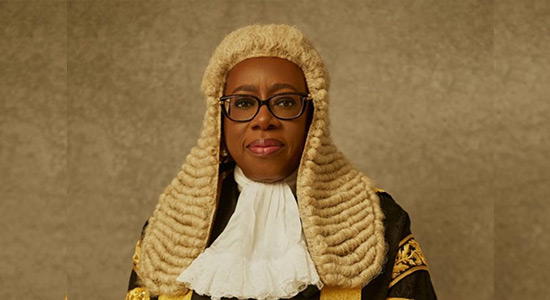
… warns against conflicting orders on election matters
By Ikechukwu Nnochiri
ABUJA– Perturbed by the backlog of cases awaiting judicial attention, the Chief Justice of Nigeria, CJN, Justice Kudirat Kekere-Ekun, on Monday, urged various courts in the country to commence virtual hearing of cases.
According to her, the raditional courtroom methods alone can no longer sustain the weight of matters pending for adjudication.
The CJN spoke at the opening ceremony of the 2025/2026 Legal Year of the Federal High Court.
She noted that the workload of the court continued to grow, not only in volume but in complexity.
“Globalisation, technology-driven crimes, financial innovations, cross-border commercial disputes, terrorism-related matters, and evolving regulatory frameworks now define much of the Court’s docket.
“These realities demand new skills, firmer case management, and rapid judicial
adaptation.
“Digitisation must therefore move from being viewed as a project-based intervention to a core institutional priority. Virtual hearings, e-filing, electronic case tracking, secure record management, and functional ICT support are no longer optional innovations; they are indispensable instruments of modern justice delivery.
“Digitisation enhances not only speed, but accountability, predictability, and public confidence. When court information is accurate, timely, and easily accessible, uncertainty is reduced and trust is strengthened.
“The progress already made in this direction is commendable, but it must be deepened and sustained through continuous training, infrastructure investment, and firm institutional commitment,” the CJN stated.
She commended the federal high court for using the occasion to unveil its Information Electronic Directory Table, Electronic Notice, and Advertorial Display Screens.
“These systems represent more than technological upgrades; they embody a deliberate shift toward transparency, order, and user-centred court administration.
“The Electronic Display Notice Board provides a secure and authoritative platform for the real-time dissemination of court-approved information, including daily and weekly cause lists, administrative circulars, official announcements, and emergency or safety notices.
“By centralising and digitising this information, the Court reduces confusion, curbs disorderly posting of notices, and ensures that judicial officers, counsel, litigants, and members of the public receive accurate and consistent information.
“Complementing this is the Electronic Display Directory Table, an interactive wayfinding tool designed to assist visitors in navigating court premises efficiently.
“By enabling users to locate courtrooms, registries, and departments independently, it reduces congestion, minimises delays, and
improves access to court services.
“Together, these systems promote dignity, efficiency, accessibility, and institutional coherence, which are values that must define the modern Nigerian Judiciary,” she added.
Meanwhile, ahead of the 2027 general elections, the CJN warned judges against the abuse of interim injunctions.
She stressed that election-related cases must be handled with discipline, consistency, and strict adherence to constitutional and statutory timelines.
“The Nation looks to the courts for clarity and balance at such critical moments. This Court has a crucial role to pay in pre-election dispute resolution.
“Conflicting interim orders, forum shopping, and the abuse of ex parte processes undermine the credibility of the entire justice system and weaken public confidence.
“Heads of Divisions must therefore enforce procedural discipline firmly and fairly. The Judiciary must never be perceived as a theatre for political gamesmanship; it must
remain a sanctuary of constitutional order.
“Delay in the administration of justice remains one of the most persistent concerns expressed by both the Bar and the public.
“While some delays are structural, many are preventable. A judge must not regard himself or herself as a passive moderator of proceedings.
“The courtroom requires guidance, firmness, and purposeful control. Effective case management is not optional; it is central to judicial responsibility.
“Accordingly, the National Judicial Council will continue to strengthen oversight of case progression, not as a tool of intimidation, but as a means of supporting institutional
discipline and improving justice delivery,” the CJN added.
In his speech, the Chief Judge of the federal high court, Justice John Tsoho, revealed that at the end of the 2023/2024 Legal Year, a total of 161,999 cases were pending and carried over to the 2024/2025 Legal Year.
He disclosed that within the period, a total of 19, 925 cases were filed, which brought the total number of pending cases to 181,924.
“From this number, a total of 16, 019 were disposed of, leaving 165,905 pending cases. The breakdown of the 16,019 cases disposed of is as follows: Civil cases: 3,113; Criminal cases: 5,818; Motions: 3,724; and Fundamental Human Rights cases: 3,364, bringing it to a total of 16,019 cases.
“Therefore, a total of 44,650 Civil Cases, 44,078 Criminal Cases, 46,228 Motions and 30,949 Fundamental Rights Enforcement applications, remained pending at the end of the last Legal Year.
“From the above analysis, it is glaring that we have done well in the face of our expansive jurisdiction and enormous workload. Our outstanding performance is not only as reflected in the foregoing figures, but is also reflected in other sectors of this country,” Justice Tsoho stated.
On its part, the Nigerian Bar Association, NBA, through its President, Mazi Afam Osigwe, SAN, said their was need for the judiciary to improve on its “institutional integrity.”
“Recent patterns have created troubling perceptions that strike at the core of judicial legitimacy,” the association noted, adding that “one of the deeply distressing frustrations endured daily by litigants, lawyers, and ordinary citizens is the unpredictability of court sittings.”
It said: “Every day, Nigerians rise before dawn, navigate tong distances, brave insecurity on the highways, spend scarce resources on transportation, and appear in Court with the hope that their matter will finally move forward, only to be met with the disheartening announcement that ‘the Court is not sitting’, ‘your case will not go on, so take a date’, or even waiting for hours only for one’s matter to be adjourned off record.
“For many, this means wasted time, wasted resources, renewed anxiety about the progress of their case or loss of confidence in the ability of the court to deliver timely justice.
“More critically, this experience chips away public faith in the judicial system. Justice that is unpredictable in its administration risks becoming inaccessible in its outcome.
“The constitutional guarantee of fair hearing within a reasonable time, enshrined in the 1999 Constitution, cannot be achieved where litigants repeatedly encounter avoidable, unexplained disruptions,” the NBA added
The post CJN to Courts: Start virtual hearing of cases to reduce delays appeared first on Vanguard News.
