•Only Oyo throne has authority — Alaafin
•His claim to exclusive authority collapsed under law, history — Afenifere
•Ooni is supreme authority in Yorubaland — Elebuibon
By Dayo Johnson, Shina Abubakar & Laolu Elijah
IBADAN—THE Alaafin of Oyo, Oba Abimbola Owoade I, has raised the dust over chieftaincy titles bearing the name ‘Yorubaland’, saying it can only be conferred by the throne of Oyo.
He also stressed that such honours are not decorative favours, but solemn duties rooted in history, law and responsibility.
However, the pan-Yoruba socio-political organisation, Afenifere, and Ifayemi Elebuibon disagreed with the monarch, insisting that the Ooni of Ife, Oba Adeyeye Ogunwusi, remains the supreme authority over Yorubaland.
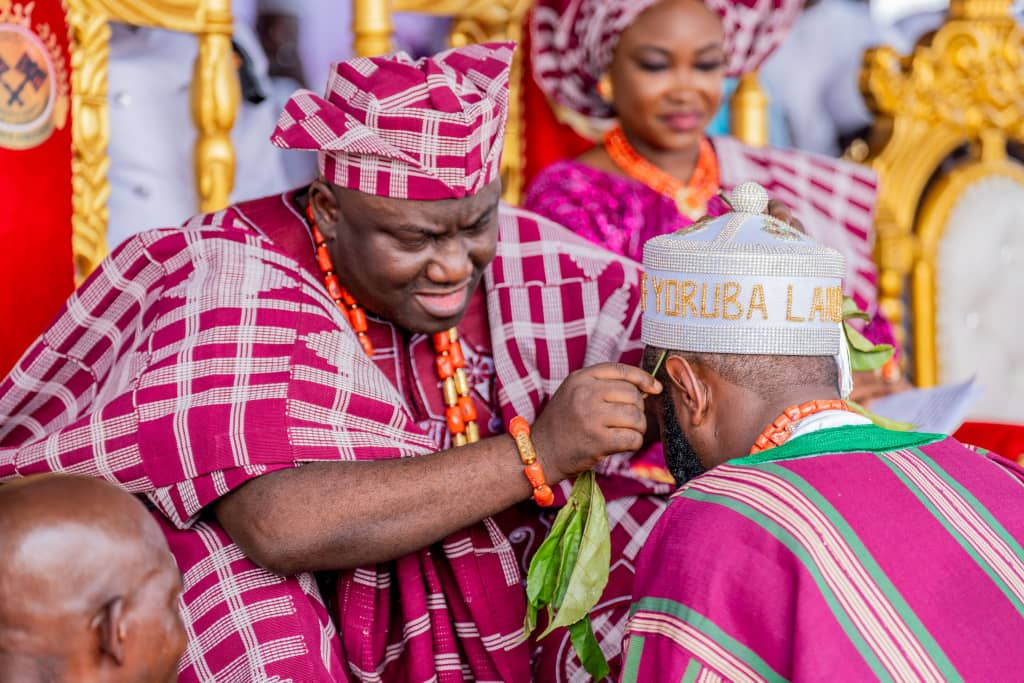
The Alaafin made the assertion, on Sunday, at the Aganju Forecourt of the Aafin Oyo, during the installation of Senator Abdul-Aziz Yari as Obaloyin of Yorubaland, and Mr. Seyi Tinubu as Okanlomo of Yorubaland.
Addressing the gathering, Oba Owoade explained that chieftaincy within Yoruba culture carries obligations that transcend personal prestige and honour.
According to him, such titles impose a lifelong responsibility to serve the people, uphold tradition and protect the collective interests of Yorubaland.
He traced the authority of the Oyo throne to the earliest political organisation of the Yoruba people, noting that the Alaafin historically occupied a central coordinating position that extended beyond Oyo town to the wider Yoruba nation.
This role, he said, was neither assumed nor self-declared, but recognised and sustained across generations.
The Alaafin said: “Chieftaincy, in our culture, is not an act of favour. It is not decoration. It is a duty, conferred only when history, authority, and responsibility align.
“From the earliest organisation of the Yoruba people, authority was never vague. Our forebears understood structure. This understanding gave Yorubaland stability long before modern governance arrived.
“The throne of Oyo emerged in that history as a coordinating authority, by responsibility. When colonial administration came, it did not invent this reality; it encountered it and recorded it. By 1914, Oyo Province had become the largest province in Southern Nigeria, covering 14,381 square miles. It was bounded in the north by Ilorin and Kontagora, in the east by Ondo and Ijebu, in the south by Ijebu and Abeokuta, and in the west by French Dahomey. This reflected recognised leadership over a wide and diverse space.
“This history explains why certain chieftaincy titles are different in nature. Titles that bear the name ‘Yorubaland’ are not local. They are collective titles. They speak not for one town or one kingdom, but for the Yoruba people as a whole. Such titles must therefore proceed from an authority whose reach, by history and by law, extends across Yorubaland.
“I do not speak to provoke debate. I speak to the state order. Among the Yoruba, authority has never been a matter of assumption or convenience. It has always been a matter of history, structure, and law. Thrones were not created equal in function, even though all are sacred in dignity.
From the earliest organisation of Yorubaland, the Alaafin of Oyo occupied a central and coordinating authority—an authority that extended beyond the walls of Oyo and into the collective political life of the Yoruba people. This was not self-declared. It was recognised, enforced, and sustained across generations. Colonial records acknowledged it. Post-independence councils preserved it. Scholars documented it.
“And finally, the Supreme Court of Nigeria affirmed it. The law is clear. History is settled. Chieftaincy titles that bear the name Yorubaland—titles whose meaning, influence, and obligation are not confined to a single town or kingdom—fall under a singular, established authority. That authority is the throne of Oyo.”
His claim to exclusive authority collapsed under law, history — Afenifere
Reacting to the Alaafin’s claim, the pan-Yoruba socio-political organisation, Afenifere, said the monarch’s assertion remains legally untenable, historically deceptive and royally imprudent.
Afenifere’s Organising Secretary, Mr Kole Omololu, in an interview with Vanguard, said such assertion should be withdrawn in the interest of order, coherence and fidelity to law.
Omololu said: “At the outset, it must be stated plainly that under the 1999 Constitution of the Federal Republic of Nigeria (as amended), traditional institutions possess no supra-regional or pan-ethnic authority.
“Chieftaincy matters lie strictly within the legislative and administrative competence of individual states, as provided under Sections 4, 5 and 315 of the Constitution, and as further articulated in the Chiefs Laws and Traditional Rulers Laws of the respective Yoruba-speaking states.
“No traditional ruler, regardless of the antiquity of his throne, exercises lawful authority beyond the territorial limits of the state and domain in which he is recognised.
“The certificate of recognition issued to the Alaafin by the Governor of Oyo State, being the sole juridical foundation of his contemporary authority, confers recognition strictly within Oyo State.
“It does not, either expressly or by implication, extend his authority to ‘Yorubaland’.
“Authority in modern Nigeria does not flow from imperial memory, romanticised antiquity or personal proclamation; it flows from law.
“The Alaafin’s powers are therefore delegated and circumscribed, not inherent, expansive or universal.
“Equally flawed is the invocation of the defunct Oyo Empire as a basis for contemporary jurisdiction.
“Empires rise and collapse; constitutional states do not inherit imperial suzerainty.
“Even at its apogee, the Oyo Empire did not extend to anything approaching the totality of present-day Yorubaland, which today spans well beyond six states and numerous communities outside Nigeria’s borders.
“Historical influence, however formidable, does not translate into present legal competence.
“If the Alaafin seeks to anchor authority on forceful annexation under imperial conquest, then consistency would demand a call for the return of British colonial rule.
“Worse still, such reasoning invites scrutiny of the Oyo Empire’s documented participation in the trans-Atlantic slave trade, for which apology and restitution would be more appropriate than historical revisionism.
“The claim of a central coordinating authority is further demolished by established custom and lived reality.
“As of today, no recognised Yoruba monarch pays annual homage to the Alaafin, nor does any statutory or customary council elevate his throne above others. Within Nigeria’s legal framework, all recognised traditional rulers are equal in dignity, each sovereign only within his lawful jurisdiction.
“The invocation of the alleged Supreme Court authority is similarly misleading. The apex court has consistently held that chieftaincy matters are questions of customary law regulated by state legislation, not instruments for pan-ethnic domination or cultural monopolisation. No reported decision of the Supreme Court vests exclusive ‘Yorubaland’ authority in the Alaafin of Oyo.
Ooni is the supreme authority in Yorubaland – Elebuibon
On his part, High Ifa Priest, Chief Ifayemi Elebuibon, has insisted that the Ooni of Ife, Oba Adeyeye Ogunwusi, remains the supreme authority over Yorubaland.
The traditionalist noted that while the Ooni is traditionally regarded as the spiritual head of the Yoruba, the Alaafin of Oyo historically wields political power.
He said: “Before the colonial era, the dual roles had never resulted in any form of supremacy war. Ile-Ife is the source from where every other thrones derived authority, while Oyo was the political source from the frontiers of the Yoruba territory expanded. The rivalry has its source in the colonial political intervention in Yoruba and the deliberate efforts to change the tradition of Yoruba as a race.
“The supremacy battle between the two thrones or monarchs has nothing to do with Yoruba tradition or history. Traditionally, the relationship between the Ooni and Alaafin is like that of a father to a child and a child does not disrespect his father.
“The Ooni, as a father, was blessed with many sons, among whom is the Oranmiyan, who became the Alaafin and was very powerful. He expanded the kingdom to the status of an Empire, but that does not make him superior to his father. Hence, Yorubaland still derives its supreme authority from Ile-Ife, headed by the Ooni.
“Because the colonialists made a treaty with the Alaafin does not make him superior over the Ooni; it is the white man’s way of creating division within the race. But according to Yoruba tradition, Ooni is the most superior among Yoruba traditional rulers.”
The post Dust over conferment of Yorubaland chieftaincy titles appeared first on Vanguard News.
