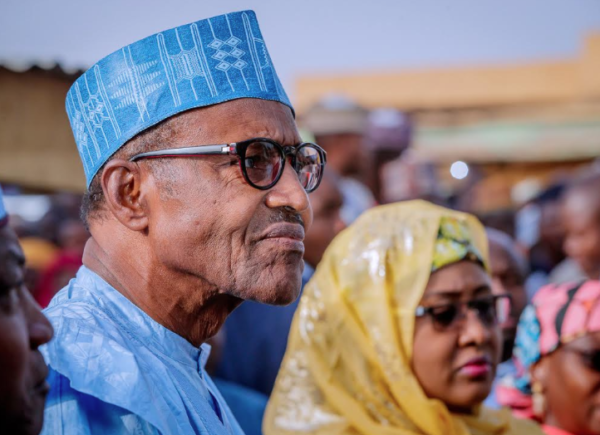
•Buhari’s last moments
By Johnbosco Agbakwuru
The final days of President Muhammadu Buhari, after his eight-year reign, were traumatic for the family due to the former president’s serious health challenges. Buhari was in his eighties when he completed his two terms.
In the book From Soldier to Statesman: The Legacy of Muhammadu Buhari, authored by Dr. Charles Omole, former First Lady Dr. Aisha Buhari recounts: “The final days were difficult. ICU for some days, then the ward, then the slide. The last three days were the worst.”The book quotes Aisha’s account: “After leaving office, in his final year before passing, phone calls increased and transatlantic trips became more frequent. The family’s calendar was filled with funerals and flights. He had gone to the UK, as he often did, to repair a tooth and enjoy the summer air.
She stayed behind in Abuja, mourning a nephew, then returned to London before going back to Nigeria when an uncle died.”Her account of his illness and death is tender, granular, and unflinching. He had been a soldier in the bush for 30 months, mostly in the South-South, soaked by rain in uniforms that dried on his body. Decades later, she believes, the cold had lodged in his lungs and bones—exacerbated by office air-conditioning. There had been smoking in his earlier life, she concedes. Age did the rest. Pneumonia was the last adversary.
The biography noted that Buhari’s children moved in and out of hospital corridors, with one daughter spending the night before his last at his side. When he deteriorated, doctors diagnosed acute pneumonia—a diagnosis that sat uneasily with the public’s hunger for a more precise explanation. “Pneumonia doesn’t usually kill people,” she was asked. She agreed but replied, “It can, especially with old age, and perhaps with a lifetime’s exposure to cold and dust in the field. He always coughed, even when he laughed.”Hospitals have an unspoken language—an innate grammar that the living never fully masters: the subtle change in a patient’s breathing, a nurse’s ability to interpret coldness in a foot as if reading scripture, and pillows becoming strategic tools.
Aisha recalled trying to lift her husband’s shoulder to place a pillow recommended by a Gambian nurse, intended to alleviate pneumonia’s grip on his lungs. “They counted together, ‘One, two, three,’ but they couldn’t shift the weight, which in her hands felt like 50 kilograms of her husband and their shared history. Instead, they inserted the pillow sideways, symbolizing a gesture of compromise.
‘Are you okay now?’ she asked. ‘Yes, thank you,’ he replied.”There were shifts and prayers, the rotation of children who slept beside him, the young Nigerian doctor she liked, X-rays taken in the morning and again later with a mobile unit, and fragile optimism after sputum tests came back without the dreaded diagnosis. It was pneumonia, they said, but at his age, pneumonia can be severe.At 2 p.m., she told him she would go home to rest, bathe, pray, and return.
He nodded, eyes closed, occasionally opening them in that gentle, restless manner of the ill, as if gauging the distance between resignation and will. She called an Uber—since state cars had gone with the doctors—and left.
In the house, she lay down and felt it: a strange pull, a disturbance that made the clock’s minute hand sound louder than it should. “Let’s go back to the hospital,” she told Yusuf. It was 4 p.m., the exact time, she later learned, when his breathing changed and then ceased. “We rarely arrive at the threshold of death before it happens. We only feel it as a tremor behind the door.”
Aisha addressed rumors that her husband may have died of cancer, stating the diagnosis they received indicated pneumonia.
“Other sources reported lung-related cancer, specifically pulmonary lymphoma. Experts note that diagnosing pulmonary lymphoma can be challenging, as its symptoms and scan appearances may resemble pneumonia. Those claiming Buhari died of cancer might have misinterpreted publicly leaked symptoms.
Aisha insisted the official diagnosis was pneumonia.Public reporting described a “prolonged illness,”
with some sources citing leukemia. The BBC’s coverage noted a “brief illness” and burial in Daura two days later; The Guardian mentioned a “prolonged illness” in London; other outlets, including advocacy sites, reported leukemia; Britannica’s biographical entry records his death in London at age 82. Aisha’s account adds intimate details: the magazine in his hand in the ICU; the small joke about moving him to a proper ward, “since you are well enough to watch TV.” She would banter with him.
The book, quoting experts, identified poor strategic communication as one of the Buhari government’s weaknesses. “Simple and banal developments were transformed into major conspiracies due to a lack of openness and effective communication,” it states.
Aisha added: “Rumors would begin, and stories would take on a life of their own, with no clear strategic direction to the messaging. Nigerians did not know what to believe. This fog of communication persisted until the very end.”
After Buhari’s death, she said, “Those who once held the levers of access—those old uncles and agile associates—felt that their power had vanished along with the principal. They feared her and her son.”
Aisha stated that neither had the desire or inclination for vendetta. The state’s takeover of her husband’s burial program, she added, saved another round of embarrassment.
“The state’s management of the burial logistics both stabilized the ritual and limited opportunities for mischief,” she said. She and her son “did not come to fight.”The presidency’s tight control of arrangements denied the old courtiers room to maneuver or inject themselves into the choreography. She calls them people “without capacity,” men she could work with “as a local government chairman,” perhaps, but not as a president’s core.
Aisha said if the 2017 crisis began in a kitchen, its broader stage was the house where that kitchen was situated. “
According to her: “Aso Villa is not merely a home but an ecosystem. The house quickly filled with relatives and their wives and grandchildren, as well as courtiers and staff who learned the shortcuts and shadows. ‘They tried to push everybody out, including me.’”She concluded: “This is my house. You can live wherever you like, but you cannot be in charge of my husband’s office and then also be in charge of me, his wife, inside my house.”
The post After leaving office, Buhari family’s calendar was filled with funerals — Aisha appeared first on Vanguard News.
