11 min read
2027: Reps cave in, back Senate on Electoral Act amendment
vanguardngr.com
Wednesday, February 18, 2026
By Henry Umoru, Omeiza Ajayi & Gift Odekina ABUJA — Fresh turmoil engulfed the National Assembly yesterday, as minority members of the House of Representatives staged a dramatic walk-out over contentious provisions in the Electoral Act Amendment Bill, even as police tear-gassed protesters ...
By Henry Umoru, Omeiza Ajayi & Gift Odekina
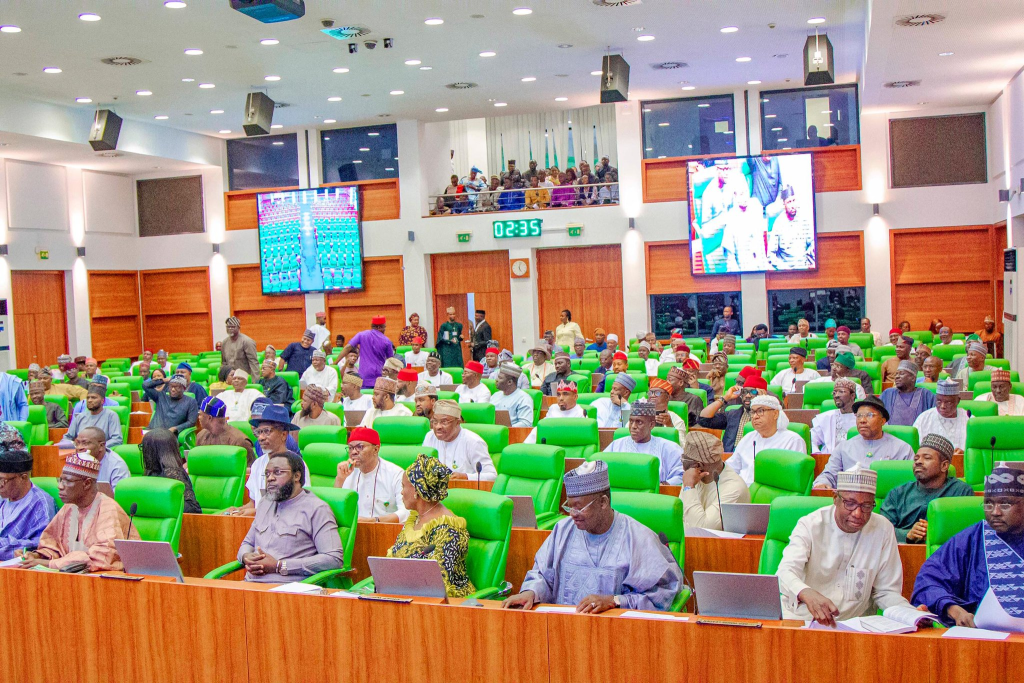
ABUJA — Fresh turmoil engulfed the National Assembly yesterday, as minority members of the House of Representatives staged a dramatic walk-out over contentious provisions in the Electoral Act Amendment Bill, even as police tear-gassed protesters demanding mandatory electronic transmission of results ahead of the 2027 general election.
On a day marked by high political drama, heated arguments and street protests, the House caved in to pressure and adopted Clause 60(3), which provides for both real-time electronic and manual transmission of election results. It also passed Clause 84, dealing with the mode of nomination of candidates by political parties.
Vanguard exclusively reported on Monday that the House of Representatives, which had earlier passed e-transmission of results, was under pressure to adopt the Senate version which provided for conditional e-transmission.
The developments triggered outrage from opposition lawmakers, civil society organisations, organised labour and pro-democracy activists, who accused the National Assembly of weakening electoral safeguards and “programming rigging into law.”
This was as the Senate amended the Electoral Act to reduce the notice period for elections from 360 days to 300 days, paving the way for adjustment of the 2027 general election timetable, thus averting a clash with the Ramadan fasting period.
The upper chamber also, for the second time in one week, rejected real-time electronic transmission of election results after a division, as 55 senators voted to retain manual transmission where network fails, while 15 kicked against the provision.
Walk-out over Clause 60(3), 84
Trouble began during clause-by-clause consideration of the Electoral Act Amendment Bill 2025 in the Committee of the Whole.
The House had earlier rescinded its December 2025 passage of the bill to address identified inconsistencies before recommitting it for fresh deliberations. But proceedings turned contentious when lawmakers considered Clause 60(3).
Bamidele Salam moved a motion seeking deletion of the provision allowing manual transmission of results, arguing that election results should be transmitted electronically without exception. The motion was seconded by Minority Leader, Kingsley Chinda.
However, when the proposal was subjected to a voice vote, the “nays” carried the day, effectively retaining both manual and electronic transmission options.
The decision sparked visible anger among minority lawmakers, who later walked out of plenary.
Addressing journalists, Chinda declared that the minority could not support any clause that creates room for manipulation.
“Our position is that elections shall and should be transmitted electronically. We are against any clause that would give room for micro-manipulation, rigging, or leeway for any untoward act,’’ he said.
He disclosed that the minority proposed that where there was any conflict between manually collated Form EC8A results and electronically transmitted results, the electronically transmitted version should prevail.
Walkout deliberate — Chinda
He said further: “Those positions were turned down, and we are aware that they were turned down by members of the APC, not on grounds of patriotism, but on grounds of political party affiliation.
“For us, after what happened on the floor, we felt it was better to register our position with Nigeria, which is the court of public opinion. So we had to leave the plenary. We had to walk out to address you.”
On Clause 84, he insisted that the mode of primaries should remain an internal affair of political parties, saying “our position remains that the method of selection of candidates should be an internal party affair. Political parties should be allowed to determine what method they want to adopt-direct primaries, indirect primaries or consensus.”
Despite the protest, the House passed the contentious provisions, setting the stage for a fresh round of political confrontation as 2027 approaches.
Police tear-gas protesters at NASS gate
While lawmakers clashed inside the chamber, chaos erupted outside the complex as operatives of the Nigeria Police Force fired tear gas at protesters gathered at the main entrance of the National Assembly.
Hundreds of demonstrators, including women and youth groups, had converged to oppose what they described as attempts to dilute electronic transmission of results. Tension escalated when some protesters tried to push toward the gate.
Elderly woman faints
In the ensuing stampede, several persons fell while scrambling to escape the fumes. An elderly woman reportedly fainted.
Attack on democracy
Activist and former presidential candidate, Omoyele Sowore, described the police action as an attack on democracy.
“This has translated to a declaration of war on Nigerians, a war against participatory democracy. For the first time, the police were using compressed containers that penetrate through your skin. Over two people have collapsed, and we’re calling on Nigerians to head down to the National Assembly,” he said.
Sowore, who insisted that protesters were merely demanding access to the gallery to monitor proceedings, said: “When you visit from another country, you have access to the Capitol hall. Why can’t we get into our own National Assembly without being separated from the so-called elected representatives of the people?
‘’We must be part of the gallery where the emergency meeting is holding so we can monitor what is within our rights as citizens.’’
No retreat, no surrender
Protesters vowed to sustain the agitation until lawmakers restored what they called mandatory real-time electronic transmission.
Civil society, labour storm NASS
Earlier, a coalition of civil society organisations and organised labour, under the umbrella of the Movement for Credible Elections , MCE, staged a massive protest at the National Assembly.
The coalition demanded sweeping reforms to guarantee transparent elections before 2027 and warned lawmakers against weakening key provisions of the Electoral Act.
Reading a joint address, former presidential candidate of Social Democratic Party, Prince Adewale Adebayo, said Nigerians had lost confidence in the electoral system due to recurring irregularities.
“Electoral malpractices have evolved into systemic failures that undermine the sanctity of voter mandates,” the coalition said.
Prince Adebayo read the address on behalf of the leaders.
The speech was signed by Dr Usman Bugaje as Co – Chair; Mr. Ayuba Wabba as Co-Chair; Amb Nkoyo Toyo – Deputy Chair; Hajia Bilikisu Magoro – Deputy Chair; Mr. Promise Adewusi, mni – Director of Administration; Mr. Ene Obi – Director of Mobilisation (CS); Peter Ameh – Director of Mobilisation – (PP); Engr Alex Ardum – Director of Mobilisation (NC); Mr. Malachy Ugwumadu, Director, Legal and Deacon Chris Iyovwaye, Director of Mobilization (SS).
Central to the protest was the insistence on mandatory, real-time electronic transmission of polling unit results to the Result Viewing Portal of the Independent National Electoral Commission, INEC.
MCE accused lawmakers of weakening reform provisions by introducing discretionary clauses that could allow manual interference with election results.
“Democracy collapses when votes are stolen,” the coalition declared.
The group outlined a 12-point reform agenda, including stricter penalties for electoral offences; statutory funding guarantees for INEC; independent audits of electoral technology; diaspora voting; early voting for essential workers; and constitutional amendments to conclude election petitions before swearing-in.
It also called for automatic loss of office for defecting lawmakers and transparent appointment processes for INEC leadership.
Organised labour threw its weight behind the protest. Leaders of the Nigeria Labour Congress, NLC. and the Trade Union Congress of Nigeria, TUC, endorsed the call for credible electoral reforms, describing them as essential for national stability.
It’s coup against democracy — Ezekwesili
Reacting to the development, former Minister of Education, Oby Ezekwesili, warned that weakening electronic transmission provisions could amount to “a coup against democracy.”
She urged the National Assembly to adopt provisions that made electronic transmission mandatory and real-time.
“The only way every vote can count is through mandatory, real-time electronic transmission of results. Anything less is unacceptable,” she said.
She criticised references to network failure in the bill, describing them as potential loopholes.
“Introducing excuses like network failure is a pretext for rigging. Nigerians must not accept this,” she warned.
Addressing citizens directly, she said: “If they pass a law that programmes rigging into our elections and the President signs it, then they have declared that Nigerians don’t matter. But we do matter, and we must stand our ground.”
She linked credible elections to governance outcomes. “Without credible elections, Nigeria will continue to suffer from poor leadership and insecurity. 2027 must not mark the end of our democracy,” she said.
El-Buba calls for mass mobilization
Similarly, leader of Evangelical Bible Outreach Ministries International, Prophet Isah El-Buba, called for nationwide mobilisation.
He said: “We must expand the frontiers of this battle as quickly as possible. You cannot take power from these people by one means only.
“If they surround us with elections, we surround them at the elections. If they surround us with network, we surround them with our own network. If they surround us with hunger, we confront them with ideas that can liberate us.”
Describing himself as a revolutionary, rather than a reformist, El-Buba urged sustained pressure on those in power, saying “each time Nigeria had a little bit of consciousness, there’s always an uprising before it. I think we are due for another uprising.”
Senate insists on conditional e-transmission, reduces election notice to 300 days
The Senate, yesterday, amended the Electoral Act to reduce the notice period for elections from 360 days to 300 days, paving way for adjustment of the 2027 general election time-table and averting a clash with the Ramadan fasting period.
The upper chamber also, for the second time in one week, rejected real-time electronic transmission of election results after a division, as 55 senators voted to retain manual transmission where the network fails, while 15 kicked against the provision.
The decision followed an emergency plenary during which the Senate rescinded its earlier passage of the Electoral Act, 2022 (Repeal and Re-Enactment) Bill, 2026 and recommitted it to the Committee of the Whole for fresh consideration.
INEC had earlier fixed February 20, 2027, for presidential and National Assembly elections, and March 6, 2027, for governorship and state Houses of Assembly polls.
Notice period reduced
Leading debate on the motion for rescission and recommittal, Senate Leader, Senator Opeyemi Bamidele, said the 360-day notice requirement in Clause 28 could result in the 2027 presidential and National Assembly elections falling within Ramadan.
He said the overlap could affect voter turnout, logistics, stakeholder participation and overall inclusiveness of the polls.
The Senate accordingly amended Clause 28, reducing the notice period to 300 days.
The amended clause states that the INEC shall, not later than 300 days before the election, publish notice in each state of the federation and the Federal Capital Territory, stating the date of the election and where nomination papers are to be delivered.
For bye-elections, INEC is to issue notice not later than 14 days before the poll.
The Senate said the adjustment would give INEC flexibility to fix election dates between December 2026 and January 2027, thereby avoiding Ramadan.
Rowdy session in Senate over Clause 60
However, proceedings turned rowdy during clause-by-clause consideration when Clause 60, which deals with transmission of results, was called.
Senator Enyinnaya Abaribe raised a point of order and later called for a division on Clause 60(3), opposing the provision that allows manual transmission of results where electronic transmission fails.
The chamber descended into heated exchanges, forcing a closed-door session that lasted nearly an hour.
On resumption, Deputy Senate President, Barau Jibrin, argued that it was out of order to revisit issues already decided.
However, Senator Bamidele, maintained that since the Senate had rescinded its earlier decision, all provisions were open for reconsideration.
When put to vote by division by Senate President, Godswill Akpabio, 55 senators voted to retain the provision permitting manual transmission in the event of network failure, while 15 voted against it.
With the outcome, the Senate again rejected mandatory real-time electronic transmission of election results, maintaining that where the network failed, the manually signed Form EC8A shall serve as the primary source of results.
Akpabio described the exercise as democracy in action and commended both sides for standing by their convictions.
The amended bill is expected to be harmonised with the House of Representatives’ version before transmission for presidential assent.
Wike fires back at opposition
Meanwhile, Minister of the Federal Capital Territory, Nyesom Wike, dismissed opposition figures backing the protest against lawmakers rejection of real-time transmission of election results as “grandstanding.”
Speaking at the University of Abuja, he took a swipe at former Rivers State governor, Rotimi Amaechi, who appeared at the protest last week with his son, a medical doctor.
“He said he came with his son, who is a medical doctor, to treat anyone who might be injured. But where was the ambulance? Where was the medical equipment? You cannot treat people with empty hands,” Wike said. He accused opposition leaders of opportunism, saying “when they are out of office, they suddenly become the voice of the people.’’
Wike, who described the agitation as “transactional,’’ defended the administration of President Bola Tinubu, saying it is focussed on purposeful leadership and difficult reforms.
The post 2027: Reps cave in, back Senate on Electoral Act amendment appeared first on Vanguard News.
Read the full article
Continue reading on vanguardngr.com


