5 min read
Mainstream media. When silence becomes editorial policy
michaelwest.com.au
Thursday, February 12, 2026
Mainstream media sets the tone, controls the narrative and decides who gets scrutiny and who gets soft focus. It records without bearing witness to the obvious. Andrew Brown. A fracture has opened in Australian media, and it is no longer subtle. On one side sits what people see every day on their...
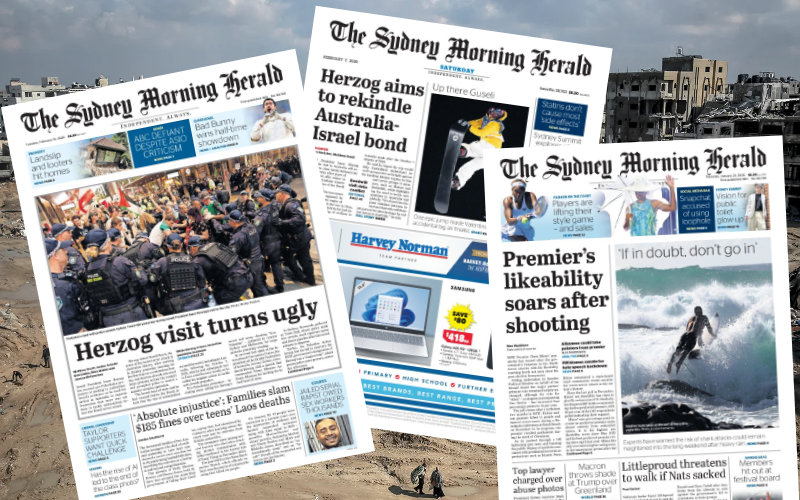
Mainstream media sets the tone, controls the narrative and decides who gets scrutiny and who gets soft focus. It records without bearing witness to the obvious. Andrew Brown.
A fracture has opened in Australian media, and it is no longer subtle.
On one side sits what people see every day on their phones. Raw footage, unedited testimony, the awful intimacy of a war recorded by those living inside it. On the other sits the Sydney Morning Herald: moderated, measured, written as though mass civilian death can be rendered bearable through tone alone.
For many Australians, that softened version is the only version.
My father is ninety-four. He does not scroll. He does not watch livestreams from Rafah. He does not see rubble shifting under bare hands or hear final messages sent from beneath concrete. He reads the Herald to understand what is being done in our name.
He is not a fringe reader. He votes. He shapes conversation. He believes the paper that calls itself the record will tell him what matters most.
However, the question is no longer whether the Herald covered Gaza. The question is whether it witnessed it.
Gaza reporting bias
Since October 2023, Gaza has become the most documented civilian catastrophe of the modern era. Tens of thousands dead. Entire neighbourhoods erased. Starvation warnings issued. Aid workers killed. Journalists killed in unprecedented numbers.
A review of senior international commentary over this period reveals something striking. The defining moral crisis of this decade rarely commanded sustained, front-facing analysis from the Herald’s most senior international voice, Peter Hartcher.
Between October 2023 and mid 2025, Hartcher appears to have written three substantive pieces primarily focused on Gaza and Palestine. Three.
That is not absence of coverage across the masthead. It is absence of weight. A crisis of this magnitude would ordinarily generate columns, follow-ups, moral framing, and pressure. Instead,
Gaza largely entered the opinion pages through the language of diplomacy, optics, and political management.
When the war’s most disturbing episodes surfaced globally, they were reported. What was missing was insistence. The drumbeat. The editorial heat.
Gaza realities
Consider what Australians were watching elsewhere. Outside of mainstream media.
Ambulance crews killed in incidents that demanded investigation.
The case of six year old Hind Rajab, whose desperate calls for rescue were recorded before the ambulance sent to her was later found destroyed.
Medical staff detained for extended periods without charge.
Reports and footage alleging abuse of detainees.
Mass graves reported at hospital sites.
Deadly shootings around food distribution points.
Seven World Central Kitchen aid workers killed in three consecutive drone strikes along a pre-cleared humanitarian route, including Australian volunteer Zomi Frankum.
Each episode travelled the world at speed. Each generated international scrutiny. In Australia, they passed through the cycle and moved on.
If China had killed an Australian aid worker in a marked humanitarian convoy in 2023, it would still dominate commentary today.
There would be demands for consequences.
Panels. Pressure.
When Israel did it, the language softened. And in that contrast – the absolution reflex – is the story.
The Herzog visit
As Gaza continues to face hunger and devastation, the SMH ran a lengthy profile of Israel’s visiting president. Readers were guided through biography, friendships in Australia, expressions of solidarity after Bondi, and a repeated refrain: he is largely symbolic. Not the executive decision maker.
This is how moral distance is constructed.
Responsibility narrows. Power is redefined downward. The head of state becomes ceremonial rather than accountable.
But symbolism is not harmless. It is representation. The president has publicly defended Israel’s conduct of the war. Asked whether civilian life could have been better protected, he expressed no significant reservation about the strategy, arguing that conflict in civilian terrain makes suffering painful but unavoidable.
That position is political. It is a defence. The widely circulated image of the president signing a shell later used in Gaza was acknowledged briefly and dismissed as poor taste. No sustained interrogation followed.
Instead, the piece pivoted to protest. Protest was framed as divisive and futile. Silence was presented as maturity.
The moral lens shifted from Gaza to Australian decorum.
Disclosure and trust
There is a further issue legacy media rarely confronts.
For years, Australian journalists have participated in sponsored delegations and familiarisation tours to Israel. These programs are lawful and common practice. But the Herald does not systematically disclose within individual articles whether a commentator covering Israel has ever accepted such hospitality.
In an era of fragile media trust, transparency is not optional. If the answer is no, say no. If the answer is yes, say when. Readers deserve clarity.
The reckoning
The public has already witnessed this war without filters. They have seen enough to know when euphemism is doing work. When restraint becomes avoidance. When balance becomes paralysis.
So when they open the Herald and encounter diplomacy talk where a human ledger should be,
they do not feel informed. They feel curated.
This is not about one columnist. It is about institutional instinct. When power is distant and adversarial, the Herald can be fierce. When power is familiar and aligned, the tone shifts.
That is the test of a paper of record, and a record does not filter reality.
It does not redirect moral energy away from those who wield force and toward those who protest it. It does not mistake civility for truth. A record is a witness.
History will remember Gaza, and it will remember who described it clearly. And who preferred reassurance.
Ink can illuminate or bury. Once printed, it cannot claim it did not know.
Read the full article
Continue reading on michaelwest.com.au


