7 min read
Why I don’t want to handle Malami’s trial – Judge
vanguardngr.com
Thursday, February 12, 2026
By Ikechukwu Nnochiri A judge of the Federal High Court in Abuja, Justice Obiora Egwuatu, on Thursday, recused himself from the money laundering charge the Economic and Financial Crimes Commission (EFCC) filed against the immediate past Attorney-General of the Federation and Minister of Ju...
By Ikechukwu Nnochiri
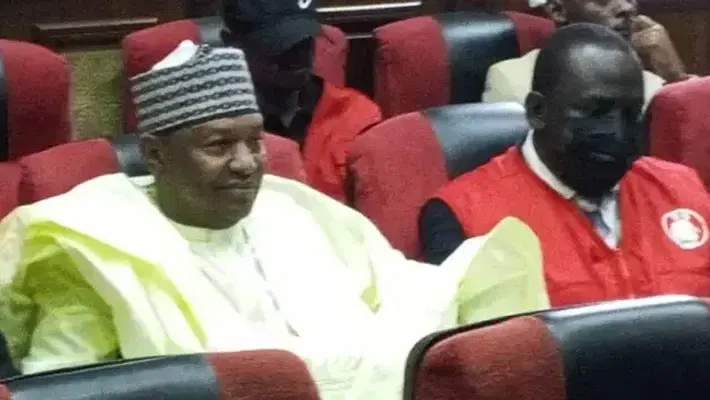
A judge of the Federal High Court in Abuja, Justice Obiora Egwuatu, on Thursday, recused himself from the money laundering charge the Economic and Financial Crimes Commission (EFCC) filed against the immediate past Attorney-General of the Federation and Minister of Justice, Mr. Abubakar Malami, SAN.
The trial judge equally withdrew from a second case involving 57 choice properties, which the anti-graft agency said were linked to the former AGF and which the court had earlier ordered temporarily forfeited to the Federal Government.
According to Justice Egwuatu, to whom the Chief Judge recently assigned both cases, he could not proceed with the matters owing to “personal reasons.”
He maintained that in the interest of justice, the case files would be returned to the CJ to be reassigned to another judge for adjudication.
Malami, who served as Justice Minister from November 11, 2015, to May 29, 2023, under former President Muhammadu Buhari’s administration, is facing a 16-count money laundering charge.
He was arraigned before the court, alongside his son, Abdulaziz, and one of his wives, Hajia Bashir Asabe.
The defendants were alleged to have laundered public funds totalling about N9 billion.
According to the EFCC, the defendant, in a bid to hide his proceeds of crime, resorted to acquiring choice properties in various cities and states, including Abuja, Kebbi, and Kano.
Following an ex parte application that was brought before the court by the agency, Justice Emeka Nwite, while sitting as a vacation judge on January 6, ordered interim forfeiture of the 57 properties that were allegedly traced to the former AGF.
Justice Nwite directed the EFCC to publish a notice inviting anyone with an interest in any of the property to appear before the court and show cause why they should not be forfeited to the government.
However, upon the expiration of the vacation period, the case files were transferred to Justice Egwuatu for the continuation of the proceedings.
Meanwhile, shortly after the first case involving the 57 properties was called up on Thursday, Justice Egwuatu announced his decision to withdraw from both matters.
The EFCC had told the court that Malami and his co-defendants had between July 2022 and June 2025, used a firm- Metropolitan Auto Tech Limited- to conceal over N1.01bn in a Sterling Bank account.
They were further accused of using the same company to siphon about N600million between September 2020 and February 2021.
Likewise, EFCC told the court that the defendants had retained N600m in March 2021 as cash collateral for a N500m loan that the firm—Rayhaan Hotels Ltd—obtained from Sterling Bank, despite allegedly knowing that the funds were proceeds of crime.
The defendants were said to have acted in breach of several provisions of the Money Laundering (Prohibition) Act, 2011.
Among those billed to testify against them were investigators, bank officials, real estate agents, as well as Bureau de Change operators.
The defendants have since denied the allegations; even as Malami filed a motion not only to explain his source of wealth but also to persuade the court to release to him three of the 57 seized properties.
He told the court that whereas he inherited one of the assets from his late father, the others were acquired before he became the AGF.
Malami identified the three property as Plot 157, Lamido Crescent, Nasarawa, GRA, Kano, purchased in July 31, 2019; a Bedroom Duplex and Boys Quarters at No.12, Yalinga Street, Off Adetokunbo Ademola Crescent, Wuse Il, Abuja, purchased in October 2018 at N150million, and ADC Kadi Malami Foundation Building, bought at N56million.
The EFCC had listed them as No. 9, 18 and 48 in the schedule of property it attached in the interim forfeiture order it secured from the court.
Specifically, the embattled ex-AGF, in the process he filed through his legal team led by Mr. Joseph Daudu, SAN, sought two prayers:
“An order of this honourable court vacating, setting aside and/or discharging the interim order(s) of this honourable court made on the 6th of January, 2026 against the respondent/applicant’s (Malami’s) properties listed as Nos. 9, 18, and 48 in the schedule of properties attached to the interim order of forfeiture of 6th January, 2026, the said properties having been duly declared in the respondent/applicant’s asset declaration forms throughout his tenure as a public officer and No. 48 is held in trust for the Estate of Late Khadi Malami Nassarawa.”
As well as, “An order of this honourable court restraining the applicant/respondent (EFCC), acting by itself or through its servants, agents and proxies from interfering with the respondent/applicant’s (Malami’s) properties in issue or disturbing the respondent/applicant’s ownership, possession and control thereof in the course of purportedly giving effect to the order of this honourable court made on the 6th of January, 2026.”
He told the court that the property were appropriately mentioned in various asset declaration forms he filled and submitted before the Code of Conduct Bureau (CCB), insisting the EFCC failed to adduce any prima facie evidence to establish that they were acquired through proceeds of crime.
Concerning the property listed as No. 48, Malami said he held it in trust for the benefit of the estate of his late father, Late Kadi Malami.
“These assets, their value and their root of title have been clearly stated and specifically demonstrated in the various asset declaration forms spanning from 2019 to 2023.
“The declaration above is prima facie evidence of the legitimacy of the acquisition and ownership of the properties,” he added.
Enumerating his sources of income, the former AGF told the court that he previously disclosed to the CCB that his earnings included: N374, 630,900 million income from salaries, estacodes, severance allowance and others;
“Sitting allowances as a board/committee member of the Federal Judicial Service Commission, Federal Capital Territory Judicial Service Commission, Legal Practitioner Privileges Committee, and a high-powered presidential committee.
“N574, 073, 000 (Five hundred and seventy-four million, and seventy-three thousand naira) as income generated through disposed assets
“N10, 017,382,684 (Ten billion, seventeen million, three hundred and eighty-two thousand, six hundred and eighty-four thousand naira) turnover from businesses.
“N2, 522, 000, 000 (Two billion, five hundred and twenty-two million naira) being loans to businesses
“N958,000,000 (Nine hundred and fifty-eight million naira) as a traditional gift from personal friends.”
He told the court that a total sum of N509,880,000 (Five hundred and nine million, eight hundred and eighty thousand naira) was realised as income from the launch and public presentation of his book titled: “Contemporary Issues on Nigerian Law and Practice, Thorny Terrains in Traversing the Nigerian Justice Sector: My Travails and Triumphs.”
According to him, “These streams of income, and the continuing profits generated from the businesses over the years, sufficiently show that the properties sought to be forfeited were acquired through legitimate and lawful means as stated in the asset declaration forms.”
Accusing the EFCC of obtaining a forfeiture order against him through the suppression of material facts, Malami maintained that the court moved against him over property that “were lawfully acquired post appointment of the respondent/applicant and declared with the Code of Conduct Bureau as legitimate assets of the respondent/applicant, in compliance with the 5th Schedule to the Constitution of the Federal Republic of Nigeria, in 2019 and 2023.”
He argued that the interim forfeiture order was obtained by “manifest exaggeration, malicious inflation of the value of the assets, and unreasonable and incompetent valuation deliberately manipulated to mislead the court, negatively affecting its discretion in granting an order based on manipulated facts and conclusions deliberately cooked up by the applicant/respondent (EFCC).”
“That this proceeding is an assault on the applicant’s fundamental right to property, his presumption of innocence and his right to live in peace with his family,” Malami added.
The post Why I don’t want to handle Malami’s trial – Judge appeared first on Vanguard News.
Read the full article
Continue reading on vanguardngr.com
More from vanguardngr.com

4 minutes ago
জালিয়াতির মাধ্যমে সরকার হলে জনগণের দুঃখ বুঝবে না: জামায়াতের আমির

5 minutes ago
В Тульском музейном объединении подарят книгу об искусстве 14 февраля

5 minutes ago
Apakah Benar Ada Siksa Kubur di Alam Barzakh Sebelum Kiamat?

5 minutes ago