5 min read
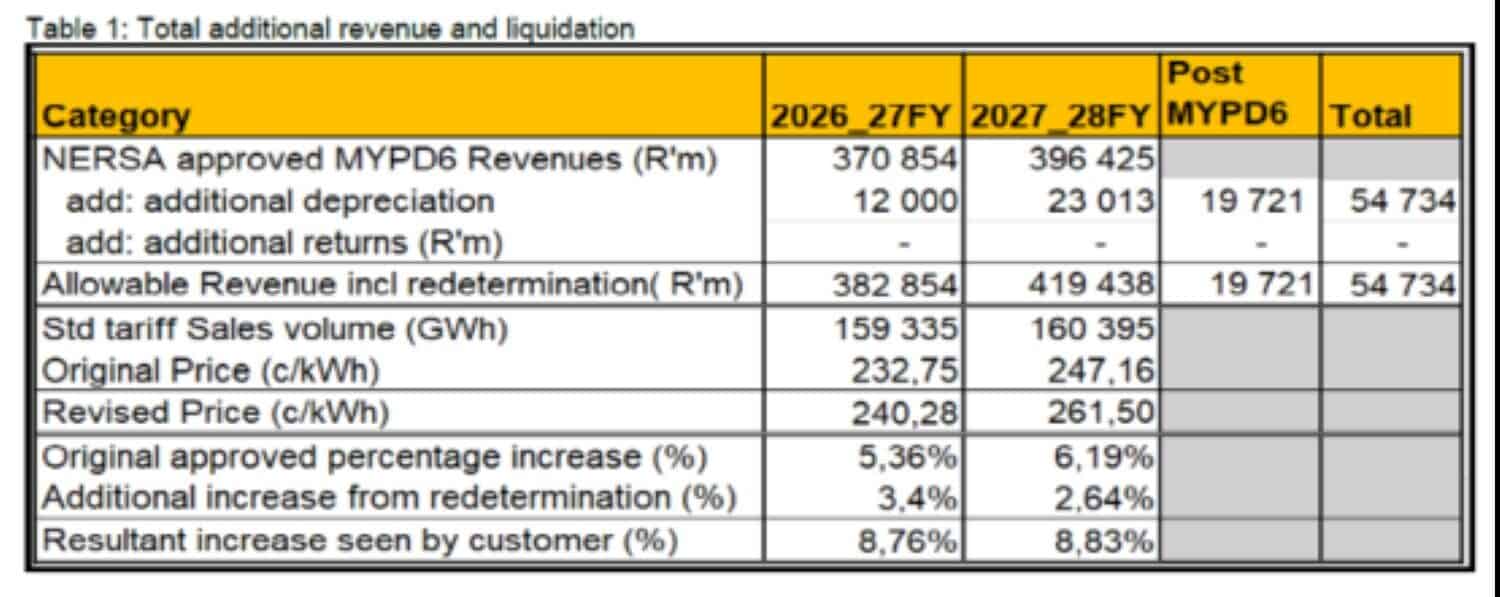
Nersa’s mistakes turn 5.36% tariff increase into 8.76%
citizen.co.za
Monday, February 9, 2026

Consumers’ fears came true this weekend when energy regulator Nersa confirmed that Eskom’s average tariffs will increase by 8.76% this year, instead of the 5.36% initially announced more than a year ago. This follows the redetermination of Eskom’s revenue to correct earlier mistakes made by Ne...
Consumers’ fears came true this weekend when energy regulator Nersa confirmed that Eskom’s average tariffs will increase by 8.76% this year, instead of the 5.36% initially announced more than a year ago.
This follows the redetermination of Eskom’s revenue to correct earlier mistakes made by Nersa. The increase will take effect on 1 April for those buying electricity directly from Eskom and on 1 July for municipal customers.
2027 tariff increase
Next year, the increase will amount to 8.83% instead of the initial 6.19%, as the additional R54 billion in revenue Nersa awarded Eskom over the weekend is phased in.
A further R19.7 will be carried over to future increases.
Moneyweb has also established that another R40 billion, related to an earlier settlement between Eskom and Nersa – also the result of mistakes made by Nersa – will be rolled over to future tariff increases.
This will make the promises made by Electricity and Energy Minister Dr Kgosientsho Ramokgopa, of electricity hikes slowing down, difficult to keep.
On an average cents-per-kWh basis, the additional increase this year will add about 7.5c to every unit of electricity consumed, bringing the price to 240.28c/kWh.
ALSO READ: Municipalities ‘must be heard’ before Nersa sorts its R76bn mistake
Redetermination follows regulatory errors
This comes as Nersa stuck to the R54 billion in additional revenue it agreed with Eskom during an earlier secret settlement.
The settlement, which Nersa only disclosed after Moneyweb reported on it, stirred outrage among residential, commercial and industrial customers, who are already struggling to make ends meet against the backdrop of consecutive above-inflation increases in electricity tariffs.
AfriForum and Minerals Council SA opposed an application to make the settlement an order of court.
The High Court in Pretoria agreed with them that it was unlawful for Eskom and Nersa to make a decision that would burden consumers without consulting them.
In December, it remitted the matter to Nersa to redetermine Eskom’s revenue in relation to the Regulatory Asset Base (RAB) and depreciation, and the regulator was ordered to put the matter out for public comment.
It is this redetermination that Nersa has now finalised.
Thousands of submissions received
From recordings of the Nersa electricity sub-committee and regulator meetings on Saturday, which Moneyweb reviewed, it is clear that the regulator was flooded with submissions.
These came “from a broad cross-section of stakeholders, including Eskom, organised industry, agriculture, mining, business groupings, civil society organisations, municipalities, and individual members of the public.”
During the meeting, it was stated that there were more than 2 000 submissions, but apparently none of the arguments put forward could move the needle from the R54 billion figure.
Deon Conradie, an electricity pricing expert, says he is not surprised by the result.
“The numbers are not about emotional debates, but rather about financial calculations based on facts. Nersa had already (when it entered the aborted settlement) determined which level of increase the economy could withstand, according to them.”
No submissions convincing enough
Conradie says this implies that none of the submissions were convincing enough for Nersa to revise the figure it had arrived at.
Nevertheless, he says the litigation was important in the broader context.
“It forced Nersa and Eskom to follow due process, rather than do whatever they want. The court confirmed the required processes and reprimanded Eskom and Nersa for deviating from them.”
Eskom will now, based on the adjusted revenue it will be allowed to recover from tariffs, work out its retail tariffs for each consumer group and submit them to Nersa for approval.
This will inform municipal budgets for 2026/27, and subsequently the applications municipalities submit to Nersa for approval of their retail tariffs which will be applied from 1 July.
ALSO READ: Nersa to redo electricity tariffs for Joburg, three other municipalities
Discounts for ferrochrome producers
The additional increase comes as the Department of Electricity and Energy is looking for a way to fund an additional discount on the electricity tariffs paid by Glencore-Merafe and Samancor for their ferrochrome smelters.
Other consumers are already paying billions more for electricity to fund Eskom’s negotiated pricing agreements for these and other energy-intensive users.
These agreements have reduced the unit cost to about R1.32/kWh, which, according to the two companies and their peers, is still too high for them to stay in business and retain thousands of jobs.
Eskom entered into an interim agreement with the two ferrochrome producers to lower the tariff further to 87c/kWh. This is said to potentially cost Eskom nearly R10 billion per year.
Nersa recently approved the 87c/kWh on the condition that any shortfall will be paid by government.
If government finanical support is required
National Treasury told Moneyweb that “should any government financial support be required, then this would be done within the current support package provided for Eskom, thus eliminating any additional support from the fiscus”.
Ramokgopa and Eskom CEO Dan Marokane have, however, assured that the shortfall will not become a further burden on other electricity users.
Glencore-Merafe and Samancor maintain that they can only survive and remain competitive if the tariff is set at 62c/kWh.
This article was republished from Moneyweb. Read the original here.
Read the full article
Continue reading on citizen.co.za
More from citizen.co.za

26 minutes ago
President Assad was 'obsessed with sex and had a lover who also procured wives of high-ranking officials for him to sleep with before he ordered her assassination'

27 minutes ago
SCSK to be removed from JPX-Nikkei Index 400

27 minutes ago
Amazon Prime Kosten: Das kostet ein Amazon Prime-Abonnement 2026

28 minutes ago