9 min read
Manufacturers record N1.8trn unsold goods as demand slumps
vanguardngr.com
Monday, February 9, 2026
…Inventory surge contradicts official claims of economic recovery By Peter Egwuatu Despite signs of improving macroeconomic indicators published by the Federal Government, the latest financial results of Nigeria’s manufacturing sector have indicated that significant pressures persist. Fi...
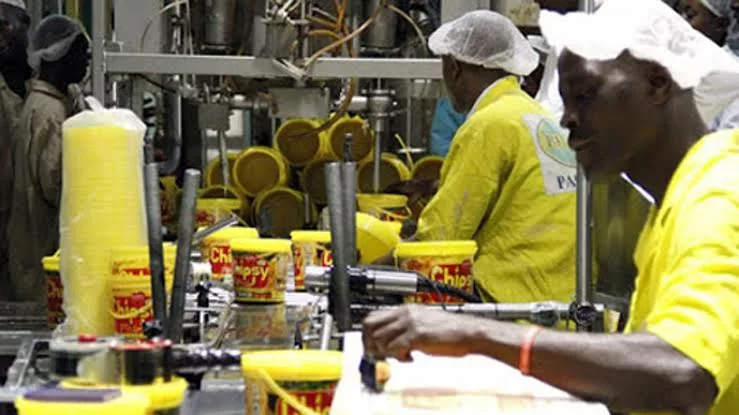
…Inventory surge contradicts official claims of economic recovery
By Peter Egwuatu
Despite signs of improving macroeconomic indicators published by the Federal Government, the latest financial results of Nigeria’s manufacturing sector have indicated that significant pressures persist.
Financial Vanguard’s findings show that the manufacturers have continued to grapple with rising inventories (unsold goods) littering warehouses along with swelling stockpiles of raw materials, exposing deep inflationary constraints, foreign-exchange and credit pressures that continue to weigh on industry performance.
Leading manufacturing firms, in the first nine months of 2025 (9M’25), recorded combined inventories increase of N200 billion, rising to about N1.8 trillion from N1.6 trillion recorded in the corresponding period of 2024 (9M’24), representing an increase of about 18.8 per cent. Over the same period, raw materials inventories climbed by about 15.4 per cent to nearly N1.5 trillion.
Financial and industry experts say the structure of the increase suggests that inventory accumulation in 2025 was driven not only by unsold finished goods but also by deliberate stockpiling of inputs as firms struggled to hedge against inflation, exchange-rate volatility and tight monetary conditions.
Industry experts argued that the trend contradicts official claims that inflation moderated significantly in 2025, given the persistent rise in production costs and replacement values.
Inventory position
A breakdown of inventory positions among 17 major manufacturing companies highlights the scale of the challenge.
Dangote Cement Plc posted the highest inventory figure at N769.5 billion compared with N669.7 billion in 9M’24.
Nigerian Breweries Plc saw inventories rise to N224 billion in 9M’25 from N181.3 billion in 9M’24, while Nestlé Nigeria Plc recorded inventories amounting to N203.4 billion in 9M’25 compared to N174.8 billion in 9M’24.
Lafarge Africa Plc recorded N117 billion from N104.2 billion, while BUA Foods Plc posted N76.7 billion from N59.8 billion. Cadbury Nigeria Plc posted N26.7 billion against 13.8 billion.
International Breweries Plc recorded N107 billion from N89.7 billion, and Guinness Nigeria Plc recorded a rise to N63.7 billion from N41.9 billion.
Other firms that also recorded significant increases in inventory included Northern Nigeria Flour Mills which posted N20.8 billion against N16.5 billion, while Champion Breweries Plc posted N3.7 billion from N2.9 billion.
Vitafoam Nigeria Plc recorded N28.7 billion against N20.5 billion.
However, Financial Vanguard observed that some of the manufacturers recorded improved inventory positions.
Dangote Sugar Plc recorded a decline in inventory in 2025 at N130.5 billion compared with N131.5 billion in 9M’24, while UAC of Nigeria Plc recorded N37.5 billion against N54.9 billion.
In the similar direction, NASCON Allied Industries Plc posted a decline to N14.3 billion against N17.6 billion in 2024.
Also Unilever Nigeria Plc recorded N28.3 billion against N30.8 billion previous year, while Berger Paints posted N2.5 billion from N3.3 billion.
Raw materials inventories deepen pressures
The inventory build-up was mirrored by a sharp rise in raw materials holdings, reflecting manufacturers’ hedge against inflation, forex challenges and imported inflation.
Leading the pack was Nigerian Breweries Plc which held stock of raw materials worth N486.9 billion up from N407.2 billion previous year. It was followed closely by Dangote Sugar Plc recording increase to N450.7 billion from N401.6 billion.
Nestlé Nigeria recorded raw materials build up to N84 billion in 9M’25 against N73.5 billion in 9M’24, while Cadbury Nigeria posted N10 billion from N5 billion.
BUA Foods recorded N52.5 billion raw material inventory as against N38.6 billion in 2024.
Guinness Nigeria raw materials stock rose to N39.6 billion from N8.7 billion, while Northern Nigeria Flour Mills posted N17.7 billion against N14.7 billion.
Champion Breweries posted N6.9 billion from N4.9 billion, Vitafoam Nigeria recorded N21.9 billion against N16.3 billion.
However, some other manufacturers recorded decline in their stock of raw materials.
Leading the pack is Dangote Cement which recorded N255.2 billion down from N299.8 billion in 9M’24.
Unilever Nigeria recorded N14.4 billion compared with N19.8 billion, while NASCON Allied Industries posted N6.6 billion against N11.2 billion.
Lafarge Africa Plc recorded a decline to N9.7 billion from N10.0 billion, while Berger Paints posted a slim decline to N4.6 billion from N4.7 billion in 2024.
Experts speak
Industry experts say the rise in raw materials inventories, reflects exchange-rate pressures during the period. Many manufacturers depend heavily on imported inputs, and the weak naira significantly raised replacement costs.
To hedge against FX volatility and potential supply disruptions, firms increased their holdings of raw materials even as production volumes and sales declined.
“Manufacturers were forced to hold more raw materials as a hedge against FX instability. But this came at a cost, especially in an environment where demand was already weak,” a financial expert said.
Why unsold inventory’s rising
Commenting, Dr. Muda Yusuf, Chief Executive Officer of the Centre for the Promotion of Private Enterprise (CPPE), said the challenges of unsold inventory alongside rising raw materials stockpiles reflect a difficult operating environment driven by macroeconomic headwinds and structural constraints.
A key factor, he said, is weak purchasing power. “Over the last three years, inflationary pressures have significantly eroded household incomes in real terms. As purchasing power weakens, consumers become less able to buy manufactured products, especially those that are not considered essential,” he stated.
Yusuf also pointed to rising production costs, saying, “For many manufacturing firms, the cost of production has increased considerably driven by factors such as energy costs, foreign exchange pressures, logistics costs and other input-related challenges. Naturally, firms have been compelled to adjust their product prices upwards in order to remain viable” he said.
However, he said higher prices further constrained demand. “Once these higher costs are reflected in final product prices, demand becomes even more constrained because consumers already grappling with weaker purchasing power cannot absorb the price increases” he added.
Yusuf, also explained that changing consumption patterns have compounded the problem. “With incomes largely stagnant and prices rising sharply, households are forced to prioritise spending. Under such circumstances, demand for non-essential manufactured products tends to fall sharply” he said.
Yusuf explained that when finished goods fail to sell, inventories naturally accumulate. “The situation is even more severe for manufacturers producing goods with expiry dates, where high inventories translate into heavier financial losses and greater operational risk” he noted
The CPPE CEO, added: “When finished goods remain unsold, raw material stocks will also remain high. Inputs are not being depleted at the expected pace because production cycles slow down in response to weak sales. Therefore, rising raw material inventory is often a direct consequence of rising finished-goods inventory.”
Industrialisation efforts under strain
On the broader implications, Yusuf warned that the trend weakens Nigeria’s industrialisation drive. “The broader implication is that Nigeria’s industrialisation effort is weakened. Industrial growth remains sluggish: in the last quarter of 2025, GDP growth in the industrial sector was approximately 1.25 per cent, compared with overall GDP growth of about 4.3 per cent” he added,
He said this is associated with low capacity utilisation, potential job losses, declining investor confidence, weaker incentives to invest in manufacturing, reduced profitability and diminished capacity to deliver shareholder value and dividends.
On the way forward, Yusuf said there is a strong case for expanding resource-based industrialisation to reduce exposure to FX volatility and lower costs through improved local input sourcing. He added that firms must remain flexible through cost restructuring, product redesign, targeted market segmentation and innovation.
Rising costs, weak demand squeeze firms
Reacting, Oluropo Dada, 13th President of the Chartered Institute of Stockbrokers (CIS), said the increase in inventories reflects rising production costs, weak consumer demand and continued dependence on imported inputs.
“The cost of labour has also increased significantly, which tends to shoot up prices of local raw materials and other inputs,” he said. “Despite the relative foreign exchange stability recorded in Nigeria in 2025, most developed economies recorded higher inflation rates, which accounted for increases in imported raw materials through imported inflation” he said.
Dada said the economic implications include increased working capital pressure, margin compression, higher financing costs, risks of capacity underutilisation and job losses. For consumers, he said, the outcome is higher prices, reduced product variety and quality adjustments such as smaller package sizes.
He advised manufacturers to pursue backward integration by developing local supply chains, investing in supplier partnerships and improving demand forecasting and inventory management to reduce FX exposure and stabilise costs.
Inflation contradiction
David Adonri, Executive Vice Chairman of Highcap Securities Limited, said inventory values can rise due to increased volumes or inflation. “The disproportionate rise in cost of production indicates that inflationary growth played a big role. This scenario contradicts the official claim that inflation rate moderated massively in 2025” he said.
He added that inflation affected both producers and consumers. “Any import-dependent enterprise that does not earn in hard currency will continue to be exposed to currency risk. This underscores the importance of backward integration, although rural insecurity makes this challenging” he noted.
Financing and demand pressures
Ambrose Omordion, Financial Analyst and Chief Operating Officer at InvestData Consulting Limited, said the jump in inventories points to slower movement of finished goods.
“High inflation in the nine months of 2025 eroded household purchasing power, as consumers prioritised spending on essentials such as food, transport and energy,” he said. “Manufacturers raised prices to survive, but consumers responded by buying less” he noted.
He added that high interest rates worsened the situation, as unsold goods funded through bank loans attracted interest expenses, squeezing margins and turning inventory from a buffer into a financial liability.
Backward integration under scrutiny
Beyond demand and financing pressures, Omordion stated that the sharp rise in raw materials inventories raises questions about the effectiveness of Nigeria’s backward-integration policy. “The policy aims to reduce dependence on imported inputs across key value chains such as food processing, cement, sugar, textiles and pharmaceuticals.
However, the persistence of high raw material inventories suggests uneven progress, leaving manufacturers exposed to inflation, currency volatility and weak consumer demand” he noted.
The post Manufacturers record N1.8trn unsold goods as demand slumps appeared first on Vanguard News.
Read the full article
Continue reading on vanguardngr.com

