5 min read
Shouted down by common sense. The end of Albo’s secrecy bill?
michaelwest.com.au
Tuesday, February 3, 2026
It entrenches and broadens government secrecy and contradicts the transparency pledge Anthony Albanese made when in opposition. Hopefully, the FOI Amendment Bill is dead, Rex Patrick reports. It seems ‘transparency’ is a word only shouted from opposition benches, and in the final sitting week of ...

It entrenches and broadens government secrecy and contradicts the transparency pledge Anthony Albanese made when in opposition. Hopefully, the FOI Amendment Bill is dead, Rex Patrick reports.
It seems ‘transparency’ is a word only shouted from opposition benches, and in the final sitting week of last year, moves were afoot in the non-government corridors of Parliament House to kill the FOI Amendment Bill. It was a Bill without friends. Everyone had spoken out against it – the Opposition, the Greens, the Cross-bench and non-government organisations.
A motion had been drafted to debate the Bill for a couple of hours on the last sitting day – to ensure that everyone understood that Prime Minister Anthony Albanese had done the dirty on the Australian public – before voting it down. But the motion hit a snag.
The Greens, who oppose the FOI Amendment Bill, couldn’t agree to consume time to debate it and kill it off because they were working with the Government to amend and pass the EPBC Act Reform package. When you do a deal with the Government on a Bill, a normal condition of the deal is that you support its passage through the Senate chamber.
Environment Bill passes Senate as Greens cut deal with Labor
But the FOI Amendment Bill will likely die a short and sharp death this week, if not today.
Senate committee report
While the Parliament was in Christmas recess, the Senate Committee looking into the FOI Bill handed down its report, with Labor senators Jana Stewart, Helen Polley, Dorinda Cox, Michelle Ananda-Rajah and Varun Ghosh sold out their constituents to support the party line.
All other participants in the inquiry opposed the Bill.
The Coalition stated in its dissenting report:
“The government’s proposed changes in this Bill do not find favour with the Coalition. They will undermine trust in the system, and weaken the ability to hold governments to account. Freedom of Information is not a privilege given by government. It is a right owed to every Australian citizen.”
The Greens were also clear in their opposition.
“Despite the near universal agreement that the freedom of information system needs reform, not one person outside the government supports this bill. It’s time for them to abandon it completely and go back to the drawing board.”
Both Senator David Pocock and Senator Lambie opposed the Bill and called for it to be “discharged from the Notice Paper”.
MWM has written extensively on the Bill.
It’s a shocker. It is to ‘right to know’ as ICE is to ‘right to protest’.
Discharge from the Notice Paper
The normal process for a Bill in the Senate is as follows.
First, a Bill is introduced; the ‘first reading’, and in many cases, it’s sent to a Senate Committee for inquiry. An Inquiry allows individuals and organisations to put their views forward to influence senators on what amendments should be made to a Bill and whether it should be supported or opposed.
Once the Committee has reported, the ‘second reading’ takes place, where all senators who want to speak on the Bill have an opportunity to do so. A vote occurs after the second reading stage, and on rare occasions, a Bill’s life is terminated.
The ‘third reading’ or ‘committee of the whole’ stage is a Q&A session held in the Senate chamber, with the relevant minister attending to answer any senator’s questions about a Bill. Ministerial staffers and officials from the relevant Government department that prepared the legislation sit in the advisor’s box at the front of the Chamber to assist the minister.
Amendments are also dealt with at the ‘third reading’ stage, before the vote on completion of the ‘third reading’ stage allows for its passage into law, or for its rejection.
Discharging a Bill from the Notice Paper breaks this process, and is rare. It has the effect of saying “debating this Bill is a waste of the Senate’s time”.
Payman motion
On today’s notice paper, set to be voted on at around 3:30 PM, is a motion to discharge the FOI Amendment Bill from the Notice Paper. It has been put forward by Senator Fatima Payman and co-sponsored by Senator Lambie and Senator David Pocock.
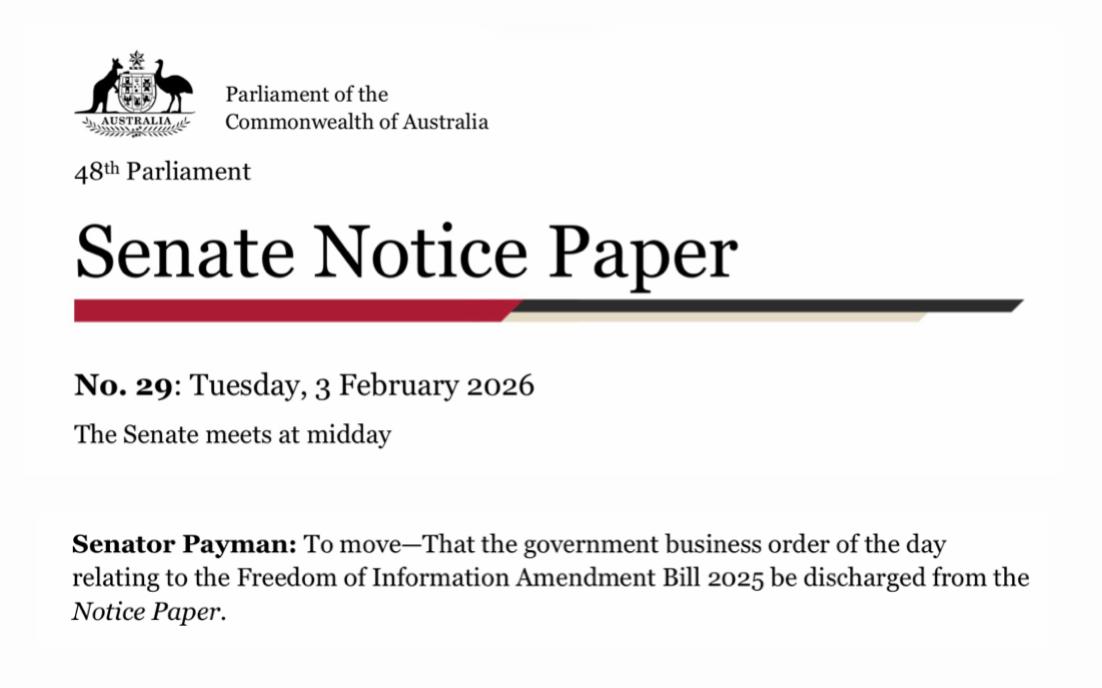
FOI Amendment Bill discharge motion
As of last night, Senator Payman did not have the Coalition or Greens’ support for the motion, but that’s not surprising, noting the Coalition is in turmoil, and it is the first routine sitting day of the year.
We’ll have to wait and see what happens. But one way or another, the Bill is destined for the legislative junk yard.
The Parliament has done its job to protect our democratic right to ensure citizens have access to information that helps us participate in Government and to form views as to the Government’s performance.
Shame on you Albo! As Senator Lambie reminded us in her dissenting report on the Bill, on 27 December 2019, as opposition leader, Albanese addressed the Chifley Research Centre Conference in Sydney, stating:
“We don’t need a culture of secrecy. We need a culture of disclosure.… Reform freedom of information laws so they can’t be flouted by government. The current delays, obstacles, costs and exemptions make it easier for the government to hide information from the public. That is just not right.
“Where’s that Anthony Albanese?
We want him back, not the Anthony Albanese that signed off on this Bill.
Neither confirm nor deny: Foreign Investment Review Board secrecy
Read the full article
Continue reading on michaelwest.com.au

